
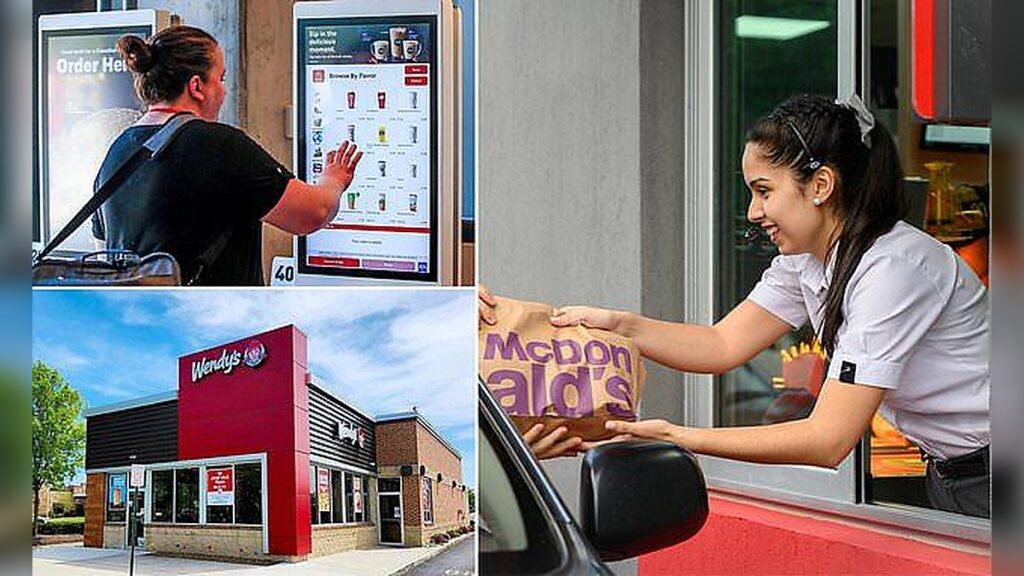
Major fast food chains are changing course on a restaurant strategy that once appeared to be the future of dining, with McDonald’s, Burger King, Wendy’s and Starbucks putting renewed emphasis on face-to-face customer service.
For years, restaurants invested heavily in self-service kiosks, mobile ordering, app-based promotions and other digital tools designed to make ordering faster and reduce pressure on traditional counter service.
But the growing preference for human interaction is now prompting some of the biggest names in the industry to reconsider how much technology should dominate the customer experience.
The emerging approach is not about abandoning digital tools altogether.
Instead, restaurants are increasingly looking for a balance between convenience and the personal contact customers still expect when they walk through the doors.
McDonald’s Puts Hospitality Back on the Menu
McDonald’s is making one of the clearest moves toward rebuilding the human side of its restaurants.
The company has launched a new initiative called “Make it Golden”, under which more than two million employees worldwide are expected to receive renewed training focused on customer service.
Tiffanie Boyd, McDonald’s global chief people officer, told the Wall Street Journal that customers now place greater importance on the overall experience alongside food and price.
“Food is important,” Boyd said. “Price is important, but experience has also become much more important than it used to be.”
The company is also incorporating service standards into evaluations of its franchise restaurants, effectively making hospitality part of how individual locations are assessed.
That represents a notable shift for a business that has spent years expanding kiosks, mobile ordering and app-based deals as part of its restaurant strategy.
Technology Is Staying, But Employees Are Too
The latest changes do not signal the end of self-service kiosks or digital ordering.
Instead, McDonald’s appears to be moving toward a model in which customers can choose the technology that suits them while still being able to find an employee when they want assistance.
The distinction is important because digital ordering was initially promoted partly as a way of reducing the need for traditional interactions at the counter.
The new emphasis suggests that convenience alone may not be enough to create the experience restaurants want customers to associate with their brands.
The change also comes at a difficult time for McDonald’s financially.




Its shares have fallen more than 13 percent so far this year, significantly trailing the broader market.
The stock reached $257.75 on September 14, leaving it near its lowest level in almost two years and trading at a valuation described as its cheapest in more than a decade.
Burger King Moves Kiosks Away From the Front
Burger King is also experimenting with a different approach to digital ordering.
A new restaurant design being developed by the chain places some of its ordering kiosks toward the side of the lobby rather than making them the dominant feature at the entrance.
The idea reflects a desire to restore some of the personal welcome that can disappear when customers are immediately directed toward a screen.
Burger King President Tom Curtis said customers still want to encounter a friendly person when they visit a restaurant.
“They want a friendly face,” Curtis said.
“We have to lean in to that because that’s evaporating in the fast food space.”
The redesign therefore appears to treat technology as one part of the restaurant rather than the entire ordering experience.
Starbucks Wants Customers to Stay and Connect
Starbucks is taking a somewhat different route by focusing on the physical atmosphere of its coffeehouses.
The company is introducing more comfortable seating, including armchairs, along with houseplants and other features intended to make its stores feel more welcoming.
The strategy is aimed in part at Americans who feel increasingly lonely or disconnected, positioning Starbucks locations as places where customers can spend time rather than simply collect an order.
That approach similarly reflects a broader recognition that the restaurant experience involves more than speed and convenience.
Customers Say Kiosks Have Created New Problems
The renewed attention to human service has also found support among customers discussing their experiences online.
Some fast food users have complained that kiosks can create additional frustration when there are too few employees available to help customers who encounter problems or simply prefer to speak to someone.
Others have pointed out that the technology does not necessarily eliminate the need for staff. Workers are still required to handle orders, resolve issues and assist customers who cannot or do not want to use a screen.
One Reddit user described visiting a McDonald’s late at night when only one employee was working despite a long drive-thru line and customers inside the restaurant.
Another argued that restaurants should not treat kiosks as a substitute for having somebody available at the front counter, particularly when customers need assistance.
The comments reflect a broader tension surrounding automation in restaurants: digital systems can offer convenience, but customers still expect a person to be available when technology fails or when they simply want human help.
A More Balanced Role for AI and Digital Ordering
The emerging strategy across the industry is therefore less about choosing people over technology and more about deciding where technology actually improves the experience.
Digital ordering, kiosks and AI can handle routine tasks and give customers greater control over how they order.
But restaurant operators are increasingly acknowledging that those systems work best when employees remain visible and available.
For chains that spent years racing toward increasingly automated restaurants, the latest moves represent a return to a simpler idea: technology can make ordering easier, but it cannot completely replace the value of being welcomed and helped by another person.
