
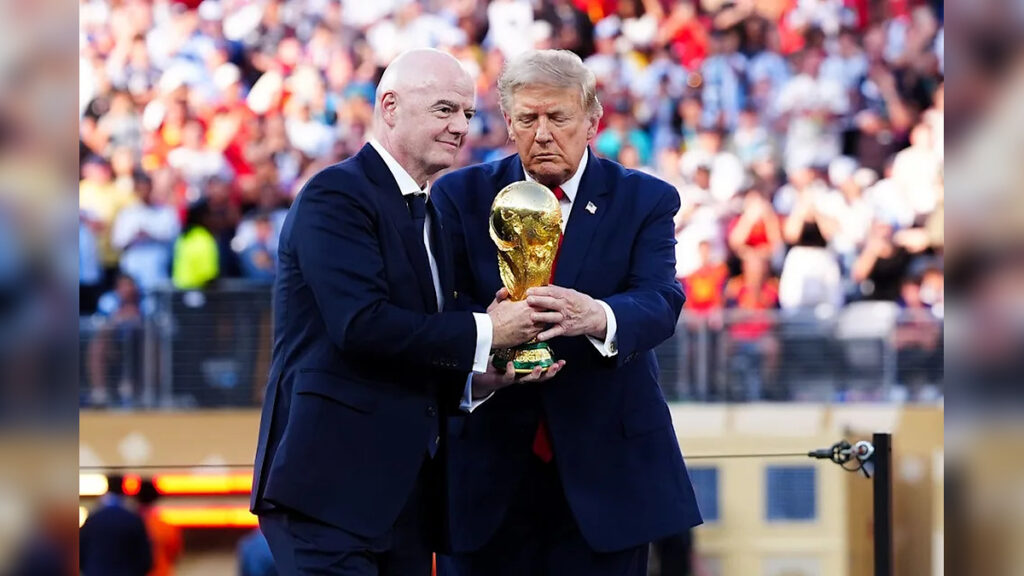
Gianni Infantino’s role as FIFA president has long extended far beyond the traditional duties of running football’s world governing body.
His latest appearance in Colombia, where he attended the inauguration of President Abelardo de la Espriella, offered another reminder of how closely the FIFA chief operates around political leaders and influential figures.
Infantino was welcomed in Bogotá by Colombian Football Federation president Ramón Jesurun, a longtime ally, before attending the ceremony alongside CONMEBOL president Alejandro Domínguez.
The visit came at a particularly sensitive moment for Infantino.
His leadership is facing renewed scrutiny following the collapse of the controversial FIFA Forward Enterprise proposal, which involved plans to sell a 21% stake in FIFA’s commercial and ticketing operations to private investors.
Despite the growing criticism, Infantino has shown no indication that he intends to retreat.
A FIFA President With the Reach of a Head of State
The scale of Infantino’s travel schedule illustrates the unusual influence that comes with leading FIFA.
Earlier this week, a convoy of heavily protected vehicles delivered him to FIFA’s headquarters in Rabat, Morocco, where he met selected members of the organisation’s management board to discuss the proposed investment plan.
His international travel is often conducted using a Qatar Airways executive aircraft made available to FIFA.
During the 2026 World Cup, the arrangement allowed him to travel between several matches in a single day.
The security and logistics surrounding his movements can resemble those provided to national leaders rather than sports administrators.
That global presence is partly built into the job. FIFA has 211 member associations, and its president is expected to travel extensively, inspect development projects and maintain relationships with football officials and political leaders across the world.
Infantino’s responsibilities therefore require him to operate well beyond FIFA’s Zurich headquarters.
The Job Comes With a Huge Financial Package
The power and visibility of the FIFA presidency are matched by a substantial compensation package.
When Infantino was first elected in 2016, his reported annual pay was around £1.3 million.
A decade later, his base salary stands at approximately £2.2 million, supplemented by a confirmed variable bonus of £1.8 million.
That takes his annual package to roughly £4 million.
He also receives a yearly per diem of about £20,500 to cover expenses and living costs.
The figure is considerably higher than the £2.6 million package received by his predecessor Sepp Blatter in his final year in office.
Supporters of Infantino’s leadership argue that the salary reflects his ability to generate record revenues for FIFA while increasing funding available to member associations around the world.
Trump Relationship Has Changed the Political Picture
Perhaps the most controversial aspect of Infantino’s presidency has been his increasingly close relationship with US President Donald Trump.
Their association has produced a series of highly public moments and has led critics to question whether the FIFA president has become too politically aligned with the American leader.
In May 2025, Infantino joined Trump on a diplomatic trip through the Middle East and subsequently arrived around two hours late for the FIFA Congress in Paraguay.
UEFA reacted angrily, accusing the FIFA president of putting private political interests ahead of his responsibilities.
European representatives staged a walk-out during the event.
Infantino later awarded Trump a FIFA Peace Prize, another decision that generated criticism over FIFA’s political neutrality.




The relationship continued into 2026 when Infantino made an unexpected appearance at the first meeting of Trump’s Board of Peace, an initiative connected to reconstruction efforts in Gaza.
The International Olympic Committee concluded that Infantino had not breached its political-neutrality rules, but the appearance nevertheless reinforced the perception that the FIFA president had developed an unusually close relationship with Trump.
The Folarin Balogun Controversy Added to the Scrutiny
The relationship came under even greater attention during the World Cup after US striker Folarin Balogun avoided a ban following his dismissal.
The decision was described as unprecedented by critics, particularly after Trump claimed that he had personally contacted Infantino to ask for the red card to be reviewed.
Infantino maintained that FIFA’s disciplinary committee was independent and that its decision could not be influenced by outside pressure.
The two men were again seen together during the final weekend of the World Cup at Trump Tower in New York, where Trump praised Infantino and referred to another decision made by FIFA.
The controversy surrounding the failed Forward Enterprise proposal then intensified questions about the closeness of their relationship because the proposed private investor was linked to the brother of Trump’s son-in-law Jared Kushner.
Infantino Has Kept the Media at Arm’s Length
Another defining feature of Infantino’s presidency has been his limited exposure to independent media questioning.
Over the past four years, he has held only two news conferences, both lasting about an hour and taking place ahead of World Cups.
Most of his public comments are instead delivered through interviews produced and distributed by FIFA itself.
That approach allows the organisation considerable control over the questions asked and the way Infantino’s answers are presented.
Ahead of the 2026 World Cup, he attempted to address concerns surrounding ticket prices and visa problems.
His response of “just, you know, chill, relax” when asked about Somali referee Omar Artan being denied entry into the United States drew further criticism.
FIFA’s statement following the Forward Enterprise controversy included an apology from Infantino, but it also warned that the organisation would no longer accept what it described as attacks on its integrity, governance and due process.
Critics Say the List of Controversies Is Growing
Infantino’s supporters can point to significant achievements during his tenure.
FIFA’s revenues have reached record levels, while expanded funding has provided crucial financial support to football associations outside Europe.
That support has helped build a powerful international base for the president.
Indeed, Infantino had already secured declarations of support from 111 associations before the latest controversy, enough to guarantee re-election under the existing voting structure.
But European football increasingly believes the situation has gone too far.
UEFA’s opposition is now centred on a broader argument that FIFA should not operate as an organisation dominated by one individual.
Critics point to the expanded 48-team World Cup, the proposed expansion to 64 teams for the 2030 tournament, the enlarged Club World Cup and the decision to award the 2034 World Cup to Saudi Arabia as examples of Infantino’s increasingly ambitious approach.
The Club World Cup itself even carries a personal tribute to the FIFA president on its trophy, something critics have questioned.
Ticket Prices and Saudi Arabia Have Added to the Pressure
The 2026 World Cup provided another source of frustration among supporters.
The tournament’s draw was staged as a lavish event, with Trump and Infantino prominent figures in the spectacle.
At the same time, fans complained about expensive tickets, while others who were willing to pay were unable to attend because of visa problems.
FIFA also allowed tickets to be resold through a secondary marketplace without a price cap while taking a 30% share from each transaction.
That policy prompted accusations that FIFA was placing commercial interests ahead of the experience of ordinary supporters.
Attorneys general in New York and New Jersey subsequently subpoenaed FIFA over its ticketing practices.
UEFA’s Threat Could Become Infantino’s Biggest Problem
For years, controversies surrounding Infantino have failed to seriously threaten his position because of the strength of his support outside Europe.
The latest crisis, however, could be different.
UEFA has threatened a boycott of FIFA competitions, with the next major test coming when the Under-20 World Cup begins in Poland in 29 days.
The European governing body has also withdrawn its previous support for Infantino, creating an increasingly open confrontation between FIFA’s leadership and European football.
For now, Infantino appears determined to continue.
His appearance in Bogotá alongside Colombia’s political leadership and senior figures from South American football demonstrated that he still commands significant international access and support.
The question is whether that global network will be enough to protect him from growing opposition in Europe.
The FIFA Presidency Has Become a Battle for Control
Only four permanent FIFA presidents have held the position since Stanley Rous was elected in 1961, highlighting just how powerful and enduring the role can be.
Infantino has used that platform to expand FIFA’s competitions, increase revenues and strengthen the organisation’s reach across the world.
But the same power that helped establish him as one of football’s most influential figures is now at the centre of the controversy.
With UEFA demanding accountability, the Forward Enterprise plan collapsed and his political relationships attracting renewed attention, Infantino’s expected fourth term is no longer as straightforward as it once appeared.
For a president who has spent years building influence across football and international politics, the greatest challenge may now be convincing his critics that FIFA’s future is being shaped for the benefit of the sport rather than the power of its president.

