
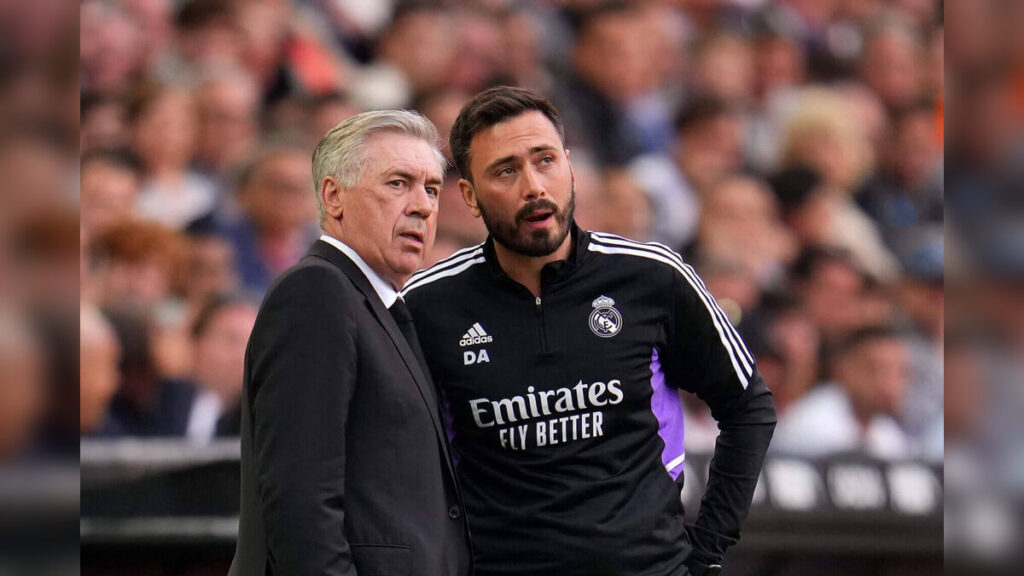
In today’s fast-evolving game, the idea of a football manager sticking stubbornly to one philosophy is starting to feel outdated.
For Davide Ancelotti, the modern coach has to be more like a curator than a purist—someone who picks, adapts, and blends ideas from across the football world.
Speaking about his journey, the former assistant at Real Madrid made it clear that no single figure can fully shape a manager’s identity anymore.
The game has simply become too complex for that.
Learning From Many, Not One
Rather than pointing to one mentor, Ancelotti described his approach as a mix of influences.
From Pep Guardiola’s revolutionary positional play to Jürgen Klopp’s aggressive pressing systems, he has studied and absorbed different ideas.
He also highlighted the tactical creativity of Roberto De Zerbi, especially in exploiting space and creating numerical advantages during build-up play.
These aren’t just surface-level inspirations—they shape how he sees the game unfolding moment by moment.
Respecting Defensive Discipline and Adaptability
While attacking ideas often grab headlines, Ancelotti didn’t overlook the importance of structure.
Coaches like Diego Simeone represent defensive organisation at its peak, while Unai Emery stands out for his ability to tweak tactics depending on the opponent.
Then there’s the influence closest to home—his father, Carlo Ancelotti.
Rooted in the teachings of Arrigo Sacchi, that legacy brings elements like zonal defending and classic formations into the mix.
Stepping Out of His Father’s Shadow
Comparisons with his father are inevitable, but Davide is quick to draw a line.
Yes, there are similarities in temperament, but tactically, he sees himself carving a different path.
He isn’t trying to replicate a legacy—he’s building one.
And that means evolving with the demands of the modern game rather than copying the past.
Why Flexibility Is the Real Identity
For Ancelotti, the biggest mistake a coach can make today is being too rigid.




Football now demands adaptability—adjusting not just to opponents, but to the strengths and weaknesses of your own squad.
The best teams aren’t locked into one system.
They shift gears, change tempo, and alter structure depending on the situation.
That middle ground between identity and flexibility is where he believes success lies.
The Ideal Team: Control, Chaos, and Everything Between
When describing his dream team, Ancelotti painted a picture of balance.
A side that can dominate possession when needed, but also thrive without it.
One that presses high with intensity yet remains compact and disciplined in deeper defensive phases.
He pointed to Paris Saint-Germain as an example of a team capable of combining structure with freedom—switching seamlessly between styles depending on the moment.
Training Ground: Where Identity Is Truly Built
In the end, Ancelotti believes a team reflects what its coach prioritises daily.
Tactical identity isn’t just theory—it’s repetition, emphasis, and consistency in training.
What a coach drills into players becomes second nature on matchday.
That’s where philosophy turns into reality.
Impact and Consequences
This mindset reflects a broader shift in football.
The era of “one-style” managers is fading, replaced by adaptable thinkers who can outmaneuver opponents in multiple ways.
For players, it means greater tactical demands—they must understand different systems and switch roles quickly.
For clubs, it raises expectations: hiring a manager is no longer about a fixed identity, but about versatility and problem-solving.
At the elite level, this evolution is already visible.
Teams that fail to adapt often get exposed, especially in competitions like the UEFA Champions League where tactical flexibility is crucial.
What’s Next?
As Davide Ancelotti continues his coaching journey, the next step is clear—translating theory into results as a head coach.
If he succeeds, he could represent a new generation of managers who don’t fit into neat categories.
Instead of being labeled as “possession-based” or “counter-attacking,” they’ll be defined by their ability to do both—and more.
Expect to see more young coaches follow this path, blending ideas rather than inheriting them wholesale.
Summary
Davide Ancelotti’s philosophy reflects the direction modern football is heading.
Instead of committing to a single tactical identity, he embraces a hybrid approach—drawing from multiple influences while shaping something uniquely his own.
His vision is simple but demanding: a team that can adapt, compete, and excel in every phase of the game.
Bulleted Takeaways
- Davide Ancelotti believes modern managers must combine multiple tactical styles
- He draws inspiration from coaches like Guardiola, Klopp, and De Zerbi
- Defensive structure and adaptability remain just as important as attacking ideas
- He is building his own identity, separate from his father Carlo Ancelotti
- Flexibility is now more valuable than rigid tactical systems
- His ideal team can dominate possession, press effectively, and defend deeply
- Training ground priorities ultimately shape a team’s identity
- The future of coaching lies in adaptability and tactical intelligence

