
Residents across the Warwickshire-Worcestershire border are mounting opposition to plans for a vast solar farm they fear will fundamentally alter one of the region’s most picturesque rural landscapes.
The proposed Arrow Valley Solar project would cover roughly four square miles, stretching across farmland and involving four separate zones linked by underground cables.
Solar panels, battery storage facilities and associated infrastructure would be installed across at least 11 parishes.
The scale of the development means it is classified as a Nationally Significant Infrastructure Project (NSIP), with a potential generating capacity of up to 500 megawatts — enough electricity to supply approximately 235,000 homes each year.
Thousands of Acres Earmarked for Solar Panels
The proposed site covers around 4,353 acres, equivalent to about 2,468 full-size football pitches.
Some of the planned installations would use tracking technology, allowing panels reportedly comparable in size to double-decker buses to move with the sun throughout the day.
If approved, the project is expected to become operational by 2031.
The development would stretch across parts of the Vale of Evesham, an area known for its productive agricultural land and long-established fruit and asparagus farming.
For residents such as 68-year-old Paul Wareing, the sheer size of the proposal is difficult to reconcile with the rural character of the area.
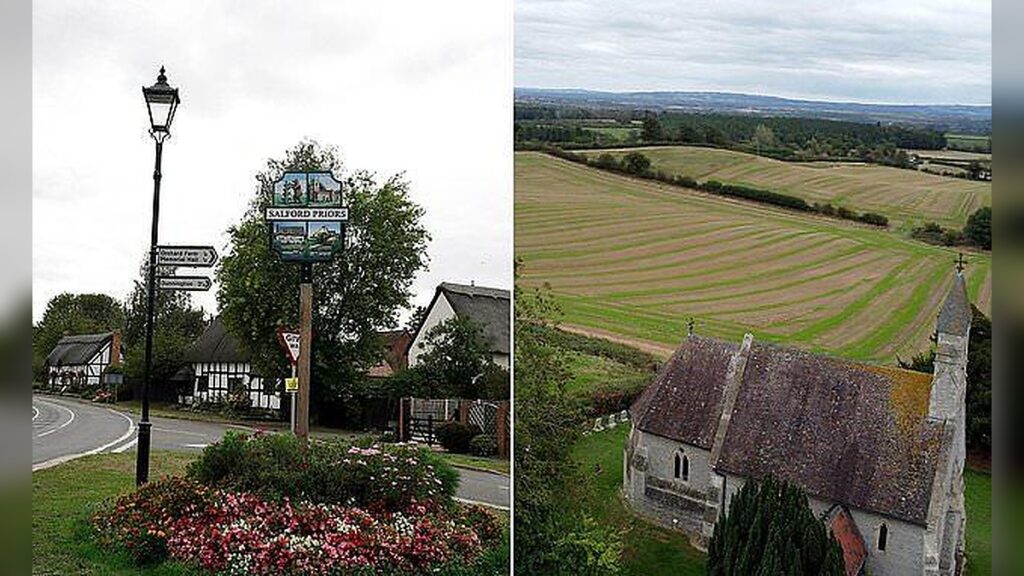
Salford Priors Residents Fear a “Crystal Desert”
Mr Wareing, a semi-retired former government project manager who lives in Salford Priors with his wife Joanna, said residents were only beginning to understand the scale of the proposed development.
He described the project as a threat to what he considers quintessential English countryside.
“People are only just waking up to the scale of this thing,” he said.
“It will destroy our green and pleasant land.”
He also raised concerns about proposed battery storage facilities. One field identified for battery units was recently the scene of a wildfire that threatened the village, he said.
“If there had been batteries in-situ then there would have been hell to pay,” Mr Wareing said.
He argued that the development would effectively transform the countryside into an industrial landscape.
“This scheme will turn a beautiful area into a giant industrial estate,” he said.
Residents Question the Use of Protected Countryside
Mr Wareing also highlighted what he sees as an inconsistency in planning restrictions.
He lives within a conservation area and said he would not be permitted to install solar panels on his own roof, yet believes a much larger solar development is being considered around the surrounding communities.
“If I wanted to put solar panels on my roof I wouldn’t be allowed,” he said.
“Instead schemes like this are allowed to blight the countryside around us.”
Other residents have expressed similar concerns about the proposed transformation of farmland and views that currently define the area.
Retired Worker Criticises Landowners
David Smith, a 68-year-old retired electricity board worker from nearby Abbots Morton, is also opposed to the plans.
He believes the development would permanently change the character of the area and has questioned the involvement of the Ragley Estate, which owns substantial amounts of land earmarked for the project.
“How will he be remembered after this?” Mr Smith said, referring to Henry Seymour, the 9th Marquess of Hertford.
“Landowners like the marquess are custodians, it is only his house for his duration.”




Mr Smith said a sizable part of the proposed solar farm would occupy estate land but claimed the panels would not be visible from Ragley Hall itself.
He is particularly concerned about panels being installed only yards from his home on land currently used to grow oilseed rape.
He fears construction could damage underground drainage infrastructure and leave the fields vulnerable to flooding.
Farmer Says Crop Production Is Becoming Unviable
A landowner involved in the project defended the decision to make farmland available for the development, arguing that conventional agriculture is becoming increasingly difficult to sustain financially.
The farmer, who did not want to be named, said he had agreed to lease 200 acres for at least 30 years.
“If the scheme gets the go-ahead there will be sheep on here — it’s going to be built so they can graze,” he said.
“I’m losing money growing crops.”
The proposal therefore reflects a wider debate over whether agricultural land should remain dedicated to food production or be used to help expand renewable energy generation.
Historic Church Faces a New View
Concerns have also emerged in Weethley, where residents say the development could transform the landscape surrounding St James’s Church.
The church has views stretching towards the Cotswolds, while its origins are connected to the historic rural community.
Dr Jane Cornwall, a psychologist and church warden at St James’s, said the building is used by a mindfulness group for people experiencing anxiety and depression.
She said people visit the church to enjoy its peaceful surroundings and uninterrupted views.
“People come here to enjoy the unadulterated view, to walk and enjoy the peaceful tranquillity,” she said.
Dr Cornwall added that she remained concerned because she believed the company behind the project had not adequately addressed residents’ fears.
Not Everyone in the Area Opposes the Scheme
Despite the strength of opposition in some communities, there is also support for the development.
A resident of Dunnington said they supported renewable energy and believed the local effects would be limited in their area.
The villager said the proposed panels near their community would not be visible from homes and would largely occupy estate land that is not currently being used extensively.
The disagreement reflects the wider divide between residents concerned about the landscape and those who see large-scale renewable energy projects as necessary to increase domestic electricity generation.
Arrow Valley Joins Growing Wave of Solar Projects
Arrow Valley Solar is one of several enormous solar developments currently moving through the UK’s planning system.
Earlier this year, the Government approved the 800-megawatt Springwell Solar Farm following a planning inquiry.
The project, located between Lincoln and Sleaford, will cover approximately 3,163 acres and is expected to generate enough electricity for around 180,000 homes.
Another proposal, the 4,361-acre Great North Road solar park beside the A1 in Nottinghamshire, could generate enough power for approximately 400,000 homes.
Against that backdrop, Arrow Valley would represent another major expansion of large-scale solar generation across rural England.
Developers Promise Environmental Assessments
Jamie Gleeson, Project Development Manager for Arrow Valley Solar, said the project was being designed with the character and heritage of the surrounding area in mind.
He said the development would be “sympathetic to the local area’s environment, character and history”.
According to Mr Gleeson, the project is intended to respond to growing demand for secure, home-grown renewable energy.
He said the plans would be informed by environmental and technical assessments as well as feedback from residents and other stakeholders.
“We recognise that people have questions about what the proposals could mean for the local area and would encourage anyone interested in the project to take part in our forthcoming public consultation,” he said.
Ragley Estate Defends Its Position
The Ragley Estate acknowledged that some residents have concerns about the proposed development.
It said the estate is one of several landowners involved in the project and directed questions about the proposal to the Arrow Valley Solar team ahead of the public consultation.
The estate has itself been the subject of a high-profile family dispute.
Last November, the Earl of Yarmouth, William Seymour, was ordered to pay a £1.3 million legal bill after losing a High Court battle concerning the management of the estate.
The dispute involved his parents, the Marquess and Marchioness of Hertford, and dated back to 2018, when they objected to his marriage to former Goldman Sachs banker Kelsey Wells, now Lady Yarmouth.
The court heard that William, as the eldest son, had expected to inherit Ragley Hall, the family’s 340-year-old ancestral seat, when he reached 30.
He was later disinherited by his father following their falling-out.
Formal Planning Process Will Determine the Proposal
Because Arrow Valley Solar is classified as a Nationally Significant Infrastructure Project, it will not proceed through an ordinary local planning application.
The scheme requires development consent, with the final decision resting with the Secretary of State.
A public consultation on the proposed solar park is scheduled to open at the end of September, giving residents, landowners and other stakeholders an opportunity to respond to the plans.
