
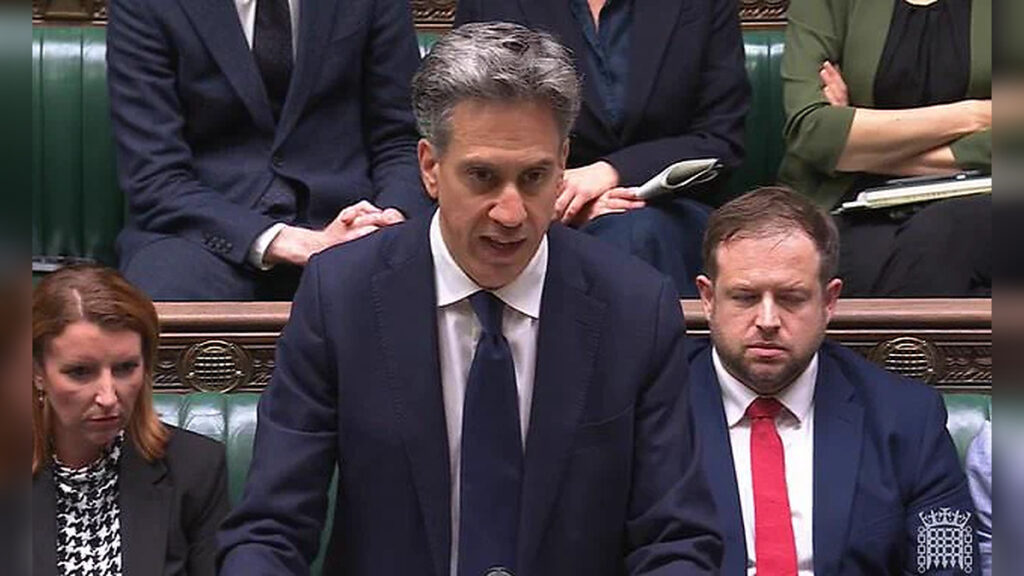
Foreign Secretary Ed Miliband has announced a new package of sanctions targeting Israeli settlements in the occupied West Bank, pushing ahead with the measures despite warnings of retaliation from the United States and Israel.
The Government says the restrictions are aimed specifically at settlement expansion rather than Israel as a whole.
They include a ban on imports produced in settlements, restrictions on companies providing services linked to settlement construction and expansion, and a prohibition on advertising settlement properties in Britain.
Britain Takes Tougher Position on Settlement Expansion
Miliband told MPs that Britain could no longer stand aside while settlement activity threatens the prospect of a negotiated two-state solution.
The measures, coordinated with France and Canada, are expected to cover businesses involved in construction, infrastructure, financing and real estate connected to settlement expansion.
The Government will also prohibit the sale of weapons to Israel where those arms are deemed to materially contribute to the occupation.
Miliband said Britain remained committed to Israel’s security while arguing that settlement expansion was undermining the possibility of lasting peace between Israelis and Palestinians.
Miliband Condemns Violence and Gaza Conduct
The Foreign Secretary, who described himself as a proud British Jew, said he felt a deep sense of shame about the suffering unfolding in the region.
He condemned the October 7 Hamas attacks and acknowledged Israel’s right to defend its population against terrorism.
However, he argued that Israel’s right to self-defence could not justify the scale of suffering in Gaza.
Miliband also accused Israeli settlers of what he described as rampant terrorism and said there was evidence of ethnic cleansing against Palestinians in parts of the West Bank.
He further told MPs that independent reports concerning the blocking of humanitarian aid and Israel’s conduct in Gaza represented growing evidence that war crimes may have been committed.
Government Defends Measures as Targeted Sanctions
Ministers have stressed that the measures do not amount to a comprehensive boycott of Israel.
Cabinet Office minister Pat McFadden said Israel remained an important security ally and trading partner, arguing that the sanctions were specifically designed to target settlement expansion.
He said the Government wanted to prevent changes on the ground from permanently destroying the possibility of a two-state settlement.
Particular concern has been raised over plans in the E1 area east of Jerusalem, where expanded construction could effectively divide the northern and southern parts of the West Bank.
Trump Warned Ahead of Announcement
Prime Minister Keir Starmer spoke to Donald Trump before the announcement, informing the US president of the Government’s intentions.
Washington has already reacted angrily through senior figures.




Mike Huckabee, the US ambassador to Israel, accused Britain of discrimination against Israel and Jewish people while warning that the decision could have consequences for British interests.
Huckabee pointed to Israel’s role in supplying medicines and pharmaceutical products to Britain and suggested that the Government needed to consider the potential consequences of its policy.
Although Trump had not publicly responded at the time of the announcement, Republican congressman Randy Fine issued a separate warning involving Florida.
Florida Threatens Restrictions on British Businesses
Fine said Florida legislation could be used against British companies that comply with the settlement boycott.
He argued that businesses required to follow Britain’s new restrictions could potentially lose access to contracts or dealings involving Florida’s state and local governments.
Fine described the British policy as a “vanity project” and warned that British businesses could face substantial financial consequences if they participated in measures targeting Israel.
He also cited Florida’s previous use of similar legislation against companies involved in boycotts of Israel.
Israel Responds With Threats of Its Own
The Israeli response has been equally fierce.
Finance Minister Bezalel Smotrich called for the British ambassador to be expelled, accusing the British Government of antisemitism and declaring that Israel would not accept what he described as hostile treatment.
President Isaac Herzog took a more diplomatic approach but warned that sanctions would represent a serious mistake, arguing that Britain should pursue dialogue rather than punitive measures.
Meanwhile, National Security Minister Itamar Ben-Gvir escalated the dispute by calling on Israel to recognise Argentina’s claim over the Falkland Islands.
Falklands Dispute Enters the Row
Ben-Gvir used the Argentine name for the islands while urging Prime Minister Benjamin Netanyahu to recognise Argentina’s sovereignty and impose sanctions on Britain.
His intervention came as Argentina’s President Javier Milei continues to promote Buenos Aires’ longstanding claim to the Falklands, which Argentina failed to seize during the 1982 war.
Britain has consistently maintained that the islands’ sovereignty is not in question.
In a 2013 referendum, 99.8 per cent of participating islanders voted to remain under British sovereignty.
Labour MP Dame Emily Thornberry dismissed Ben-Gvir’s comments, pointing out that an Israeli oil company had recently faced Argentine sanctions connected to activity involving the islands.
Security Cooperation Becomes a Major Concern
The dispute has also raised concerns over Britain’s security relationship with Israel.
Shadow foreign secretary Tom Tugendhat warned that damaging cooperation with an important intelligence partner could have consequences for British national security.
He urged the Government to put Britain’s security interests first, particularly given the intelligence cooperation that he said had helped protect British lives.
The Government has rejected suggestions that the sanctions represent a break with Israel, insisting that security and wider bilateral links will continue.
Labour Faces Political Pressure
The decision also comes at a politically sensitive moment for Labour.
The party has faced growing pressure from activists and voters over its approach to Israel and Gaza, while the issue of Palestine has become increasingly prominent in the political contest surrounding the upcoming by-election in Keir Starmer’s Holborn and St Pancras constituency.
The Government’s decision therefore represents an attempt to take a harder line on settlement expansion while maintaining that its wider relationship with Israel remains intact.
Settlements Continue to Fuel International Dispute
Israel has established roughly 160 settlements in the West Bank since occupying the territory during the 1967 Six-Day War.
The number of Israeli settlers living there has grown substantially over the decades.
International opposition to the settlements has intensified following Israel’s plans for thousands of additional homes, including proposals east of Jerusalem that critics argue could further fragment the West Bank.
Miliband said Britain’s policy was intended to protect the possibility of a two-state solution rather than punish the Israeli population or end broader relations between Britain and Israel.
The Foreign Secretary’s announcement nevertheless marks one of the strongest British interventions yet against Israeli settlement expansion, setting the stage for an increasingly tense diplomatic dispute with both Israel and sections of the US political establishment.
