
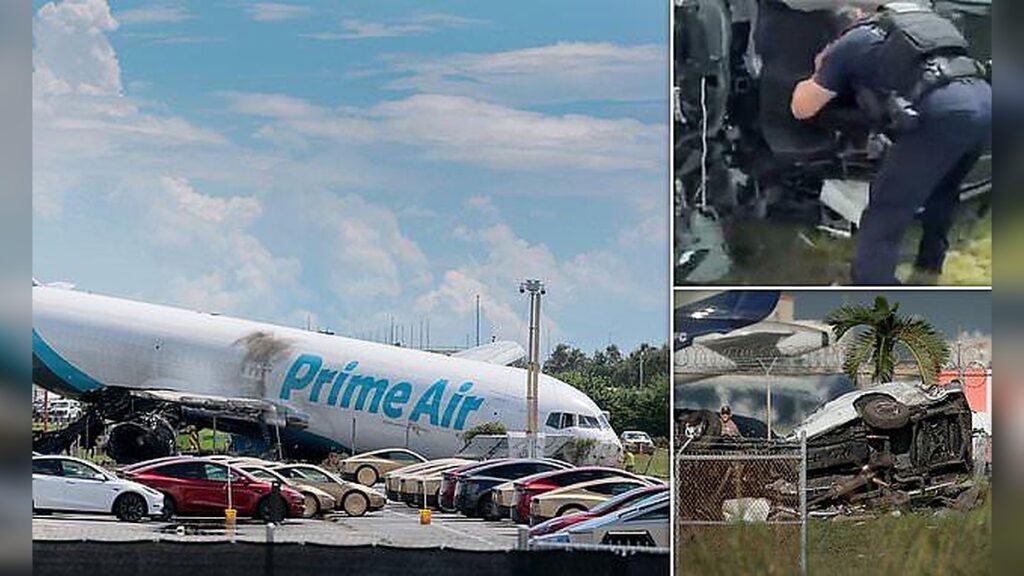
Amazon has suspended its use of cargo carrier 21 Air following the deadly crash of one of the company’s Boeing 767 aircraft at Miami International Airport, as scrutiny intensifies over allegations that the airline previously mishandled safety concerns.
The decision was made after Amazon reviewed the circumstances surrounding the September 6 accident while cooperating with the National Transportation Safety Board (NTSB), which is leading the investigation.
Amazon Moves Shipments to Other Cargo Carriers
Amazon spokesperson Kelly Nantel said the company had decided to pause operations with 21 Air, the operator of Flight 7598.
The shipments previously assigned to 21 Air will instead be handled by other carriers, including Sun Country Airlines, Hawaiian Airlines, Air Transport International, ABX Air, ASL Airlines and Cargojet.
Amazon has worked with 21 Air for nearly two years.
The North Carolina-based carrier operates about 17 aircraft, with eight currently flying on behalf of Amazon, while DHL Express is also among its customers.
21 Air Defends Its Safety Record
21 Air said it remains focused on assisting those affected by the crash and cooperating with investigators.
The company said it was working closely with the NTSB, the Federal Aviation Administration (FAA), Amazon and other partners as authorities determine what caused the accident.
21 Air also maintained that it has confidence in its safety policies, procedures and training.
The carrier previously described the crash as a devastating accident and expressed condolences to the families and loved ones of those killed.
Former Pilots Raise Safety Allegations
The suspension comes amid claims from former 21 Air employees that safety concerns raised within the company were not adequately addressed.
According to interviews and records cited by CBS News, former pilots alleged that concerns involving aircraft maintenance, crew rest requirements and communication standards were sometimes suppressed by management.
Karl Seuring, a former 21 Air pilot with more than 30 years of aviation experience, has alleged that he was dismissed after raising safety concerns.
Seuring said he had complained to a manager about safety issues and was told that nothing would change.
He subsequently brought a retaliation complaint to the Occupational Safety and Health Administration, which rejected the claim.
He appealed the decision, and the case remains pending before a Department of Labor tribunal.
Testimony Details Alleged Operational Problems
Documents cited in the reporting include allegations that pilots raised concerns about aircraft being operated despite mechanical problems, insufficient rest for flight crews and the use of pilots who allegedly could not communicate safely in English.
Seuring’s attorney, Michael Anello, also told a judge that another former 21 Air pilot, Johnny Salmonson, was pressured to undertake flights that allegedly conflicted with mandatory crew-rest regulations.
Anello argued that the pilot faced retaliation after objecting to the practices.




21 Air has disputed the allegations.
Amir Anoshiravani, a former captain mentioned in Seuring’s testimony, told CBS News that he had never met Seuring and rejected his credibility, saying the former pilot was angry because he had been fired.
Pilot Describes Aircraft Speed Incident
Seuring also provided testimony about an incident in April 2022 involving a mechanical problem that allegedly caused an aircraft to accelerate continuously.
According to his account, the aircraft reached speeds that could potentially damage its wing flaps, leaving him concerned about his safety.
He said there was no subsequent debriefing or discussion about the incident with his captain, David Norgren, characterizing the response as an attempt to move on without addressing what had happened.
Seuring also testified about another 21 Air aircraft that allegedly experienced a pressurization problem while flying from Alabama to Trinidad in 2022 and was forced to divert to Puerto Rico.
He alleged that the captain, Amir Anoshiravani, struggled to take command of the situation and that first officers had to intervene to bring the aircraft safely to the ground.
Another Former Pilot Describes Reporting Concerns
Bruce Joseph, another former 21 Air pilot, gave testimony in a separate Labor Department tribunal in March 2024.
Joseph alleged that employees were discouraged from formally documenting safety concerns.
He said the company’s then-director of safety instructed him not to record a safety issue before discussing it with then-CEO Mike Mendez.
Joseph said only a small number of his concerns were formally recorded because he had to repeatedly insist that they be logged, adding that doing so brought him into conflict with senior management.
The allegations form part of ongoing legal proceedings and have not been established as findings against 21 Air.
Crash Investigation Focuses on Final Moments
The September 6 crash occurred when the Boeing 767 overran the runway at Miami International Airport.
The aircraft, piloted by Joseph Carroll, 55, and Jaime Felipe Silva Molina, 37, struck a van before passing through a fence and entering a nearby roadway, where it destroyed an SUV.
Both pilots survived and were subsequently released from hospital.
The five people killed in the crash were identified as Rolando Aleman, 55; Yoel Rodriguez Naranjo, 53; Julio C. Pineda, 75; Carlos Acosta Fajardo, 53; and Javierkys Reyes Quevedo, 47.
Recorder Data Reveals Speed Warnings
Investigators have begun piecing together the final moments using information recovered from the aircraft’s cockpit voice and flight data recorders.
According to the NTSB, one pilot repeatedly warned about the aircraft’s speed while the other was attempting to land.
The recording summary indicated there was no consistent verbal response to those warnings.
The aircraft touched down on the Miami runway, and roughly 15 seconds later one of the pilots called for a go-around, an attempt to abort the landing and make another approach.
NTSB investigator-in-charge Chihoon Shin said flight-data recorder information showed an increase in thrust consistent with an attempted go-around.
However, the aircraft’s speed brakes and thrust reversers were not deployed.
Investigators have not yet determined why those systems were not used.
Miami Airport Lacks Runway Arrest System
A preliminary FAA report has also highlighted the absence of an Engineered Materials Arresting System, or EMAS, at Miami International Airport.
The system is designed to help stop aircraft that overrun runways by using beds of lightweight, crushable material installed beyond the runway.
The FAA said EMAS has been installed at more than 120 airports across the United States.
The absence of the system is one of the factors noted in the preliminary FAA material, but authorities have not indicated that it caused or determined the outcome of the September 6 crash.
The NTSB investigation into the accident remains ongoing.
