
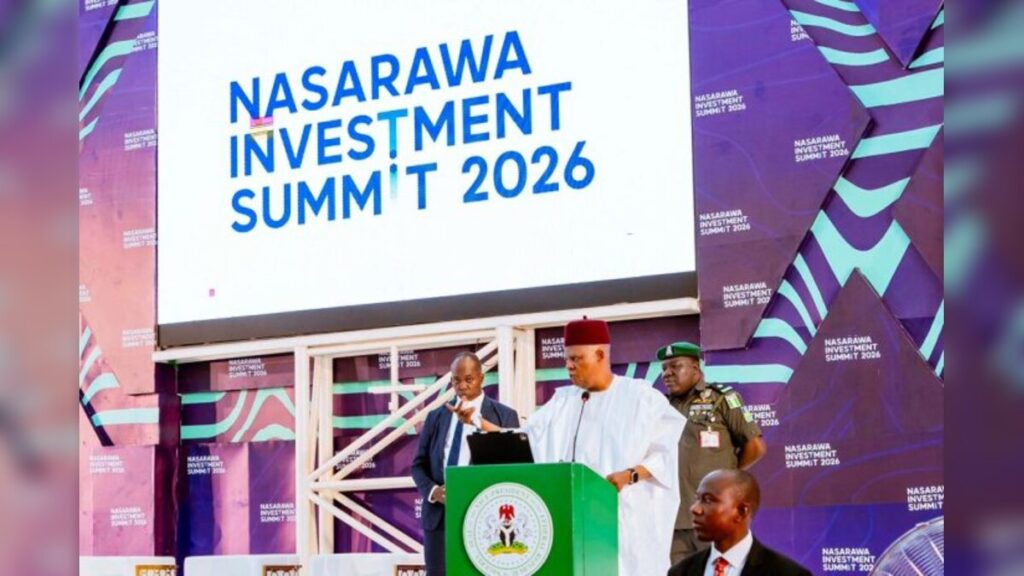
Nigeria’s ongoing economic restructuring under President Bola Ahmed Tinubu is being positioned as a turning point for how the country’s federation operates, with states now taking a more active role in driving development.
Speaking at the Nasarawa Investment Summit 2026 in Lafia, Vice President Kashim Shettima said the reform agenda is deliberately designed to strengthen subnational economies so they can function with less dependence on federal support.
According to him, the goal is not just national stability but building states that can independently attract investment, grow industries, and sustain long-term development.
Why States Are Becoming the Focus of Economic Policy
The federal government’s approach is increasingly centred on empowering states through fiscal reforms, improved revenue sharing, and structural economic adjustments.
Shettima explained that key reforms already underway include:
- Energy sector restructuring
- Tax system reform
- Improved fiscal balance across tiers of government
- A unified digital investment gateway
He added that projects such as the Ajaokuta–Kaduna–Kano gas pipeline and the Abuja industrial corridor are expected to support industrial growth across regions like Nasarawa, especially as the state develops its own gas master plan.
In practical terms, the idea is to turn states into competitive economic units rather than passive recipients of federal allocation.
Lafia Investment Summit and the “Declaration” Message
The Nasarawa Investment Summit 2026 was used as a platform to reinforce investor confidence in the state and its long-term policy direction.
Governor Abdullahi Sule emphasised that the state is building institutions that will outlive political cycles, ensuring that investment decisions are not disrupted by leadership changes.
A key outcome of the event was the “Lafia Declaration,” which Shettima described as a binding public commitment to sustained economic reform and continuity in governance direction.
The declaration is being framed as a signal to investors that Nasarawa’s policies are stable, predictable, and long-term in nature.
Federal Government’s Reform Narrative and Economic Data Signals
The administration argues that recent macroeconomic indicators support the success of its reforms.




Shettima pointed to:
- A rise in capital inflows from $12.32 billion in 2024 to $23.22 billion in 2025
- A 51.19% return in the equity market in 2025
- Market capitalisation reaching ₦99.38 trillion
He said these figures show that investor confidence is returning because Nigeria is beginning to demonstrate policy direction and economic discipline.
The broader message from Abuja is that credibility and stability are becoming central to attracting investment back into the economy.
Institutional Alignment at the State Level
Part of the reform push includes encouraging states to build their own investment structures and regulatory systems.
In Nasarawa’s case, institutions such as:
- Nasarawa Investment Development Agency (NASIDA)
- One Stop Investment Centre
- State Electricity Regulatory Commission
- Nasarawa Infrastructure Fund
are being positioned as key drivers of investment attraction and economic planning.
NASIDA officials also revealed that the agency has already attracted over $2 billion in investments into the state, reinforcing the argument that subnational economies are becoming active investment destinations.
Impact and Consequences
If sustained, the reform strategy could significantly change Nigeria’s federal economic structure.
Stronger states may reduce pressure on federal allocation systems and create regional growth hubs driven by local policy decisions.
This could also lead to increased competition among states to attract investors through infrastructure, incentives, and regulatory efficiency.
However, it also raises expectations on state governments to deliver governance capacity, transparency, and infrastructure readiness—areas where performance has historically been uneven.
There is also the risk that stronger-performing states could widen development gaps between regions if reforms are not balanced.
What’s Next?
The immediate next phase is likely to focus on implementation—ensuring that fiscal reforms translate into real investment inflows and job creation at state level.
More states are expected to adopt investment agencies and digital one-stop systems similar to Nasarawa’s model.
Federal and state governments will also need to align on power sector reforms, tax harmonisation, and infrastructure financing to ensure the system works cohesively rather than competitively.
Investor response over the next 12–24 months will likely determine how successful the reform narrative becomes in practice.
Summary
Nigeria’s federal government says its economic restructuring is shifting power toward states, allowing them to become independent growth centres.
Speaking at the Nasarawa Investment Summit 2026, Vice President Kashim Shettima highlighted fiscal reforms, infrastructure projects, and rising investment inflows as evidence of progress.
The Lafia Declaration and Nasarawa’s investment push are being positioned as models for subnational economic transformation.
Bulleted Takeaways
- Nigeria’s reforms aim to strengthen state-level economies
- Vice President Shettima spoke at Nasarawa Investment Summit 2026 in Lafia
- Key reforms include energy, tax, fiscal balance, and digital investment systems
- Capital inflows and stock market gains are cited as signs of recovery
- Lafia Declaration is framed as a long-term economic commitment
- Nasarawa has attracted over $2 billion in investments via NASIDA
- States are being positioned as independent engines of economic growth
- Risk remains of uneven development if state capacity differs widely

