
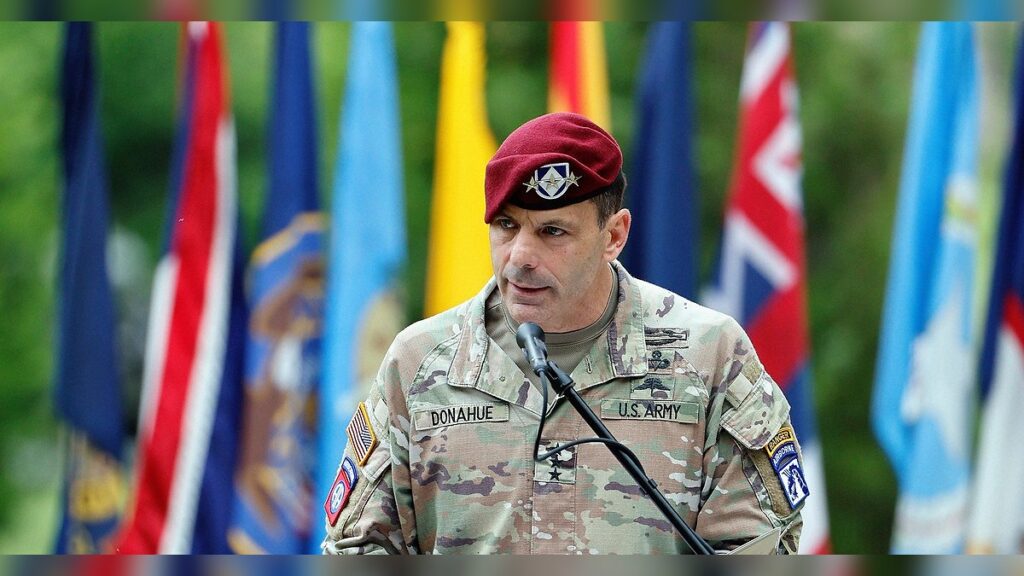
A major shift is unfolding inside the U.S. military leadership as General Chris Donahue, one of the Army’s most respected commanders, prepares to retire while Defense Secretary Pete Hegseth advances a broad restructuring effort that has already reshaped the Pentagon’s senior ranks.
Donahue, 56, is expected to leave his position as commander of U.S. Army operations in Europe and Africa, with an official retirement announcement anticipated soon.
His departure marks another significant change in an ongoing series of personnel moves that have sparked debate across military and political circles.
Decorated Career Comes to a Close
Throughout more than two decades of military service, Donahue built a reputation as one of the Army’s most accomplished combat leaders.
His résumé includes command of the elite Delta Force and leadership roles within the renowned 82nd Airborne Division.
Many within the military establishment viewed him as a future candidate for Army chief of staff because of his extensive battlefield experience and leadership credentials.
One of the defining moments of his career came during the 2021 U.S. withdrawal from Afghanistan.
As commander of the 82nd Airborne Division, Donahue became widely recognized as the last American service member to leave the country.
An image captured through night-vision equipment showed him boarding a military transport aircraft, a photograph that quickly became symbolic of the end of America’s longest war.
Command Downgrade Reportedly Prompted Exit
According to reports, Donahue’s retirement comes as Hegseth moves to reduce the status of the Europe and Africa Army command from a four-star position to a three-star post.




Such a downgrade carries significant implications within the military hierarchy.
Four-star officers are assigned only to positions designated at that level.
When those positions are eliminated or reduced in rank, officers often face retirement unless another equivalent command becomes available.
The reported decision would reduce both the prestige and authority associated with the role, making Donahue’s departure a notable consequence of the restructuring effort.
Broader Pentagon Shake-Up Continues
Donahue’s exit is part of a wider reorganization campaign that has led to a series of departures, reassignments, and leadership changes throughout the Pentagon.
Critics argue that the pattern suggests an effort to remove senior officials viewed as insufficiently aligned with the administration’s priorities.
Supporters, however, contend that the changes are necessary to streamline what they see as an overly large and bureaucratic general officer corps.
The pace of the shake-up has reportedly accelerated in recent weeks, particularly following military tensions and confrontation involving the United States and Iran.
Debate Over Military Leadership Intensifies
The leadership overhaul has generated sharp disagreement among defense observers.
Advocates of the changes believe a leaner command structure could improve efficiency and accountability within the armed forces.
Others warn that pushing experienced commanders into retirement could weaken institutional knowledge and reduce leadership depth at a time when global security challenges remain high.
As the debate continues, Donahue’s departure stands out because of his prominence within the Army and the respect he earned throughout his career.
Successor Expected to Take Command
Attention is now turning to who will lead the command next.
Lieutenant General Kevin Admiral is expected to be nominated by Hegseth to replace Donahue and oversee Army operations across Europe and Africa.
The Pentagon has not yet publicly commented on the reported changes, but the transition is likely to remain closely watched as the administration continues its effort to reshape the military’s top leadership structure.
