
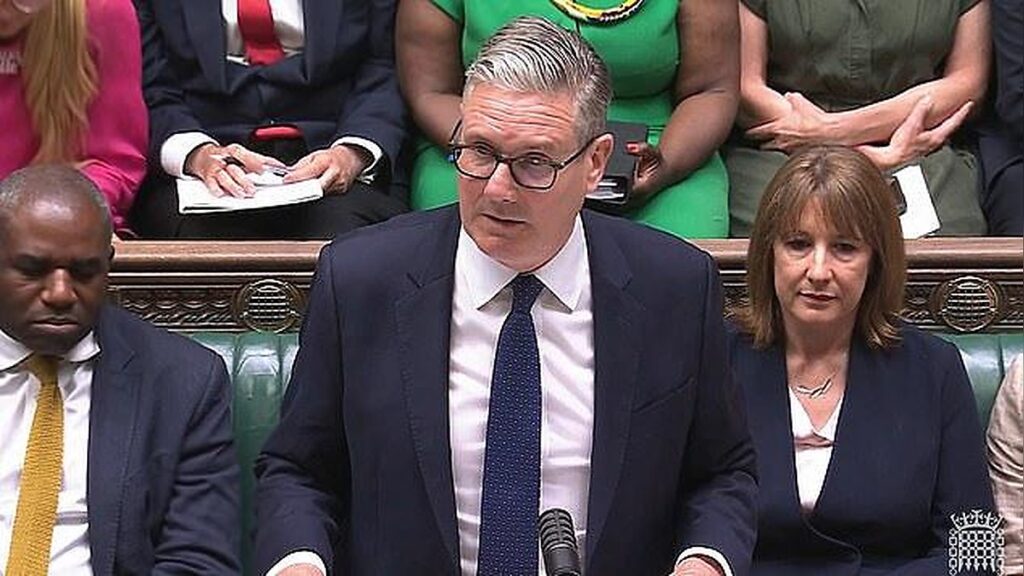
Political attention at Westminster shifted dramatically as Prime Minister Keir Starmer returned to the House of Commons following the announcement that he will step down from office.
What should have been a routine Prime Minister’s Questions session instead became a public examination of his weakening authority, with rivals and critics focusing on the growing momentum behind Andy Burnham, who is widely expected to become Labour’s next leader.
Attempting to project calm amid the political upheaval, Starmer told MPs that he was “very pleased” to see Burnham back in the Commons.
His comments came just days after an emotional resignation announcement that effectively opened the door for Burnham’s anticipated takeover.
Opposition Seizes on Labour’s Internal Shift
The atmosphere quickly turned hostile as Conservative leader Kemi Badenoch used the occasion to highlight what she described as divisions within Labour’s ranks.
Badenoch accused Starmer of being abandoned by those closest to him, describing his surroundings as filled with “traitors and deserters.”
When the Prime Minister attempted to defend his record and point to achievements during his time in office, she challenged the logic of his argument.
“If everything is going so well, why is he resigning?” she asked, drawing loud reactions from MPs across the chamber.
Rachel Reeves and Labour Figures Draw Fire
The Conservative leader also directed criticism toward Chancellor Rachel Reeves. Badenoch claimed Reeves had failed to publicly support Starmer during his resignation announcement and instead appeared more interested in aligning herself with Burnham’s emerging leadership bid.
She suggested the Chancellor’s actions reflected a broader shift within Labour as senior figures position themselves for the next phase of government.
Attention then turned to Ed Miliband, who has been mentioned by some observers as a possible Chancellor under a Burnham administration.
Badenoch mocked Miliband’s political journey, recalling his previous leadership of Labour before launching a personal attack linked to his famous 2010 leadership contest against his brother, David Miliband.




Notably, Burnham himself was absent from the Commons chamber during the exchanges.
Questions Over Starmer’s Future After Downing Street
While Labour MPs increasingly rally behind Burnham, attention is also turning to what Starmer might do once he leaves Downing Street.
Sources within Labour reportedly believe there is little chance the outgoing Prime Minister will remain in Parliament for long. Several former prime ministers, including David Cameron, Boris Johnson, and Tony Blair, departed Parliament relatively quickly after leaving office, although others such as Rishi Sunak, Theresa May, and Gordon Brown remained MPs for some time.
Given his background as a former Director of Public Prosecutions, some have speculated that Starmer could return to legal work.
However, reports suggest that sections of the legal community remain unhappy with some of his recent policy positions and public remarks, making such a return far from straightforward.
Allies Float International Opportunities
As questions mount about his domestic political future, some allies have begun discussing the possibility of Starmer taking on a major international role.
Among the suggestions being circulated is the prospect of seeking the position of Secretary-General of the United Nations.
The current office holder, António Guterres, is expected to leave the post at the end of the year after serving two terms.
Supporters argue that Starmer’s reputation abroad remains significantly stronger than it does at home.
They describe him as dependable, diligent, and well respected by international leaders, qualities they believe would suit a global diplomatic role where consensus-building matters more than domestic political theatre.
Others remain skeptical, pointing out that no leader from a country holding a permanent seat on the UN Security Council has ever gone on to become Secretary-General.
Defence Decisions Become New Battleground
Even as his departure approaches, Starmer is still attempting to complete key pieces of government business.
One of his priorities is finalising a long-awaited Defence Investment Plan before attending a major NATO gathering in early July, where he is expected to meet Donald Trump.
However, those close to Burnham reportedly believe such significant decisions should be delayed until the incoming leader formally takes charge.
Their position highlights the growing reality that political authority within Labour is already beginning to shift away from the current Prime Minister.
A Leader in His Final Days of Power
The events in the Commons underlined the difficult position facing Starmer as he enters the final phase of his premiership.
While he continues to occupy Downing Street, attention across Westminster is increasingly focused on Burnham’s expected arrival and the shape of the next Labour government.
For Starmer, the challenge now is maintaining enough influence to complete unfinished business while the political spotlight steadily moves toward the man waiting to replace him.
