
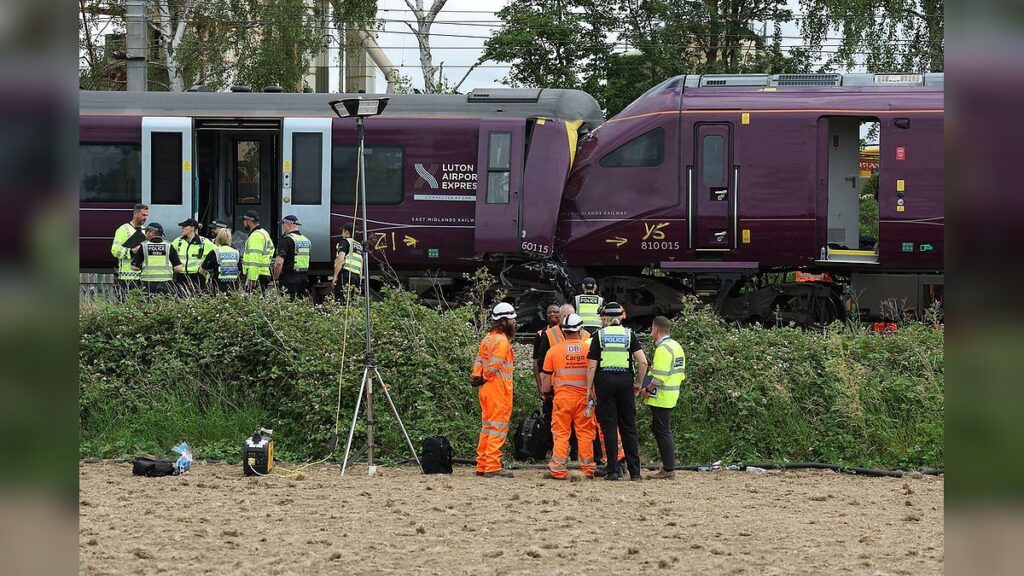
A major rail collision in Bedfordshire has left one train driver dead and more than 160 passengers injured, as investigators work to determine exactly what caused two East Midlands Railway services to crash on the Midland Main Line near Elstow.
Fatal Crash Sparks Major Rail Investigation
The collision occurred at approximately 5:15 p.m. on Friday, June 19, 2026, on the busy stretch of railway south of Bedford station.
The accident involved two passenger trains operated by East Midlands Railway.
Train 1H46, the 4:40 p.m. service traveling from Corby to London St Pancras, struck train 1B67, the 3:50 p.m. service from Nottingham to London St Pancras.
The impact happened around 2.5 miles south of Bedford.
The driver of train 1H46 lost his life in the crash.
Authorities also confirmed that 162 people suffered injuries, with 102 requiring hospital treatment.
As of the latest update, 53 people remain hospitalized, including eight passengers listed in critical condition.
Extensive Damage to Both Trains
The force of the collision caused severe structural damage to both trains and led to partial derailments.
Investigators have been documenting the wreckage through ground surveys, aerial inspections, and advanced laser-scanning technology to better understand how the crash unfolded.
Recovery teams are also carefully removing damaged rail vehicles from the site using cranes before transporting them to secure locations for further examination.
Rail officials expect recovery operations and infrastructure repairs to continue for several days before the affected section of railway can fully return to normal service.
Emergency Teams Moved Quickly to Secure Evidence
The Rail Accident Investigation Branch (RAIB) was notified just minutes after the crash, receiving the first alert at 5:27 p.m.
Investigators were immediately dispatched, with the first inspector arriving at the scene less than an hour later.
Since then, RAIB has been working alongside the British Transport Police, the Office of Rail and Road, Network Rail, and East Midlands Railway to gather and preserve evidence.
Critical materials already collected include CCTV footage, radio communication recordings, signalling data, and the trains’ On-Train Data Recorders, commonly referred to as railway “black boxes.”
Some of these recorders were trapped inside heavily damaged sections of the trains and could only be recovered during complex salvage operations.
Train Ahead Had Stopped Unexpectedly
Preliminary findings suggest that train 1B67 was stationary at the time of the crash.




According to investigators, the Nottingham-to-London service had come to an unexpected stop near signal WH152 after developing a fault in its Automatic Warning System (AWS).
The malfunction triggered an automatic brake application, bringing the train to a halt on the Up Fast line.
Railway systems correctly registered the occupied track section and automatically changed the signal behind the stopped train—signal WH154—to red.
This safety measure is designed to prevent another train from entering the occupied section of track.
Signals Warned of Danger Ahead
Data collected so far shows that train 1H46 departed Bedford station at around 5:10 p.m. and proceeded southbound.
Forward-facing CCTV footage indicates that the train passed a yellow caution signal while leaving the station.
A second yellow signal was also observed as the train crossed from the Up Slow line onto the Up Fast line at Bedford South Junction.
As the train continued its journey, it approached signal WH154.
Investigators say CCTV footage clearly shows that the signal was displaying a red aspect when train 1H46 approached and ultimately passed it.
The exact warnings received by the driver remain unknown at this stage because investigators are still analyzing data from the front vehicle’s recorder, which was not immediately accessible due to crash damage.
Brakes Applied Seconds Before Impact
Although analysis of the front train’s recorder continues, investigators have already reviewed information from the recorder located in the rear vehicle.
Initial findings show that braking was activated approximately nine seconds before the collision while the train was traveling at about 76 mph (122 km/h).
Data further indicates that the train had slowed to roughly 49 mph (79 km/h) at the moment of impact.
These figures remain preliminary and could be revised as investigators complete their technical analysis.
Understanding the Safety Systems Involved
The investigation is paying close attention to the railway’s signalling and warning systems, particularly the Automatic Warning System.
AWS is designed to alert drivers whenever they approach signals that require caution or stopping.
Drivers receive audible warnings and must acknowledge them in the cab.
Failure to respond within a set period automatically triggers emergency braking.
Investigators are now examining whether all relevant systems on train 1H46 were functioning correctly and what indications were presented to the driver in the moments leading up to the collision.
Key Questions Investigators Aim to Answer
RAIB’s inquiry will focus on several critical areas, including the sequence of events that led to the crash and the actions taken by those involved.
Investigators will examine why train 1B67 stopped unexpectedly, the condition and performance of signalling equipment, the operation of braking and safety systems, and the visibility and effectiveness of signal WH154.
The investigation will also assess how both trains performed during the collision, evaluate the emergency response, and review whether existing risk-management measures at the location were adequate.
Officials will additionally consider whether lessons from previous rail safety recommendations were properly implemented and whether further measures are needed to prevent similar accidents.
Final Report to Recommend Safety Improvements
RAIB emphasized that its investigation is entirely independent from inquiries being conducted by law enforcement agencies, railway operators, and regulators.
Once the examination is complete, investigators will publish a full report outlining their findings and any recommendations aimed at improving rail safety across the network.
For now, attention remains focused on understanding how a routine journey on one of Britain’s busiest rail corridors turned into a deadly accident that has left a lasting impact on passengers, railway staff, and the wider rail industry.
