
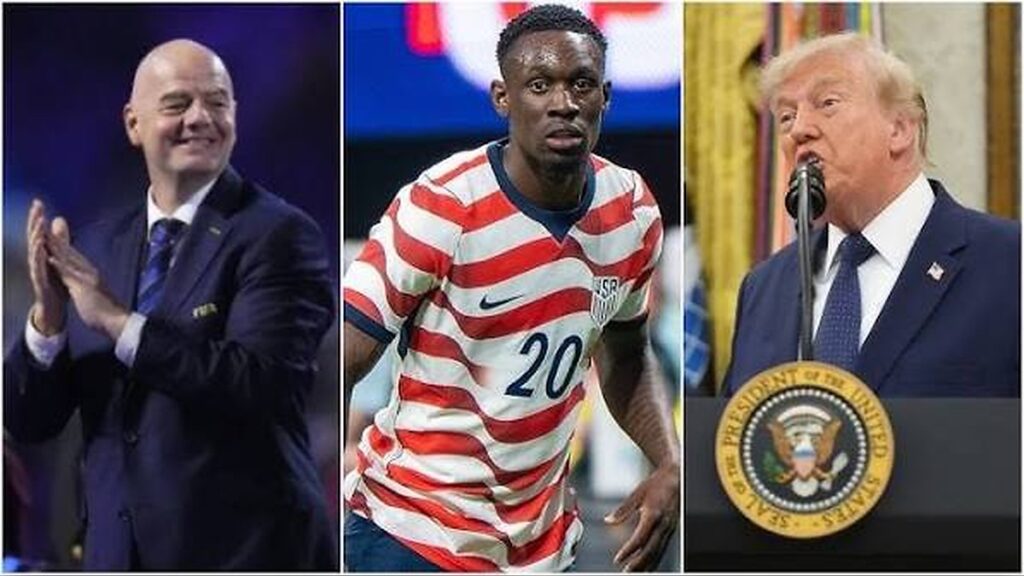
FIFA is facing intense criticism after reversing the suspension of United States striker Folarin Balogun following direct contact between U.S. President Donald Trump and FIFA president Gianni Infantino.
While the decision allowed Balogun to feature in the United States’ World Cup knockout clash against Belgium, it has also triggered widespread concerns about political influence in football and whether FIFA applied its own rules consistently.
The controversy erupted after Balogun received a red card during the United States’ 2-0 group-stage victory over Bosnia and Herzegovina, a dismissal that ordinarily would have ruled him out of the Round of 16 encounter.
Historic Decision Clears Balogun to Play
Instead of serving the customary one-match suspension, FIFA announced that Balogun’s ban would be suspended for a one-year probationary period.
The striker was fined $40,000 but remained eligible for selection against Belgium.
The decision was unprecedented. It marked the first time since 1962 that a player sent off during a FIFA World Cup avoided an automatic suspension for the following match.
Belgium attempted to challenge the ruling before kickoff, but FIFA dismissed the appeal as inadmissible.
Balogun ultimately took the field, although the United States suffered a heavy 4-1 defeat that ended its World Cup campaign after Belgium surged ahead following costly American defensive mistakes.
Defeat Overshadowed by Off-Field Controversy
Although Belgium comfortably advanced, much of the post-match discussion centered not on the result but on FIFA’s handling of Balogun’s case.
Critics argue that the reversal has revived long-standing concerns over FIFA’s governance, transparency and resistance to political pressure.
Many believe the circumstances surrounding the decision risk damaging confidence in the integrity of the tournament.
FIFA’s Political Neutrality Rules Under Fresh Examination
The backlash has been fueled by FIFA’s own history of enforcing strict rules against government involvement in football administration.
In recent years, FIFA suspended Kenya and Zimbabwe after determining that government interference had compromised the independence of their national football associations.
During those suspensions, both countries lost access to FIFA funding and were excluded from international competitions until their sanctions were eventually lifted.
Observers have questioned why similar principles appear not to have been applied when a sitting U.S. president publicly requested that a disciplinary decision be reconsidered.
Billions in Sponsorship Could Depend on Public Trust
The controversy comes during one of the biggest World Cups in history.


With the tournament expanded to 48 teams and jointly hosted by the United States, Canada and Mexico, television audiences and online engagement have reached record levels.
Broadcasters have reported billions of digital and social media views, while advertisers are expected to invest more than $10 billion throughout the competition.
Industry analysts note that sponsors are investing not only in audience size but also in the credibility of the competition.
Any perception that sporting decisions can be influenced by political figures could undermine confidence among fans and commercial partners alike.
Infantino Defends FIFA’s Judicial Process
Gianni Infantino has rejected suggestions that he personally influenced the outcome.
According to the FIFA president, he informed Trump during their conversation that the disciplinary review was already underway and that any final decision would rest solely with FIFA’s independent judicial bodies.
FIFA has also directed inquiries to public statements issued by Infantino and the chair of its disciplinary committee, maintaining that the review process remained independent throughout.
Corruption History Adds to Public Skepticism
For many observers, FIFA’s past scandals make the latest controversy even more difficult to ignore.
The organization’s reputation was severely damaged in 2015 when several senior FIFA officials were indicted by the U.S. Department of Justice over an alleged network of bribery and kickback schemes involving media and marketing rights.
Although the Balogun case involves no accusations of financial corruption, critics argue that the appearance of political influence risks reopening old doubts about FIFA’s governance.
White House Push Followed Appeal for Review
Reports indicate that the effort to revisit Balogun’s dismissal began shortly after the Bosnia and Herzegovina match.
Commerce Secretary Howard Lutnick and White House World Cup Task Force Executive Director Andrew Giuliani reportedly contacted President Trump after attending the game.
Trump later spoke directly with Infantino and requested that the incident be reviewed, despite there being no formal process for appealing an on-field red card.
Speaking before Monday’s match, Trump insisted he never instructed FIFA to overturn the decision.
He maintained that he simply asked for a review, adding that he believed an independent committee—not Infantino—ultimately reached the conclusion.
European Football Leaders Voice Strong Opposition
Reaction across European football has been swift.
UEFA described FIFA’s handling of the case as crossing “a red line,” while Belgium’s football federation expressed deep concern, arguing that the decision threatens the integrity of the sport.
Human rights organization FairSquare also criticized FIFA’s governance, with co-founder Nicholas McGeehan warning that the controversy could complicate Infantino’s prospects when he seeks re-election as FIFA president in 2027.
Neither the Belgian federation nor U.S. Soccer immediately issued further responses regarding the dispute.
Could the Decision Trigger a Wave of Appeals?
Beyond the immediate controversy, football officials are now questioning whether FIFA has created a precedent that will encourage future disciplinary challenges.
France’s football federation has already sought the removal of a yellow card shown to midfielder Michael Olise, while insisting its request was unrelated to the Balogun ruling.
England manager Thomas Tuchel also acknowledged the uncertainty created by FIFA’s decision after defender Jarell Quansah received a red card against Mexico.
Rather than confirming an appeal, Tuchel questioned where the governing body should now draw the line, warning that FIFA’s latest decision could make future disciplinary consistency increasingly difficult to maintain.

