
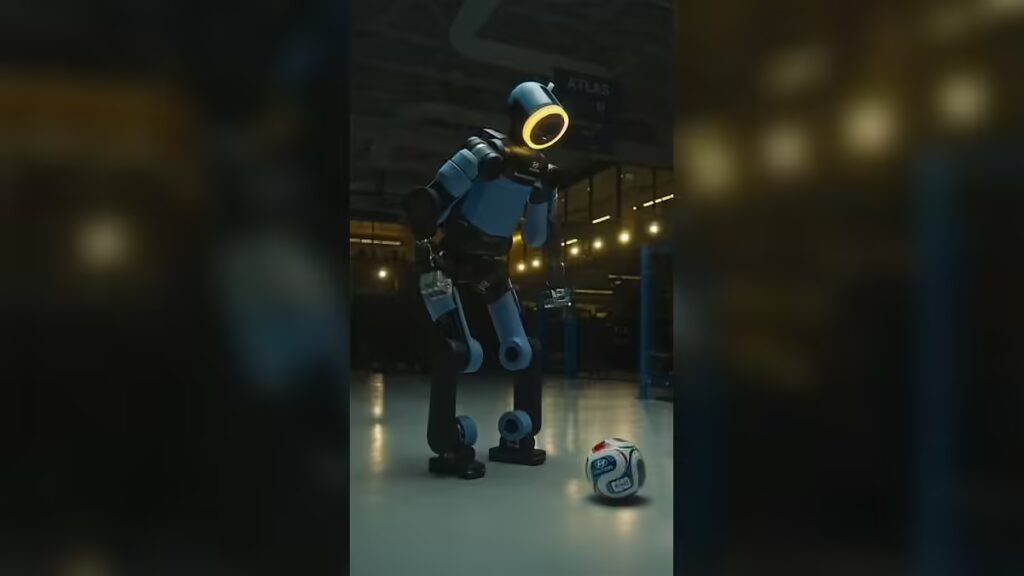
A groundbreaking moment unfolded at halftime of the FIFA World Cup Round of 16 clash between Brazil and Norway on Saturday, as a humanoid robot took center stage in a first for the tournament.
Before the players returned to the field at New York/New Jersey Stadium, the robot walked along the pitch, recreated famous goal celebrations, and presented the match ball to the referee in front of more than 80,000 spectators and millions watching worldwide.
Atlas Brings Robotics to Football’s Biggest Stage
The humanoid robot, known as Atlas, is the latest creation from Boston Dynamics and made its World Cup debut after years of planning.
Standing around five feet tall, Atlas entertained fans by mimicking the signature celebrations of football stars Harry Kane, Erling Haaland, Matheus Cunha, and Son Heung-min before completing the symbolic handover of the match ball.
The appearance marked the first time a humanoid robot has been incorporated into one of football’s most recognizable pre-match traditions at a FIFA World Cup.
According to Hyundai Motor Company Executive Vice President and Global Chief Marketing Officer Sungwon Jee, the event represented far more than a promotional display.
He described the ceremony as the beginning of Atlas’ public journey, showcasing how advanced robotics could eventually serve people in practical and meaningful ways.
Hyundai, the parent company of Boston Dynamics, has maintained its partnership with FIFA for nearly three decades.
Atlas Learns Through Training Rather Than Traditional Programming
Unlike conventional industrial robots that follow fixed instructions, Atlas has been developed using machine learning techniques that allow it to acquire behaviors through training.
Boston Dynamics Director of Robot Behavior Alberto Rodriguez explained that earlier versions of the robot relied on pre-programmed commands, while the latest generation develops its abilities by learning from experience, adapting its movements in a way that more closely resembles modern artificial intelligence systems than traditional factory automation.
Instead of simply executing predefined actions, Atlas is trained to respond to changing conditions and unexpected situations.
Football Skills Developed Through Massive Simulation
To prepare for its World Cup appearance, Atlas underwent extensive training inspired by professional football.
Engineers first exposed the robot to video footage of elite players performing various drills and movements. Motion-capture recordings of Boston Dynamics engineers carrying out similar actions were also collected and fed into advanced physics-based simulations.
Within cloud computing environments powered by graphics processors, Atlas repeated these movements millions of times under different scenarios. Tasks that could require a human athlete many months of practice were compressed into approximately 24 hours of intensive virtual training.




The process allowed the robot to refine movements while continuously adapting to changing conditions rather than memorizing a fixed routine.
Engineers Prepared Atlas for the Challenges of Natural Grass
One of the biggest technical hurdles involved teaching Atlas to move confidently on a football pitch.
Unlike smooth factory floors, grass presents constantly changing levels of grip and resistance, increasing the risk of slipping or becoming unstable.
To address this, Boston Dynamics redesigned the robot’s training methods to ensure it could walk and run effectively across both hard surfaces and natural turf.
During simulations, engineers deliberately introduced unexpected complications.
Ground friction was altered without warning, obstacles appeared along the robot’s route, the ball’s position was intentionally misrepresented, and Atlas was even provided inaccurate information about the size of its own feet.
These repeated challenges forced the robot to develop flexible responses capable of handling unpredictable real-world conditions instead of relying on perfect circumstances.
Repetition Builds Robotic “Muscle Memory”
According to Rodriguez, the training system enables Atlas to develop what he describes as robotic muscle memory.
Rather than calculating every movement from scratch during operation, the robot learns instinctive responses through countless repetitions, allowing it to react quickly even when environmental conditions change unexpectedly.
Boston Dynamics believes these capabilities demonstrate that advanced humanoid robots can now operate reliably beyond controlled laboratory settings, including in demanding outdoor environments while performing complex athletic movements.
The company hopes that public demonstrations such as the World Cup appearance will help familiarize people with robotics as humanoid machines become increasingly integrated into everyday life.
Hyundai Expands Its Long-Term Robotics Strategy
Hyundai Motor Group strengthened its commitment to robotics after acquiring a controlling stake in Boston Dynamics from SoftBank in 2021.
Since then, the automaker has positioned robotics as a central component of its future business strategy alongside traditional vehicle manufacturing.
The company has announced plans to invest approximately $26 billion in the United States over four years, including the construction of a robotics production facility near Savannah, Georgia.
The factory is expected to have the capacity to manufacture up to 30,000 Atlas robots annually by 2028.
Meanwhile, Atlas is already undergoing testing within Hyundai’s automotive operations, where its initial responsibilities include sequencing vehicle parts during manufacturing.
World Cup Appearance Signals Shift From Research to Public Demonstration
Hyundai views Atlas’ participation in the FIFA World Cup as a milestone in the commercialization of humanoid robotics.
Company executives say the event represents a transition from internal research and industrial testing to showcasing the technology before a global audience.
Hyundai also sees robotics, autonomous systems, and intelligent infrastructure as becoming increasingly important pillars of its long-term vision for mobility beyond automobiles.
By introducing Atlas during one of football’s most watched events, the company hopes to demonstrate how advanced humanoid robots could eventually move from specialized industrial settings into broader everyday applications.

