
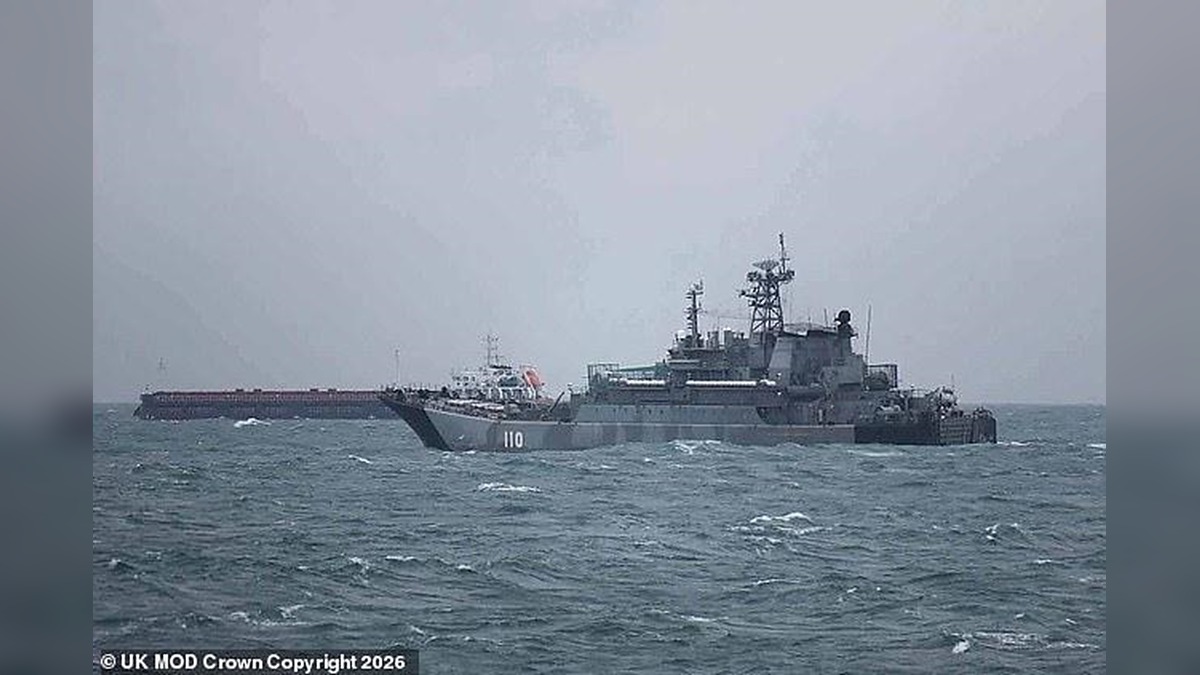
The Royal Navy deployed Merlin helicopters to monitor a Russian intelligence-gathering vessel after it was detected operating close to NATO warships conducting military exercises off Scotland.
The Russian ship, Viktor Leonov, a Vishnya-class intelligence vessel, was tracked near the Outer Hebrides between September 29 and October 8, according to the Royal Navy.
The vessel was reportedly monitoring NATO naval activity during Exercise Strike Warrior, a military drill involving approximately 2,000 personnel from six NATO member nations.
Merlin Helicopters Dispatched to Follow Russian Ship
The Merlin Helicopter Force was tasked with tracking the Russian vessel after it was identified operating in the area.
The helicopters were deployed from their home base at Royal Naval Air Station Culdrose in Cornwall to Glasgow Prestwick Airport to support the operation.
Captain James Hall, commanding officer of RNAS Culdrose, praised the personnel involved in the deployment and their response to the operational requirements.
He said: “I am immensely proud of the efforts of our people, who have once again demonstrated that the UK is prepared to respond to immediate operational requirements.”
Captain Hall added that the mission demonstrated Britain’s readiness to protect its territory and respond to potential threats.
“This operation has been a critical means for demonstrating to ourselves, our adversaries and the nation that we are willing and capable of securing the homeland 24/7,” he said.
He also confirmed that the Merlin Helicopter Force remained prepared to respond whenever required.
Navy Expected Russian Surveillance During NATO Exercise
A Royal Navy source told the Daily Mail that the presence of Russian intelligence vessels during major NATO exercises was anticipated.




The source described the activity as relatively routine, explaining that Russian ships regularly monitor large-scale military drills involving NATO forces.
“They will come out for big exercises like Strike Warrior. It’s a routine. We always expect the Russians when exercises like this happen,” the source said.
The Merlin helicopter fleet underwent a £40 million upgrade earlier this year, including the introduction of advanced sonobuoys designed to improve its ability to detect and track Russian submarines.
British Warships Monitor Russian Naval Movements in the Channel
The interception of Viktor Leonov comes amid several other Royal Navy operations involving Russian vessels around British waters.
Last month, HMS Dauntless, a Type 45 destroyer, and HMS Tyne, a patrol vessel, were deployed to monitor the Russian frigate Neustrashimy as it escorted sanctioned cargo ships through the English Channel.
The monitoring operation ran from October 1 to October 14.
HMS Tyne was subsequently deployed alongside a Wildcat helicopter to track another Russian naval vessel, Aleksandr Shabalin, between October 11 and October 14.
The ship had also been escorting a cargo vessel.
An RAF Protector RG1 drone was additionally used to monitor Russian naval movements.
The unarmed aircraft spent more than 10 hours tracking foreign vessels between late September and mid-October.
Russian Activity Around British Waters Increases
Russian activity in and around British waters increased by 25 per cent during the first seven months of the year compared with the corresponding period in 2025.
In June, Royal Marine Commandos boarded and seized Smyrtos, a Russian shadow-fleet tanker, during a six-hour military operation.
The seizure was authorised by former Prime Minister Sir Keir Starmer following months of warnings that Russian shadow-fleet tankers were being used by Vladimir Putin to transport sanctioned oil.
The vessels had also been travelling through the English Channel despite concerns over their role in circumventing international sanctions.
Defence Spending Target Raises Questions
Meanwhile, Defence Secretary John Healey has acknowledged that the Government‘s plan to increase defence spending to three per cent of gross domestic product is a target rather than a firm commitment.
Speaking on Sunday, Healey said Britain would look to achieve the spending level by the end of the decade.
The Chancellor also described 2030 as a target date but stopped short of making a definitive commitment that the three per cent threshold would be reached by then.
