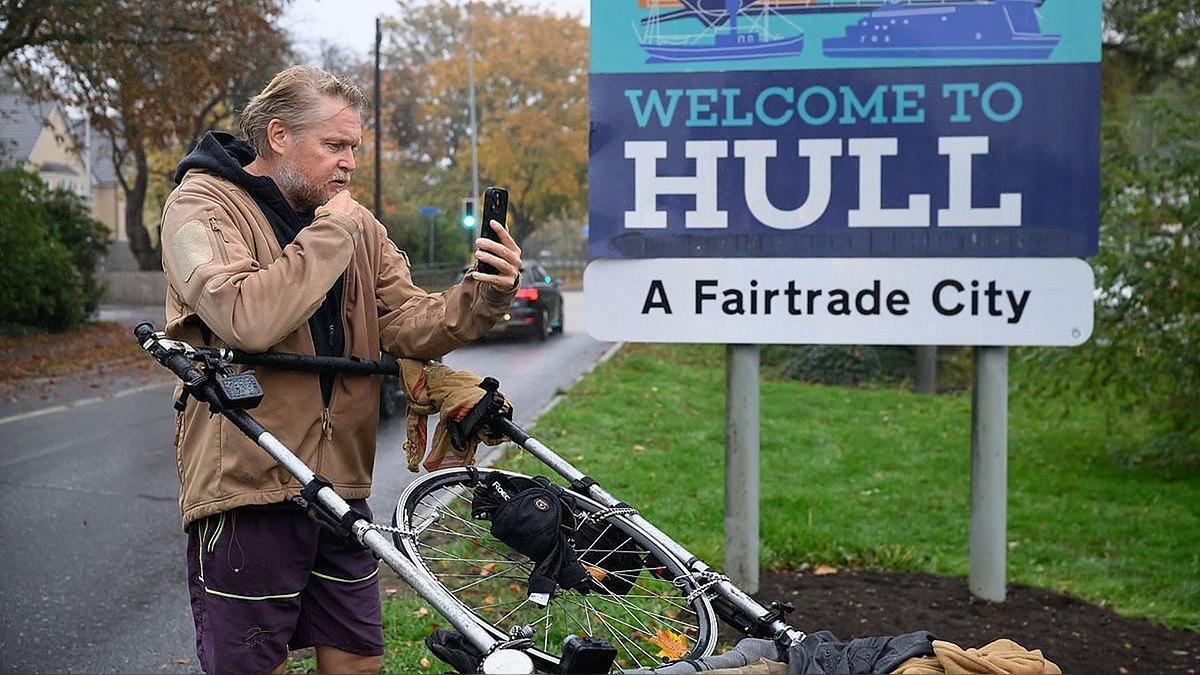
After nearly three decades travelling across continents on foot, British adventurer Karl Bushby has finally returned to his hometown of Hull, bringing an extraordinary 28-year expedition to an end at his mother’s front gate.
The 57-year-old former paratrooper, who began his journey in 1998, completed an estimated 75 million steps across 30 countries, covering approximately 30,000 miles without using transport to advance along his planned route.
His return marks the conclusion of an adventure that took him through dangerous jungles, frozen waters and politically sensitive border regions, while repeatedly testing his determination to make it home.
A Long-Awaited Reunion With Family
Bushby received a public welcome at Queen Victoria Square in Hull at approximately 11am, where Lord Mayor Councillor Maria Coward greeted him outside City Hall before a private reception.
He subsequently continued to his mother’s home, where he was reunited with his family, including his mother, Angela, who had followed his progress for almost 28 years.
His homecoming also gave him the opportunity to meet his 12-year-old granddaughter in person for the first time.
Although they had communicated through video calls, they had never previously met face to face.
His son Adam, now 36, was eight when Bushby left Britain and has visited his father only four times during the expedition.
Adam has spoken about the conflicting emotions surrounding his father’s achievement, explaining that although he is proud of what Bushby accomplished, growing up without him was difficult.
“There were parts of my life where you just need your dad for it,” he told the Yorkshire Post.
The Birthday Card That Inspired the Expedition
The idea behind the Goliath Expedition developed while Bushby was still serving in the military.
His father, Keith, had sent him a birthday card recalling a disagreement about whether it was possible to walk from London to New York by crossing the Bering Strait.
Bushby began studying a map and tracing a possible route through Europe and Asia, across Alaska and down through the Americas.
He eventually extended the challenge to begin at the southernmost tip of South America.
He left Hull in October 1998, travelling through the Falkland Islands to Punta Arenas in Chile.
On November 1, he began walking north with approximately £500 and a trailer carrying his equipment.
His conditions were straightforward: he would not use transport to move along the expedition route, and he would not return home until he could complete the journey on foot.
Bushby initially estimated that the undertaking would take around 12 years.
However, his trailer, nicknamed The Beast, broke down on the first day, offering an early indication of the difficulties ahead.
Childhood Challenges and Military Beginnings
Born into a military family, Bushby experienced difficulties during his school years and was diagnosed with dyslexia at 13.
He left school at 16 without qualifications before joining the Junior Parachute Company.
His father had served in the SAS, while his younger brother Adrian also pursued a military career.
Bushby’s own military training was challenging, requiring five attempts before he successfully completed the necessary training.
He later married a woman from Northern Ireland, also named Angela, and they had a son, Adam.
However, their marriage ended before the expedition began, with his former wife and son returning to Belfast.
Growing Up Without His Father
For Adam, his father’s departure meant spending much of his childhood explaining an unusual family situation to other children.
Some struggled to believe that his father was walking around the world, making it difficult for him to explain why Bushby was absent from everyday family occasions.
A reunion in Alaska in 2004, when Adam was 14, helped him understand that his father was determined to finish the expedition before returning home.
As the years passed, letters were replaced by telephone conversations and video calls, allowing them to maintain contact across thousands of miles.
Nevertheless, Bushby missed important milestones, including school years, birthdays, Christmas celebrations and the birth of his granddaughter.
He has admitted that the prolonged separation affected his relationships and family life, explaining that the emotional burden became increasingly difficult to manage.
“It gets heavier over time,” he said.
He has also advised other people considering lengthy adventures to pursue their ambitions while keeping the duration within reasonable limits, warning that journeys lasting more than five years can have serious effects on families and relationships.


His Mother Followed the Journey From Hull
Throughout the expedition, Bushby’s mother, Angela, kept track of his progress through newspaper cuttings and scrapbooks.
She experienced years of uncertainty, particularly when reports emerged about the dangers her son encountered in remote locations.
Last December, she revealed that she had seen him only three times since his departure.
Despite the lengthy separation, she continued to regard him as her little boy and spoke about how understanding his dyslexia had helped him overcome difficulties experienced during childhood.
She had also prepared a familiar greeting for his eventual return: “…and what time do you call this, Karl?”
His father Keith also played an important role in supporting the expedition, regularly providing weather information from Hereford when Bushby needed updates.
During the dangerous 2006 crossing of the Bering Strait, Bushby contacted his father after reaching Russian territory, excitedly announcing: “Terra firma, terra firma.”
Dangerous Jungle Crossings and Detentions
The expedition exposed Bushby to numerous physical dangers and encounters with immigration authorities.
In 2001, he was detained for 18 days after travelling through the Darién Gap between Colombia and Panama.
The region was affected by conflict involving FARC guerrillas, the Colombian military and Panamanian police, making the crossing particularly difficult.
Concerned that his appearance as a foreign traveller carrying expensive outdoor equipment could attract kidnappers, Bushby dyed his hair and skin, wore damaged clothing and transported his belongings in sacks to avoid attracting attention.
He was eventually detained while officials established his identity and reasons for travelling through the restricted border area.
Other experiences included threats at gunpoint, an encounter with a polar bear and an incident in Alaska in which he was buried by snow.
He also faced less dramatic but persistent dangers, including exhaustion, sunstroke and vehicles passing dangerously close to him on busy roads.
The Bering Strait Crossing Triggered a Border Dispute
One of the expedition’s most significant milestones came in 2006, when Bushby and fellow adventurer Dimitri Kieffer crossed the frozen Bering Strait between Alaska and Russia.
Although they successfully reached the Russian side, their arrival did not mean they could continue their journey.
Russian authorities detained the pair because they had entered the country outside an officially recognised border crossing.
The incident developed into a prolonged administrative dispute that threatened the expedition.
Bushby subsequently encountered further difficulties with Russian immigration authorities, including problems securing an extension to his visa.
In response, he walked across the United States to the Russian embassy in Washington, turning his immigration difficulties into a public campaign.
The effort eventually helped him obtain permission to continue.
Financial Crisis and Pandemic Delayed His Progress
The 2008 global financial crisis created additional problems by reducing the availability of potential sponsors.
Bushby has estimated that almost half of his time away from home was spent dealing with issues involving visas, political restrictions and financial support rather than making progress along his route.
By 2017, he had reached Mongolia, but continuing through Central Asia proved increasingly difficult.
The COVID-19 pandemic brought further border closures, while geopolitical tensions restricted the routes available to him.
These developments repeatedly forced him to reconsider his plans and search for alternative ways to continue towards Britain.
Swimming Across the Caspian Sea
With his intended land route no longer practical, Bushby eventually turned to the Caspian Sea as an alternative.
In 2024, he and fellow long-distance adventurer Angela Maxwell undertook a 288km crossing from Kazakhstan to Azerbaijan.
The pair had met years earlier while crossing the Gobi Desert and were supported by safety boats and two Azerbaijani swimmers during the challenge.
Neither Bushby nor Maxwell considered themselves particularly strong swimmers, and the crossing involved rough waters, strong winds and the physical and psychological demands of spending weeks at sea.
They swam in separate sessions, returning to the support boats to rest and sleep.
Games of dominoes provided entertainment when conditions permitted, while the movement of the boats sometimes made eating difficult.
English Channel Crossing Brought Him Back to Britain
Even after reaching western Europe, Bushby encountered another obstacle on his route home.
His request to use the Channel Tunnel’s service tunnel to reach Britain was rejected, forcing him to organise another supported swim.
He eventually crossed the English Channel, spending approximately 20 hours in the water over three days.
On October 5, he arrived at Shakespeare Beach near Dover, where his father and filmmaker Werner Herzog were among those waiting to welcome him.
Herzog is directing a documentary about Bushby’s extraordinary expedition.
Having finally returned to British soil, the adventurer still had one important requirement to fulfil: reaching his mother’s home in Hull.
Strangers and Relationships Along the Route
Despite the dangers and difficulties, Bushby has repeatedly acknowledged the generosity of people he encountered throughout his travels.
Strangers provided food, water and money, while others offered accommodation and assistance when he became ill.
Some people travelled considerable distances to locate him after reading reports about his progress.
His journey also resulted in lasting friendships, including a family in Chile that became particularly close to him and whom he regarded almost as another family.
However, the expedition also affected his romantic relationships.
Bushby fell in love twice during the 28 years and lost both relationships as he continued pursuing his ambition.
He has described those personal losses as some of the most difficult experiences of the journey.
Life Beyond the Expedition
With his return to Hull, Bushby faces the challenge of adjusting to a life that no longer revolves around walking towards the next destination.
For almost 28 years, his daily existence has been organised around route planning, border restrictions, sponsorship and the practical demands of travelling across continents.
Now that the expedition has reached its intended destination, he must consider what his life will look like without the mission that has occupied nearly half his lifetime.
After being robbed, imprisoned and exposed to life-threatening situations, Bushby has acknowledged that the prospect of returning to his childhood bedroom and having to decide what to do next is among the things that now concern him.
For the moment, however, his return to Hull has brought an end to the journey he began in 1998 and reunited him with the family he left behind.
