
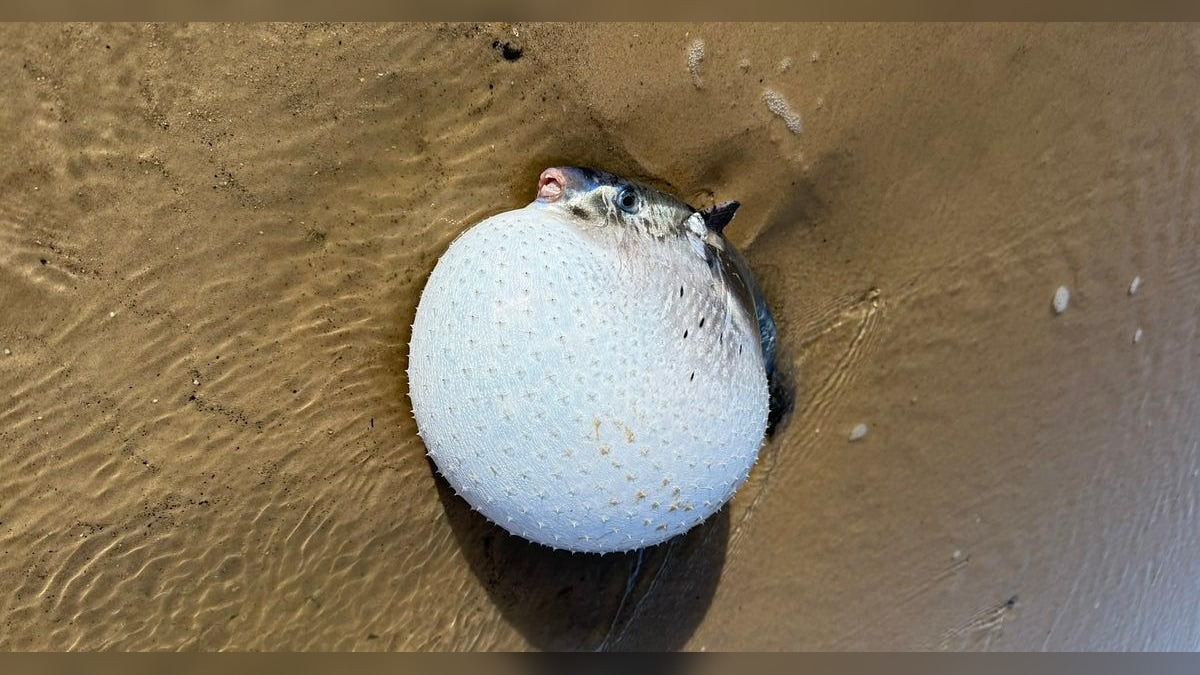
A highly poisonous pufferfish has been discovered dead on a beach in Dorset after apparently being carried hundreds of miles off course by recent storms.
The unusual sea creature was found on the sand at Knoll Beach in Studland by diver Owen Booty, who initially mistook it for a small marker buoy.
However, as he approached the object, he realised it was a fully inflated pufferfish measuring approximately 17 inches (43.1cm) in length.
Although the fish was already dead when it was discovered, it remained potentially dangerous because its natural toxins can persist in its body long after death.
Recent Storms Believed to Have Carried Fish Into UK Waters
Oceanic pufferfish are normally found in tropical and subtropical waters across the Atlantic, Pacific and Indian oceans.
The fish discovered in Dorset is believed to have been swept into British waters by Storm Austen and Storm Boelo, which recently affected parts of the region.
Booty, who operates Freedive Life in Poole, said he regularly explores the Dorset coastline but had never expected to encounter such a creature washed up on a local beach.
He explained that he had gone for a walk along the coastline because rough sea conditions had made diving impossible.
After noticing the unusual object on the sand, he decided to investigate and quickly recognised it as a pufferfish.
Having encountered the species while diving abroad, Booty said he already had an idea of what he had found.
However, he sent photographs to Dorset Wildlife Trust and a friend who works as a marine biologist to confirm its identity.




Wildlife Charity Warns Public Against Handling Pufferfish
Dorset Wildlife Trust confirmed that the discovery involved a species rarely encountered in British waters.
A spokesperson for the charity said oceanic pufferfish generally inhabit open waters in warmer parts of the Atlantic, as well as the Indian and Pacific oceans, although occasional sightings occur in the UK.
The organisation advised members of the public not to touch or handle any pufferfish they might find along the coastline.
It also encouraged anyone who comes across one to report the discovery to the charity.
Toxic Fish Can Cause Fatal Poisoning
Pufferfish are named after their distinctive defensive behaviour of inflating their bodies into a balloon-like shape when threatened.
This makes them more difficult for larger predators to swallow.
However, their natural toxins make them extremely hazardous to humans.
The poisonous substances found in certain pufferfish can be far more toxic than cyanide.
Exposure can occur when the fish’s sharp, concealed spines pierce the skin, allowing toxins to enter the bloodstream.
People can also suffer poisoning after eating pufferfish that has not been prepared correctly.
The toxins are concentrated in the fish’s internal organs and can contaminate the edible flesh if those organs are accidentally cut during preparation.
Belgian Tourists Discover Rare Prehistoric Fossil in Dorset
The pufferfish discovery comes amid other unusual finds along the Dorset coastline.
Belgian tourists Michel Plissart and Carine Christens recently uncovered the remains of a 174-million-year-old giant ichthyosaur while walking along a beach near Bridport.
The couple were exploring a section of the Jurassic Coast when they noticed a shelf of rock protruding from the sand.
On closer inspection, they spotted several pieces of bone emerging from the exposed sandstone.
Their discovery turned out to be a rare ichthyosaur fossil, identified as the youngest example of its kind ever discovered in the UK.
