
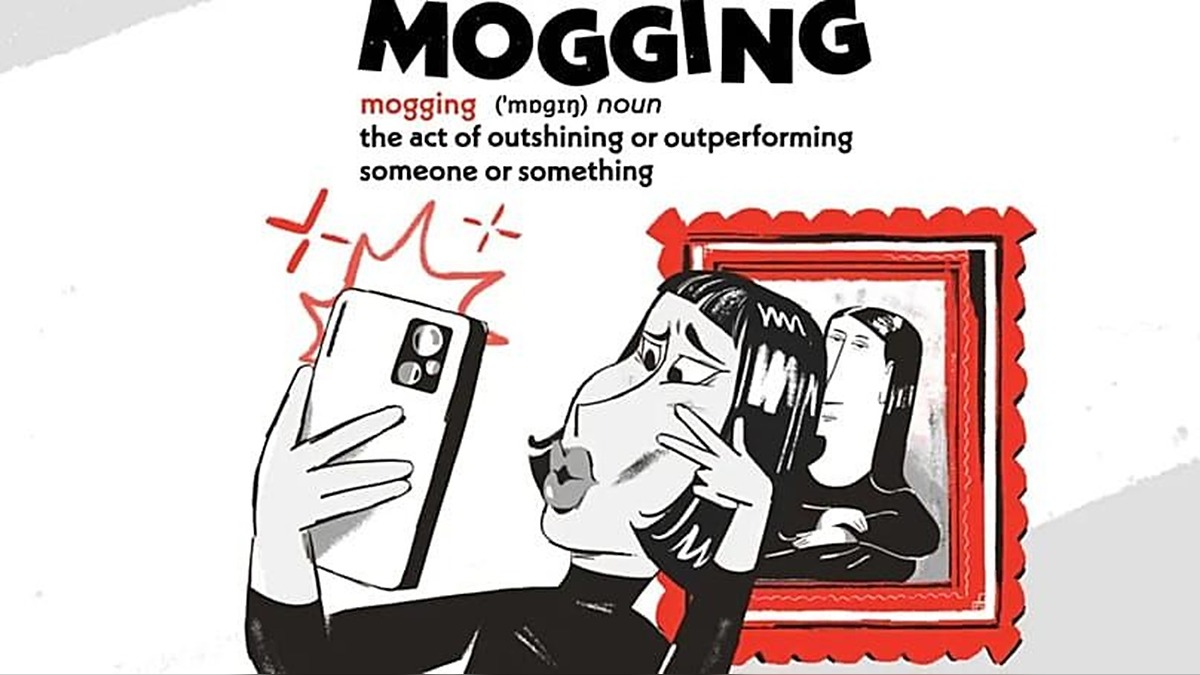
The slang term ‘mogging’, used to describe someone who dominates, outperforms or outshines others, has been named the Collins English Dictionary’s Word of the Year for 2026.
The expression recorded a 210 per cent increase in usage during the year, securing the top position ahead of several competing terms, including ‘carspreading’ and ‘Manchesterism’.
Collins lexicographers selected the word after examining language trends recorded in the Collins Corpus, the dictionary’s database used to monitor commonly used expressions, particularly those circulating online.
Described as fast-growing slang among Generation Z and Generation Alpha, ‘mogging’ has developed into a playful expression that can be used either as a compliment or an insult, depending on the circumstances.
Gen Z and Gen Alpha Drive Popularity of the Expression
The term, which should not be confused with ‘mugging’, has previously been associated with the acronym AMOG, meaning Alpha Male of the Group.
However, its popularity has expanded beyond that original association, with younger generations increasingly using it to describe someone who stands out or demonstrates superiority over others.
Its growing public profile received further attention at last month’s Conservative Party conference, where young attendees were spotted wearing badges displaying the word.
Former Conservative MP Jacob Rees-Mogg also welcomed the dictionary’s decision, despite the apparent resemblance between his surname and the winning expression.
Describing the announcement as excellent news, Rees-Mogg said it would “transmogrify our vocabulary”.
He added: “It is, in truth, mognificent, which I am expecting to be word of the year in 2027.”
Collins Explains How the Winning Word Was Selected
Alex Beecroft, managing director of Collins Dictionary, said the selection process involved examining how frequently words appeared and identifying patterns in their usage.
He explained that ‘mogging’ stood out because of the way younger generations had adopted the expression and incorporated it into everyday communication.
“It’s a great example of how Gen Z and Gen Alpha have adopted a word and turned it into humorous slang, making the language their own and ‘mogging’ the rest of us!” Beecroft said.




He added that the selection demonstrated how different generations continued to influence and reshape the English language.
Other Expressions Competing for the 2026 Title
Several other emerging expressions were considered for this year’s recognition.
‘Manchesterism’ gained popularity following the appointment of Mancunian Andy Burnham as Prime Minister.
Another contender, ‘carspreading’, refers to a pause in play used during football matches at this summer’s FIFA World Cup in the United States.
The shortlist also included ‘friendslop’, a term describing a type of independent video game designed for group play, and ‘fricy’, which refers to food and drinks combining fruity and spicy flavours.
‘Bixie’ was another expression highlighted by the dictionary.
It describes a women’s hairstyle that falls between a pixie cut and a bob.
‘Vibe Coding’ Took the 2025 Title
Last year’s Collins Dictionary Word of the Year was ‘vibe coding’, an expression associated with the growing use of artificial intelligence in software development.
The term describes an approach that allows people without traditional programming knowledge to create computer code by giving instructions to AI programmes.
Other expressions featured on the 2025 list included ‘biohacking’, which describes attempts to alter the body’s natural processes to improve health and longevity.
‘Clanker’ also attracted attention as a derogatory term for computers, robots and artificial intelligence systems.
Popularised by Star Wars: The Clone Wars, the expression spread across social media as users employed it to communicate frustration with AI chatbots and platforms.
The word ‘glaze’ also gained popularity, referring to excessive or undeserved praise or flattery.
Another expression, ‘aura farming’, describes the deliberate cultivation of a distinctive, charismatic or impressive public image.
Dictionary.com Previously Highlighted TikTok Slang
Collins was not the only dictionary organisation to recognise internet-driven expressions in its annual selection.
In October 2025, Dictionary.com named the TikTok-associated term ‘67’ as its Word of the Year.
The organisation acknowledged that the expression had no universally agreed definition, with interpretations varying among different groups.
While some people used it to mean ‘so-so’, others, particularly younger users, adopted it as an expression intended to confuse or annoy their parents.
Popular Gen Z and Gen Alpha Expressions Explained
Other slang expressions commonly used by younger generations include:
- Mogging: Playfully outshining, outperforming or outdoing another person.
- Carspreading: A pause in play used during football matches.
- Aura points: A way of measuring how cool someone is or how much positive energy they project. People can gain or lose points depending on their behaviour.
- Sigma: Used to describe a dominant, independent or popular individual, often associated with the lone-wolf personality. The expression ‘what the sigma’ is also used as an alternative to ‘what the hell’.
- Slay: Used to describe someone who has performed exceptionally well or impressed others.
- It’s giving: An expression used to communicate approval or describe someone’s personality, appearance or general energy. For example, ‘it’s giving CEO’ suggests someone has the qualities associated with a chief executive.
- Bussin: Used to describe something particularly delicious or enjoyable to eat.
