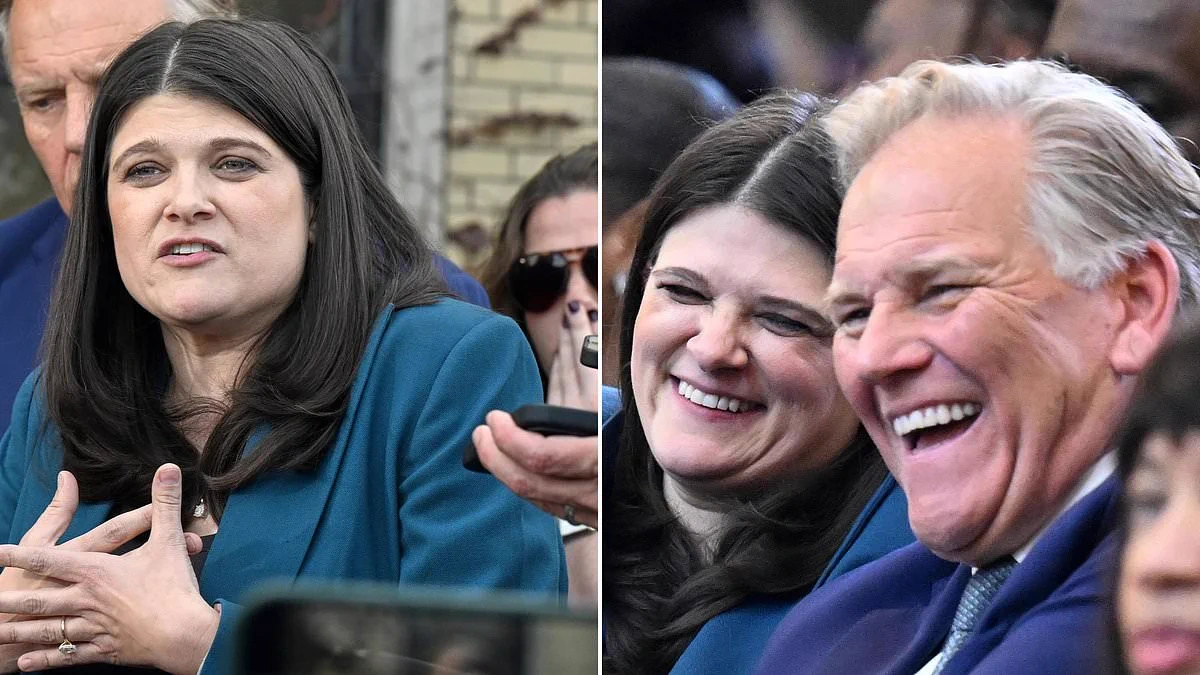
Democratic Congresswoman Haley Stevens has issued a lengthy defence of her decision to endorse Republican Senate candidate Mike Rogers, criticising members of her own party for their reaction and calling for greater tolerance of internal disagreements.
In a statement published on X on Monday night, the Michigan lawmaker addressed the controversy surrounding her decision to withdraw her support for Democratic nominee Abdul El-Sayed and back Rogers instead, just days before the midterm elections.
Stevens, who lost the Democratic Senate primary to El-Sayed in August, maintained that she remained a committed Democrat and described her endorsement of Rogers as a personal decision based on her convictions.
“My decision to withdraw my endorsement of Abdul El-Sayed and support Mike Rogers has angered many Democrats. I understand why,” she wrote.
“But it was not impulsive, and it was not made for me by anyone else. It was a decision of conscience.”
Her statement, titled ‘The Decisions We Make’, followed a difficult CNN interview with Anderson Cooper on Sunday, during which she faced repeated questions about the circumstances surrounding her sudden change of position.
Congresswoman Accuses Democrats of Rejecting Dissent
Rather than apologising for her endorsement, Stevens challenged the response from Democratic leaders, accusing some members of the party of condemning her without attempting to understand her reasoning.
She argued that the party’s reaction contradicted its stated commitment to inclusion and political tolerance.
“Instead of asking why a lifelong Democrat reached this point, some leaders rushed to condemn me, question my motives, and push me out,” she stated.
Stevens added that Democrats could not claim to support unity while refusing to accept disagreements within their own ranks.
“We cannot preach inclusion while punishing dissent. We cannot promise to heal a divided country if we cannot tolerate disagreement among ourselves.”
Her comments came amid criticism from senior Democrats, including Senate Minority Leader Chuck Schumer, who described her decision to endorse Rogers as a “despicable betrayal”.
Several members of her congressional staff also resigned in protest following the announcement.
Stevens Rejects Claims Fiancé Influenced Her Endorsement
The congresswoman also addressed speculation about the involvement of her fiancé, Jason Turkish, in her decision to support Rogers.
Turkish had publicly announced that he intended to vote for the Republican candidate before Stevens made her endorsement public.
However, Stevens rejected suggestions that his political position had influenced her choice, arguing that the criticism reflected sexist assumptions about women’s political independence.
“Some critics have also dragged my fiancé into this, suggesting he or others must have made my decision for me,” she wrote.
She maintained that she had made the decision herself and that Turkish was entitled to hold political views separate from hers.
“That is sexism dressed up as political analysis. My fiancé has his own views.
I have mine. I made this decision, and I am proud of it.”
El-Sayed Faces Criticism Over Campaign Advertisements
Stevens also used the statement to explain her objections to El-Sayed’s campaign, alleging that she had been excluded from his political operation despite endorsing him after their primary contest.




She claimed that her endorsement had been accepted but that she was subsequently left out of the campaign’s activities.
“I was shut out. The endorsement was welcomed; the people behind it seemed to be forgotten,” she wrote.
Among her complaints was an advertisement from an outside group supporting El-Sayed that connected rising grocery prices with American support for Israel.
She also criticised an advertisement produced by El-Sayed’s campaign that featured conservative commentator Tucker Carlson, saying his involvement had upset Black and Jewish voters.
“Blaming Israel for the price of eggs and elevating Tucker Carlson are not the way to build trust or bring people together,” Stevens stated.
The congresswoman further questioned El-Sayed’s association with controversial online streamer Hasan Piker, whom she accused of making troubling remarks about Jewish Americans.
Piker had compared outreach to Jewish voters in West Bloomfield with canvassing in a Ku Klux Klan neighbourhood.
Although Stevens acknowledged that El-Sayed had condemned the comparison, she argued that his decision to campaign alongside Piker demonstrated poor political judgment.
Stevens Says Rogers Is Her Preferred Senate Candidate
Stevens said her concerns about El-Sayed eventually led her to conclude that he should not serve in the United States Senate.
She explained that she subsequently considered which candidate should receive her support and settled on Republican Mike Rogers.
“Once I concluded that Abdul El-Sayed is not fit to serve in the United States Senate, I had to confront who should,” she wrote.
The congresswoman said she hoped Rogers would serve in the tradition of the late Republican Senator John McCain, whom she associated with putting national interests ahead of party loyalty.
“I chose Mike Rogers, with the hope that he can serve in the tradition of John McCain: a senator willing to put country before party.”
Her endorsement came despite her previous criticism of Rogers, including warnings that the country could not afford another MAGA senator and that he would act as a rubber stamp for President Donald Trump.
CNN Interview Intensifies Questions Over Sudden Change
Stevens’ Monday statement also followed her Sunday appearance on CNN, where Cooper questioned the timing of her endorsement and asked what had changed between Saturday night and Sunday morning.
Fellow Michigan Democrat Debbie Dingell had said Stevens assured her on Saturday evening that she would not endorse Rogers.
However, Stevens appeared alongside the Republican candidate at Perfecting Church in Detroit the following morning, abandoning plans to campaign with El-Sayed.
During the CNN interview, Cooper pressed her to explain the apparent overnight reversal.
“I woke up this morning clear-eyed, fresh and focused on what was in my heart and that’s that,” Stevens responded.
As the exchange became increasingly tense, she suggested that Cooper was upset with her decision.
The CNN presenter subsequently told her that she was not answering his questions, describing the situation as frustrating.
Dingell, who appeared on the programme immediately after Stevens, described the interview as “one of the most painful interviews I have watched”.
Trump Praises Stevens as Democrats Condemn Her Decision
Stevens’ endorsement received a positive response from Republicans, with President Donald Trump praising her as a highly respected Democrat and describing her move as an act of bravery.
Trump also expressed hope that she would consider joining the Republican Party.
However, Democratic figures in Michigan continued to criticise the congresswoman.
Michigan Democratic Party chairman Curtis Hertel accused her of abandoning her principles, while Dingell publicly expressed her disappointment over the developments.
Stevens’ longtime chief of staff also resigned following the endorsement, stating that members of the congressional office were “shocked and heartbroken”.
Stevens Calls for Healing Within Democratic Party
Despite the backlash, Stevens concluded her statement by reiterating her intention to remain involved in the Democratic Party and contribute to its future.
She said the divisions exposed by the controversy demonstrated the need for reconciliation within Michigan, the party and the wider country.
“There is healing to be done in Michigan, in our party, and in our country,” she wrote.
Stevens added that she wanted to help build a Democratic Party that was more welcoming, stronger and more willing to accommodate disagreements.
“We can build a stronger, more welcoming, more courageous Democratic Party. And I plan to help lead that effort.”
