
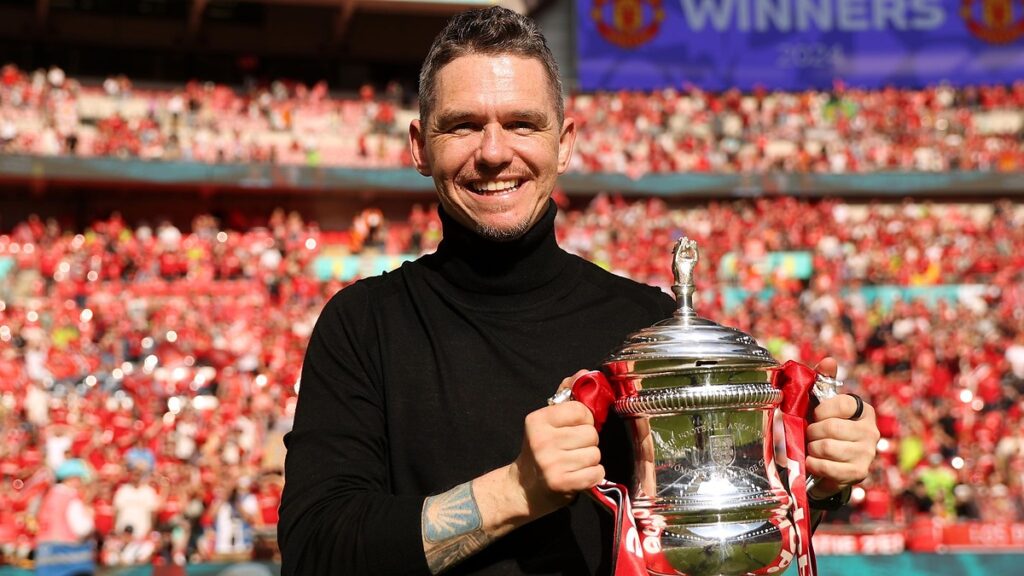
Manchester United Women have confirmed the departure of head coach Marc Skinner after both parties agreed to end their working relationship, bringing to a close a five-year spell that delivered historic achievements but also increasing pressure to compete with the Women’s Super League’s biggest spenders.
The decision comes just weeks before the start of the new campaign, leaving the club searching for a new manager ahead of their opening league fixture in early September.
Mutual Agreement Brings Five-Year Partnership to a Close
United announced that Skinner’s contract had been terminated by mutual consent despite the manager signing a two-year extension only last summer.
The 48-year-old arrived at the club in 2021 and oversaw a period of significant development, helping establish Manchester United as one of the leading teams in English women’s football.
However, a fourth-place finish in the most recent Women’s Super League campaign meant the club narrowly missed out on qualifying for European competition.
Chelsea secured the league title, while Arsenal and Manchester City also finished ahead of United in the standings.
Historic Successes Defined Skinner’s Tenure
Although his departure follows a disappointing league finish, Skinner leaves behind several notable milestones in the club’s history.
Under his leadership, Manchester United reached three consecutive Women’s FA Cup finals, eventually lifting the trophy in 2024 to claim the first major silverware in the women’s team’s history.
His side also enjoyed its strongest-ever Women’s Super League campaign during the 2022-23 season, finishing second and earning qualification for the UEFA Women’s Champions League.




That memorable campaign also saw United advance to their first Champions League quarter-final and reach the League Cup final.
Transfer Activity Raises Questions Over Club Ambition
Skinner’s exit comes during a summer in which Manchester United have faced growing scrutiny over their recruitment strategy.
While several WSL rivals have significantly strengthened their squads, United have added only two new players—young defender Andrea Medina and goalkeeper Janina Leitzig.
At the same time, the club has lost one of its key attacking players after Melvine Malard completed a move to Chelsea in a transfer reportedly valued at approximately £850,000.
The contrast between United’s limited transfer business and the aggressive investment made elsewhere has fuelled debate about whether the club is doing enough to challenge consistently for major honours.
Club Pays Tribute to Departing Manager
In its official announcement, Manchester United thanked Skinner for his contribution during a transformative period for the women’s team.
The club praised his professionalism, dedication and commitment throughout his tenure while extending its best wishes for the next stage of his coaching career.
The statement acknowledged the role Skinner played in helping drive the continued progress of Manchester United Women during his years in charge.
Calls for Greater Investment Grew Throughout His Final Season
Skinner’s reign was not without criticism, with sections of the fanbase questioning whether the team had reached its ceiling under his leadership.
The former Birmingham City and Orlando Pride manager consistently defended his work by pointing to the financial gap between United and the league’s leading clubs.
He argued that sustained success required greater backing, warning that competition was intensifying not only from Chelsea, Arsenal and Manchester City but also from ambitious clubs such as London City Lionesses and Tottenham.
Towards the end of last season, Skinner stressed the importance of reviewing how resources were allocated, insisting that Manchester United needed stronger investment to remain competitive at both the top of the table and against rapidly improving rivals.
New Chapter Begins Before Season Kick-Off
The timing of Skinner’s departure creates an immediate challenge for Manchester United, with preparations for the new Women’s Super League season already well underway.
With the campaign set to begin in just over a month, the club must now identify a successor capable of building on the progress achieved under Skinner while closing the gap to the league’s strongest contenders amid increasing expectations from supporters and growing competition across the WSL.
