
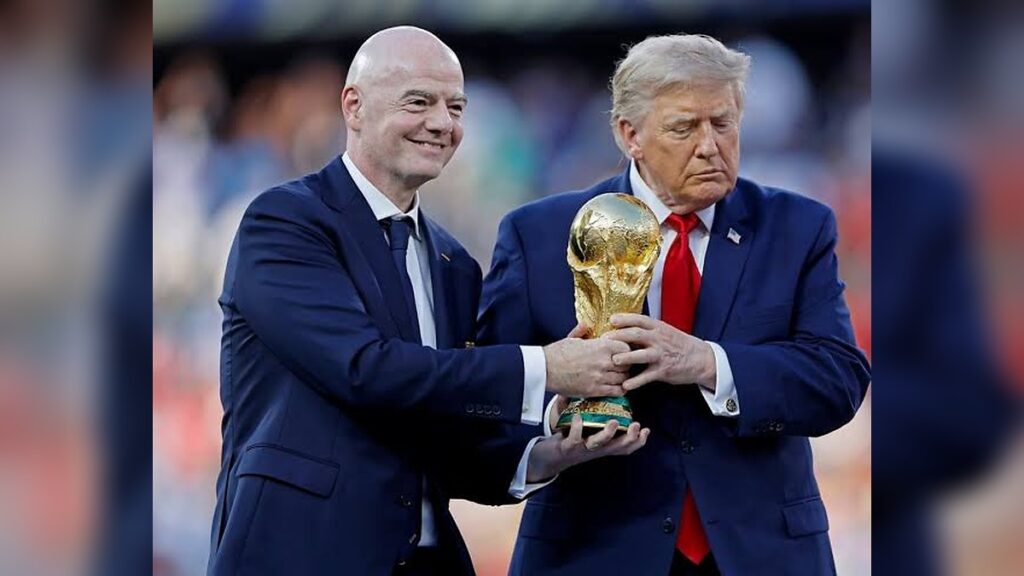
FIFA president Gianni Infantino has abandoned his controversial proposal to sell a stake in the commercial rights of the World Cup and other FIFA tournaments after overwhelming resistance from football’s governing bodies, national associations and senior figures within his own organization.
The dramatic reversal follows days of mounting criticism that left the plan politically unsustainable and has intensified questions over Infantino’s leadership ahead of next year’s FIFA presidential election.
Global Opposition Forces FIFA Into Retreat
The proposed FIFA Forward Enterprise project sought to attract around £3.1 billion ($4.1 billion) in private investment by offering investors a stake in FIFA’s premier competitions.
Infantino argued the initiative would generate additional funding to strengthen football development across the world, particularly in smaller nations that rely heavily on FIFA support.
However, after widespread consultations and growing backlash, the FIFA president announced the proposal would no longer move forward.
In a statement, Infantino said the project had become too divisive and that FIFA’s priority must remain unity among its member associations.
He added that discussions with confederations and stakeholders would continue to focus on expanding football while maintaining consensus.
UEFA Leads Resistance Against the Proposal
The strongest resistance came from UEFA, which reportedly threatened to boycott FIFA competitions unless the investment proposal was abandoned.
European football’s governing body was later joined by CONCACAF and the Asian Football Confederation (AFC), while New Zealand Football also publicly opposed the initiative despite the Oceania Football Confederation delaying its collective position.
Reports also suggested UEFA wanted binding guarantees that FIFA would never again attempt to introduce private ownership into its competitions as a condition for ending its opposition.
By Friday, countries opposing the proposal reportedly numbered 135—representing nearly two-thirds of FIFA’s membership—effectively ending any realistic chance of the project receiving approval.
Internal Revolt Deepens Crisis for Infantino
The controversy escalated further when senior FIFA officials openly broke ranks with the president.
Carlos Cordeiro, one of Infantino’s senior advisers, resigned while delivering a scathing criticism of the proposal, describing it as damaging to football’s long-term future.


Cordeiro argued that selling a permanent interest in the World Cup made little financial or strategic sense and questioned the lack of transparency surrounding the negotiations, including the identity of potential beneficiaries and the governance arrangements for investors.
He insisted decisions involving football’s most valuable asset should prioritize the interests of the sport rather than private financial gain.
FIFA Chief Operating Officer Delivers Extraordinary Rebuke
Perhaps the most damaging criticism came from FIFA Chief Operating Officer Kevin Lamour, who publicly distanced the governing body’s administration from the proposal.
Lamour claimed the investment plan was not developed by FIFA as an institution but instead reflected the ambitions of a single individual.
He accused the organization’s leadership of misleading FIFA’s own administration and urged football’s political leaders to take responsibility for protecting the game’s future.
Lamour also acknowledged that speaking out could cost him his position but said loyalty to football and his colleagues outweighed concerns about his own career.
Investment Partners Sparked Additional Scrutiny
Infantino had reportedly hoped to launch the new commercial enterprise with financial backing connected to Joshua Kushner, the investor and brother of Jared Kushner, the son-in-law of former U.S. President Donald Trump.
Investment bank J.P. Morgan was also understood to be advising on potential investors.
The reported involvement of politically connected figures added another layer of controversy, particularly in the United States.
Democratic Senator Ron Wyden criticized the proposal, arguing that football supporters were justified in opposing what he described as an attempt to turn the World Cup into another private equity asset.
Questions Raised Over FIFA’s Decision-Making
Many FIFA member associations questioned how such an advanced proposal could have been developed before broad consultation had taken place.
Although FIFA maintained that member associations would ultimately have the opportunity to debate the project, critics argued that identifying investors before securing political approval undermined the credibility of the consultation process.
UEFA also alleged that FIFA attempted to persuade member associations by offering financial incentives worth approximately £30 million ($40 million) in exchange for supporting the proposal before a September deadline.
Pressure Mounts on Infantino’s Leadership
Although the investment proposal has now been withdrawn, the controversy has intensified speculation over Infantino’s political future.
Sources within international football suggest confidence in the FIFA president has weakened significantly, particularly among CONCACAF member nations.
British Prime Minister Andy Burnham also weighed into the debate, describing the proposal as unacceptable and arguing it demonstrated that Infantino was no longer the right person to lead world football.
Under FIFA’s statutes, member associations have the ability to initiate a vote of no confidence if enough nations support such a move, although UEFA has not publicly indicated whether it intends to pursue that option.
Blatter Joins Critics as Election Looms
Former FIFA president Sepp Blatter added his voice to the growing criticism by warning against allowing private investors to gain ownership of football’s most prestigious competitions.
Blatter argued that FIFA exists to safeguard the global game rather than generate profits for outside investors, cautioning that selling stakes in the World Cup would ultimately compromise football’s identity and values.
With Infantino preparing to seek a fourth presidential term next year, the collapse of the investment proposal represents one of the biggest political setbacks of his tenure and leaves his leadership facing renewed uncertainty.

