
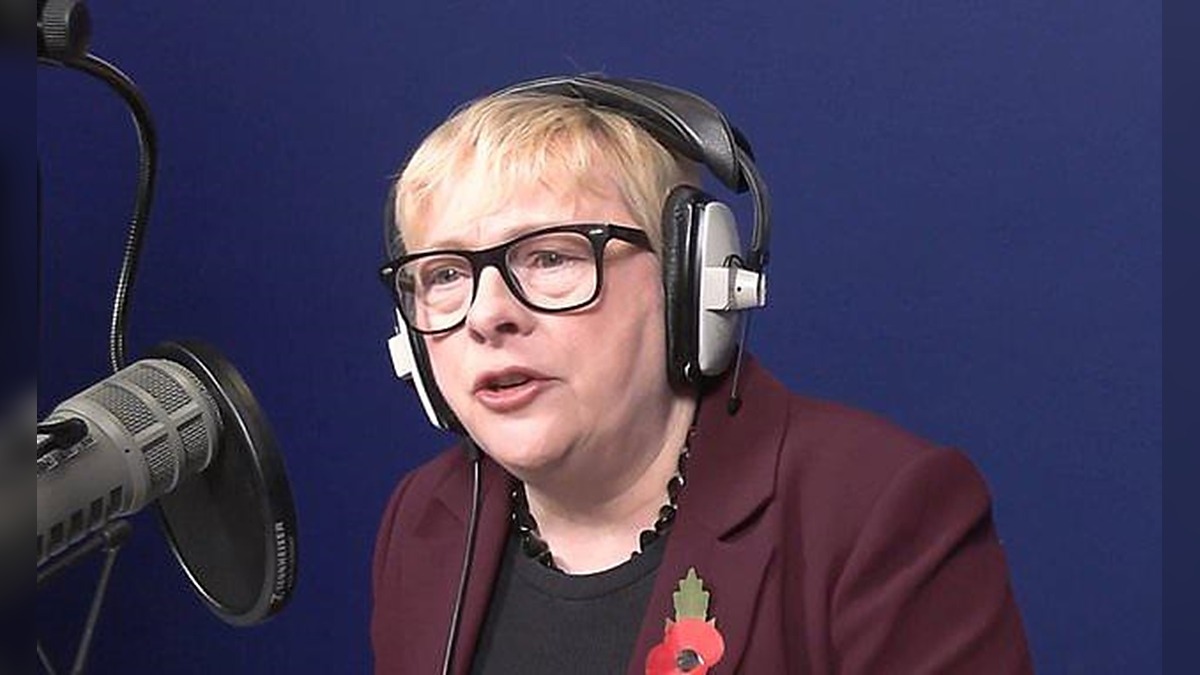
Environment Secretary Angela Eagle has dismissed concerns that closer ties between the UK and European Union could result in smoky bacon crisps being renamed, telling critics to “get a life”.
The minister made the remarks after questions emerged about the potential consequences of a new Brexit agreement being negotiated by Prime Minister Andy Burnham ahead of a major UK-EU summit scheduled for November 20.
Concerns have centred on proposed European regulations that restrict the use of meat-related descriptions on vegetarian food products.
Under the rules, manufacturers could be required to change the names of certain products, potentially affecting familiar crisp varieties.
Asked whether the proposed agreement could lead to restrictions on bacon-flavoured crisps, Dame Angela told Times Radio: “We’ve had EU straight bananas, and now we’re talking about banning smoky bacon crisps, I think you should get a life.”
She argued that the negotiations were primarily intended to improve trade between Britain and its closest European neighbours.
Government Defends Proposed Food and Farming Agreement
A food and farming agreement is among three deals the Prime Minister is expected to pursue at the Brussels summit with European Commission President Ursula von der Leyen.
The proposed sanitary and phytosanitary (SPS) agreement would see the UK align with EU regulations covering food, animal and plant health standards.
The arrangement is intended to remove post-Brexit checks on British agricultural and food exports entering European markets.
Dame Angela said the agreement could reduce the uncertainty, additional costs and trade barriers experienced by British farmers and food producers since Brexit.
She said: “This is actually about ensuring that we can do business with our closest neighbours.
“We’ve got huge potential growth in our economy if we allow our farmers and food producers to be able to export into Europe again without all the huge uncertainty and the costs and frictions that Brexit brought us.”
The Environment Secretary added that the proposed arrangement could help increase economic growth and improve prosperity.
She also acknowledged that people were entitled to focus on the potential restrictions surrounding smoky bacon crisps, although she questioned their attention to the issue.
Leaked Documents Reveal Financial Demands From Brussels
The scale of the concessions being discussed has become clearer following the circulation of draft agreements among EU member states.
A 200-page draft covering food, animal and plant health regulations has been shared ahead of the November 20 meeting.
Alongside it, documents outlining proposed agreements on emissions trading and a youth experience scheme have also been circulated, together with a 15-page joint statement between the UK and EU.
The draft statement reportedly indicates that Britain could be required to make financial contributions towards projects designed to reduce economic and social inequalities across European Union member states.
The proposed funding could support infrastructure developments, including roads, airports and renewable energy facilities in less prosperous parts of the bloc.
The document states: “We agree that the UK’s participation in parts of the EU’s internal market requires an appropriate level of financial contribution towards reducing economic and social disparities between the regions of the EU that reflects the degree of the UK’s participation in the EU’s internal market.”




EU Seeks Restrictions on Deportation of Criminals
Another contentious provision in the draft agreement concerns the deportation of EU nationals convicted of criminal offences in Britain.
According to the leaked documents, the UK would commit not to proceed with the deportation of offenders to EU countries.
The proposal forms part of the wider negotiations as the Labour Government seeks to ease pressure on Britain’s prison system.
The provision is expected to attract scrutiny as the government considers the conditions attached to closer cooperation with the European Union.
Britain Could Welcome Up to 80,000 Young EU Citizens Annually
The proposed youth mobility arrangement could allow between 75,000 and 80,000 European citizens aged between 18 and 30 to travel to the UK each year.
Under the reported proposal, successful applicants would be permitted to stay in Britain for up to three years.
The suggested annual limit represents an increase on the 50,000 places previously offered by British negotiators.
The scheme is expected to form part of the agreements being considered at the November summit.
EU Pushes for Lower University Fees for European Students
Brussels is also seeking changes to the tuition fees charged to European Union students attending British universities.
Since Brexit, EU students have generally been classified as international students and charged higher fees than British undergraduates.
Their annual tuition costs currently range from £11,400 to £38,000, depending on the institution and course.
This compares with the domestic undergraduate fee of £9,790 a year for British students.
The EU wants its citizens studying in the UK to qualify for the same tuition rates as British students, potentially requiring the government to subsidise the difference.
The proposed arrangement could cost British taxpayers approximately £450 million annually.
Burnham Defends Economic Benefits of Closer EU Ties
The Prime Minister has argued that the potential economic gains from improving relations with the European Union justify pursuing the agreements.
Speaking to The Economist, Mr Burnham said new Treasury analysis suggested that removing barriers affecting food and agricultural exports could increase Britain’s gross domestic product by as much as 0.4 per cent.
He estimated that the potential increase could amount to approximately £12 billion annually.
He said: “Now, that is a number that you cannot ignore.
If something can be done to add 0.4 per cent to British GDP, that should be pursued very vigorously, and that’s what I’m doing.”
However, the Government has stressed that negotiations remain ongoing and that Britain has not agreed to all the EU’s demands.
Brexiteers Warn Against Becoming an EU Rule-Taker
The proposed agreements have attracted criticism from Brexit supporters, who have warned the Government against surrendering the freedoms Britain secured when it left the European Union.
Critics have raised concerns that aligning British regulations with European standards could leave the country accepting rules over which it would have limited influence.
The debate has also intensified amid speculation that Mr Burnham could consider taking Britain back into the European Union after the next general election.
Michel Barnier Says UK Could Negotiate to Rejoin EU
Former EU Brexit negotiator Michel Barnier has added to the discussion by suggesting that Britain could begin negotiations to rejoin the bloc if that became its political choice.
Speaking to Sky News, Mr Barnier, who led the European Union’s negotiating team during the UK’s withdrawal, said the possibility of Britain’s return had always remained open.
He said: “I always thought during the Brexit negotiations that the door will remain open.
If it is the choice of the UK to ask for a new negotiation to rejoin, it’s perfectly possible to begin such a negotiation without any kind of obligation to take part in the euro.”
However, he stressed that membership of the EU single market would remain a non-negotiable condition.
Mr Barnier said there could be no arrangement allowing Britain to select individual benefits while avoiding other obligations associated with single-market membership.
He added that the UK was already familiar with the conditions required to rejoin both the single market and the customs union.
