
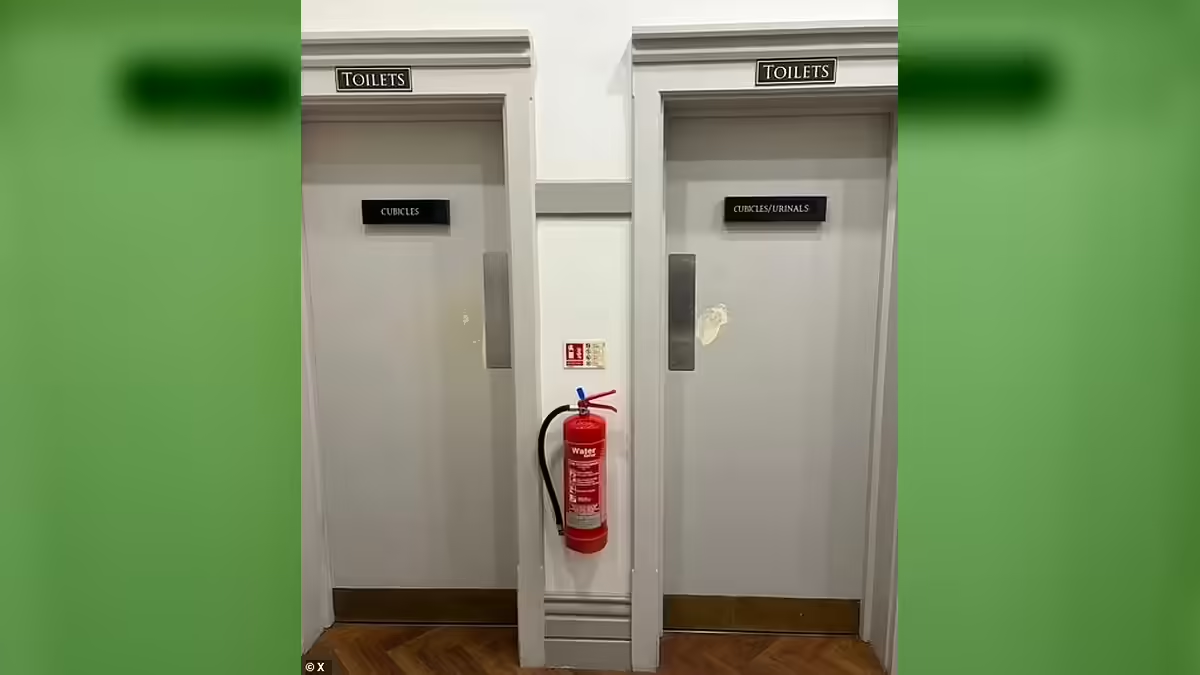
King’s College Cambridge has become the centre of a dispute over single-sex facilities after critics objected to toilets near its main bar being labelled according to the facilities inside rather than with traditional male and female signs.
The toilets carry signs reading “cubicles” and “cubicles/urinals,” a system the college says has been in place for several years.
The controversy has resurfaced following the introduction of the Equality and Human Rights Commission’s updated services Code of Practice in August, against the backdrop of an ongoing national debate over how organisations should provide facilities for women, men and transgender people.
King’s College Toilet Signs Trigger Fresh Dispute
The facilities at the centre of the controversy are located near the main bar at King’s College.
Instead of conventional male and female labels, one entrance is marked “cubicles,” while another is identified as “cubicles/urinals.”
The Telegraph reported that an alumna had accused the college of “caving in to activists” over the arrangement.
King’s, however, stressed that the signs are not a recent response to the latest legal developments and have been used for several years.
Changes Followed Earlier LGBT+ Recommendations
According to the report, the decision to move away from male and female signage followed recommendations associated with a university LGBT+ group and guidance published in 2018.
That guidance estimated, using national averages, that Cambridge University could have between 100 and 150 transgender people and argued that they should not be rejected from binary toilet facilities.
The resulting approach identified the physical facilities available rather than explicitly assigning each toilet to men or women.
Critics argue that such arrangements can create uncertainty for people specifically seeking single-sex facilities.
Alumna Accuses Cambridge of Creating ‘Hostile Environment’
An unnamed female graduate strongly criticised the college’s approach.
She argued that Cambridge had given too much ground to transgender-rights campaigners and claimed the university had become a hostile environment for people who hold gender-critical beliefs about biological sex.
The alumna also referred to controversies surrounding students who established the Cambridge Society for Women.
She argued that university students should be exposed to competing beliefs rather than existing within what she described as an Oxbridge “bubble.”
Woman Questions Availability of Male-Free Toilets
Another critic raised concerns on social media about whether women could easily identify facilities where men would not be present.
She accused King’s of expecting female visitors to search around the college for guaranteed single-sex toilets and described the provision as “male-biased.”
The criticism reflects a broader disagreement over whether gender-neutral or mixed facilities adequately address the privacy, dignity and hygiene requirements of all users.
Supporters of inclusive facilities, meanwhile, argue that suitable provision is also necessary for transgender people who may experience difficulty or distress when accessing toilets.
Sex Matters Criticises King’s Arrangement
Helen Joyce, director of the campaign organisation Sex Matters, also criticised the signage.
She described the arrangement as the “worst of both worlds for men and women.”




Sex Matters campaigns for policies and legal interpretations centred on biological sex, particularly in areas involving single-sex services and facilities.
The criticism comes at a time when organisations across Britain are reassessing policies following changes to official equality guidance.
New EHRC Code Took Effect in August
The Equality and Human Rights Commission’s updated Code of Practice for services, public functions and associations came into force on August 5, 2026.
The statutory guidance followed the Supreme Court’s 2025 ruling concerning the interpretation of “sex” in the Equality Act 2010.
The EHRC says the updated code does not itself create new law or additional legal obligations. Instead, it provides guidance intended to explain how existing equality legislation should be interpreted and applied.
The code recognises circumstances in which separate or single-sex services may lawfully be provided while also addressing protections associated with gender reassignment.
EHRC Guidance Allows a Mix of Different Facilities
The legal position is more nuanced than requiring every toilet facility to follow one particular model.
The EHRC code states that, in many circumstances, organisations may take a holistic approach involving a mixture of separate or single-sex facilities and mixed-sex facilities.
It gives the example of a shopping centre providing separate-sex toilets while additionally offering individual lockable rooms with their own handbasins that can be used by people of either sex.
The commission says the appropriate mix should reflect the needs and relative numbers of different users.
Liberal Democrats Challenge EHRC Approach
The King’s controversy has emerged alongside a wider political battle over the new guidance.
Liberal Democrat members voted overwhelmingly at their 2026 conference for the EHRC code to be replaced, describing the existing approach as “discriminatory and unworkable.”
Party leader Ed Davey backed the motion.
The Liberal Democrats argue that new guidance should allow everyone to access public facilities safely while providing greater legal certainty for organisations responsible for those facilities.
Critics Say Rewriting Guidance Could Weaken Women’s Rights
Not everyone within the wider debate agrees with the Liberal Democrats’ position.
Dr Zoe Hollywood, chair of Liberal Voice for Women, argued that transgender people had not lost their legal rights and warned that changing the guidance could undermine protections available to women.
The disagreement illustrates the sharply different interpretations surrounding the practical consequences of the Supreme Court judgment and subsequent EHRC code.
Campaigners on both sides say they are concerned about dignity, safety and discrimination, but disagree strongly over how those principles should operate in shared public facilities.
NHS Trust Faced Similar Dispute Over Toilet Policy
The Cambridge controversy follows another dispute involving the Midlands Partnership University NHS Foundation Trust.
The trust faced criticism after informing staff that there would be no immediate change to its existing facilities policy following the introduction of the EHRC code.
It said it was awaiting additional guidance from NHS England.
A female employee subsequently said some women were uncomfortable with the situation but felt unable to challenge senior management.
The episode demonstrated the practical uncertainty organisations can face when trying to interpret legal requirements alongside existing workplace policies.
King’s Says Single-Sex and Gender-Neutral Options Are Available
King’s College has defended its overall provision rather than accepting the suggestion that students and visitors lack appropriate choices.
The college said it aims to provide a safe, welcoming and inclusive environment for both members of the university community and visitors.
According to King’s, single-sex and gender-neutral toilet facilities are available at multiple locations throughout the college.
It also emphasised that the controversial “cubicles” and “cubicles/urinals” signs have existed for several years rather than being introduced following the new EHRC code.
College Says Controversial Toilets Are Only Part of Wider Provision
King’s argued that focusing exclusively on the toilets near its bar does not provide a complete picture of facilities across the college.
The institution said it provides several different types of toilets and washing facilities for students and guests.
That wider provision is significant because current EHRC guidance recognises that organisations may provide a combination of single-sex and mixed-sex facilities depending on circumstances.
Nevertheless, the renewed controversy at one of Cambridge University’s most famous colleges demonstrates how toilet provision remains caught at the centre of a wider legal, political and cultural argument over sex, gender reassignment, privacy and inclusion in Britain.
