
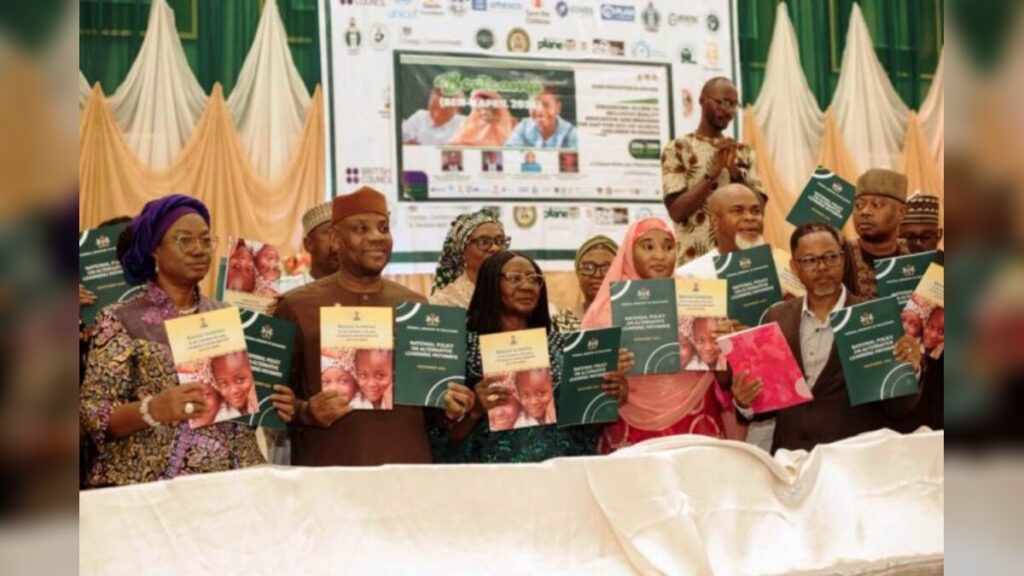
Nigeria’s education authorities are stepping up efforts to confront one of the country’s most pressing challenges—millions of children still outside the school system.
This time, the approach is shifting toward smarter planning, stronger partnerships, and targeted investments designed to make education more accessible and effective for every child.
That renewed urgency took center stage at the 2026 Basic Education Bootcamp in Jos, where policymakers, development partners, and stakeholders gathered to move beyond talk and focus on practical, workable solutions.
Why Data Is Now at the Heart of Education Reform
At the event, Minister of Education Maruf Tunji Alausa made it clear that solving the out-of-school crisis starts with one thing: reliable data.
Nigeria is currently grappling with an estimated 15 million children out of school, alongside persistent struggles in literacy and numeracy.
According to the Minister, meaningful reform is impossible without knowing exactly where these children are and why they’re not in school.
The government is now prioritizing data systems that can track learners in real time and guide targeted interventions that actually work.
Digital Tracking and Smarter Planning Take Shape
To support this strategy, the Federal Ministry of Education is expanding the National Education Management Information System (NEMIS) and accelerating the rollout of the Learner Identification Number (LIN).
These tools are designed to track students across the country, offering real-time insights into enrollment patterns and learning gaps.
Already, the 2025/2026 Annual School Census has recorded over two million learners, providing critical data to guide decision-making.
As a result of these improved systems, nearly one million out-of-school children have been identified and mapped for reintegration into formal or alternative education pathways.
Massive Investments Back the Reform Agenda
Beyond data, funding is playing a major role in driving these changes.
Between January 2025 and January 2026, more than ₦106 billion in matching grants from the Universal Basic Education Commission was accessed by states to strengthen basic education.
The government has also committed ₦22 billion to teacher development, leading to the training of about 978,000 teachers nationwide.
Infrastructure hasn’t been left out either—over 10,000 classrooms have been renovated, and 7.8 million textbooks distributed to improve learning conditions.




Reaching the Most Vulnerable Children
Special attention is being given to marginalized groups, particularly children in Almajiri and non-formal education systems.
Efforts in this area include the training of 1,400 Tsangaya teachers, identification of 119 learning centers nationwide, and deployment of 760 enumerators to gather grassroots-level data.
These steps aim to ensure that no child is left out, regardless of background or location.
Reform Programs Designed to Transform Learning
Minister of State for Education Suwaiba Said Ahmad highlighted several ongoing initiatives shaping the future of education in Nigeria.
Programs like LUMINA 2030, EduRevamp, Skill-Up, and Communities of Practice are focused on improving curriculum delivery, strengthening teacher capacity, expanding digital learning, and enhancing monitoring systems.
Together, they are expected to boost access, equity, and overall learning outcomes.
States Raise Alarm Over Broader Risks
From the state level, concerns are growing about the wider implications of the crisis.
Caleb Mutfwang, represented by Deputy Governor Josephine Piyo, warned that the rising number of out-of-school children poses serious threats, including increased poverty, insecurity, and social exclusion.
Plateau State is responding with its own initiatives—building and renovating classrooms, improving water access, and supplying learning materials to create better environments for students.
Turning Dialogue Into Action
The Bootcamp wasn’t just another policy discussion.
According to senior education officials, it was designed to deliver actionable outcomes.
Stakeholders used the platform to identify key gaps, share experiences, and develop measurable strategies aimed at not just getting children back into school—but keeping them there.
Education expert Titus Syengo reinforced the urgency, describing Nigeria’s estimated 18.5 million out-of-school children as a national emergency.
He stressed that Nigeria’s success—or failure—will have ripple effects across Africa due to its size and influence.
He also called for Afrocentric approaches that reflect local realities, alongside a strong focus on foundational learning.
Impact and Consequences
If these reforms succeed, Nigeria could see a significant reduction in the number of out-of-school children, improved literacy rates, and stronger long-term economic growth.
However, failure to act effectively could deepen existing challenges—fueling unemployment, insecurity, and inequality.
The stakes are high, not just for individuals but for national development and regional stability.
What’s Next?
The next phase will focus on scaling these initiatives nationwide, improving coordination between federal and state governments, and ensuring that funding translates into real outcomes.
More data will be collected, more children identified, and more targeted interventions rolled out.
The real test will be consistency—ensuring these efforts don’t lose momentum over time.
Summary
Nigeria is taking a more strategic and data-driven approach to tackling its out-of-school children crisis.
With stronger investments, improved tracking systems, and coordinated national action, the government aims to bring millions of children back into the education system and improve learning outcomes across the board.
Bulleted Takeaways
- Nigeria is intensifying efforts to reduce its out-of-school children population through data-driven reforms
- Reliable data and learner tracking are now central to education policy
- Over ₦106 billion has been invested in basic education through UBEC grants
- Nearly one million out-of-school children have been identified for reintegration
- Teacher training, classroom renovation, and textbook distribution are ongoing nationwide
- Special programs are targeting vulnerable groups like Almajiri children
- Experts warn the crisis poses serious risks to Nigeria’s economy and security
- The success of these reforms could influence education progress across Africa
