
For centuries, the fate of the Ark of the Covenant has hovered somewhere between history and legend.
Said to be a gold-covered chest built under the guidance of Moses, it reportedly held the Ten Commandments—arguably among the most influential moral codes ever recorded.
Now, a fresh wave of scientific curiosity is breathing life into the search.
Archaeologists aren’t claiming a discovery just yet, but they’re inching closer to something intriguing: hidden underground spaces that may finally offer clues to one of history’s greatest unsolved mysteries.
Where History Says It All Began
According to biblical tradition, the Ark was crafted shortly after the Israelites fled Egypt, sometime in the 13th century BC.
It was no ordinary object—it symbolized divine presence and was kept in the most sacred section of the temple, the “Holy of Holies,” in ancient Jerusalem.
But history took a violent turn during the Babylonian siege of Jerusalem.
When Babylonian forces destroyed the First Temple, the Ark vanished from the historical record.
No confirmed sightings, no verified recoveries—just theories.
A New Lead Beneath the Surface
Enter Dr. Chris McKinny, an archaeologist proposing a modern twist to an ancient puzzle.
His focus? The City of David, located just south of the Temple Mount.
Instead of digging, researchers are using advanced tools like muon detectors—devices that track cosmic particles to reveal what lies beneath the ground.
Think of it as X-ray vision for archaeologists.
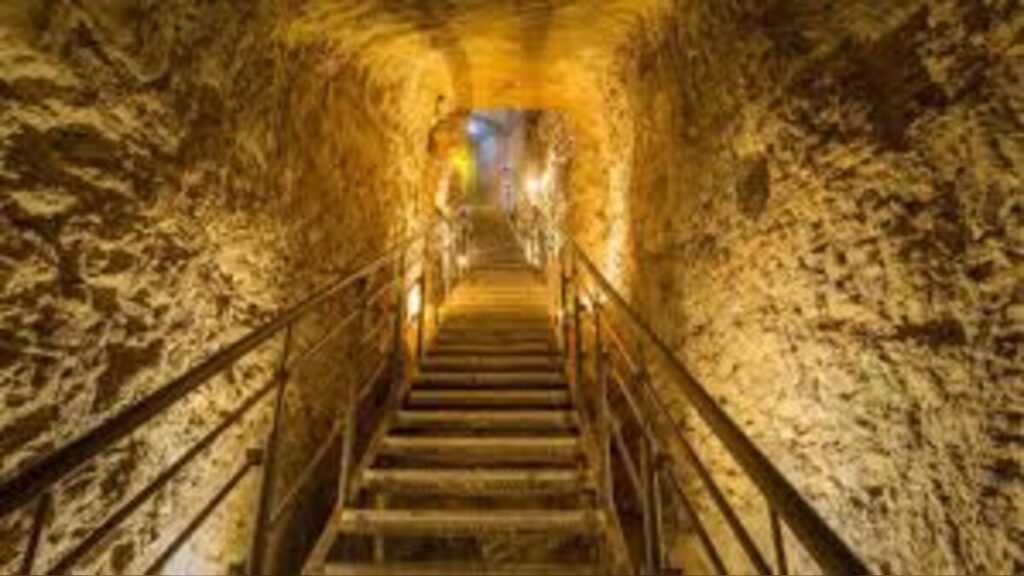
Early scans have already revealed hidden voids and unknown structures, hinting at a network of tunnels or chambers buried deep below.
If the Ark still exists—and if it’s still covered in gold as described—this technology could potentially detect it without disturbing the site.
Three Ancient Stories, One Common Thread
Dr. McKinny’s work also leans heavily on historical texts and long-standing traditions.
Interestingly, three major theories dominate discussions about the Ark’s fate:



The Temple Mount Theory
Often called the “Mount Legend,” this theory suggests priests hid the Ark beneath the Temple complex before the Babylonian invasion.
Given the sacred status of the Temple Mount, excavation here is extremely restricted, making it one of archaeology’s biggest blind spots.
The Rocky Refuge Theory
Another account centers on Jeremiah, who allegedly hid the Ark in a rocky location between two mountains.
The exact spot remains unclear, with guesses ranging from nearby wilderness to distant highlands.
The Mount Nebo Tradition
The oldest version, found in the Book of 2 Maccabees, claims Jeremiah carried the Ark to a cave on Mount Nebo—a place closely tied to Moses’ final days.
This version adds a layer of poetic symmetry: the Ark resting near the prophet who helped shape its story.
Despite their differences, all three accounts share a striking idea—the Ark wasn’t lost by accident.
It was deliberately hidden.
Technology vs. Tradition
What makes today’s search different is the technology.
Beyond muon detectors, scientists are exploring tools like ground-penetrating radar, seismic imaging, and electrical resistivity mapping.
These methods can “see” underground without excavation—a crucial advantage in sensitive religious zones.
Still, there’s a catch. Political tensions, religious sensitivities, and legal restrictions make direct exploration nearly impossible in certain areas, especially around the Temple Mount.
So for now, much of the work remains theoretical or exploratory.
Impact and Consequences
If the Ark were ever found, the implications would ripple far beyond archaeology.
Religiously, it would be one of the most significant discoveries in human history, potentially reshaping interpretations of biblical events.
Politically, it could ignite tensions in an already sensitive region, especially around sacred sites in Jerusalem.
Culturally, it would spark global fascination, drawing scholars, tourists, and media attention on an unprecedented scale.
Even scientifically, it would validate the growing role of non-invasive technologies in uncovering ancient secrets.
What’s Next?
For now, patience is the name of the game. Researchers like McKinny aren’t rushing into excavations.
Instead, they’re refining scanning technologies and studying ancient texts for overlooked clues.
There’s also hope that future advancements will allow deeper, clearer imaging of underground structures—even in restricted areas.
But that’s a long-term vision, not an immediate breakthrough.
Summary
The search for the Ark of the Covenant is far from over.
While no definitive discovery has been made, a combination of ancient tradition and cutting-edge science is opening new doors.
Hidden chambers beneath historic ground, long dismissed as myth, are now being taken seriously.
Whether the Ark still exists—or remains forever hidden—it continues to captivate both faith and science in equal measure.
Bulleted Takeaways
- The Ark of the Covenant is believed to have disappeared during the Babylonian destruction of Jerusalem in 586 BC.
- Modern archaeologists are exploring underground areas using advanced, non-invasive technology.
- The City of David and Temple Mount are key areas of interest.
- Three major traditions suggest the Ark was intentionally hidden, not destroyed.
- Religious and political sensitivities limit physical excavation in crucial locations.
- A discovery would have massive religious, cultural, and geopolitical consequences.
- For now, the search continues—quietly, cautiously, and with growing anticipation.

