
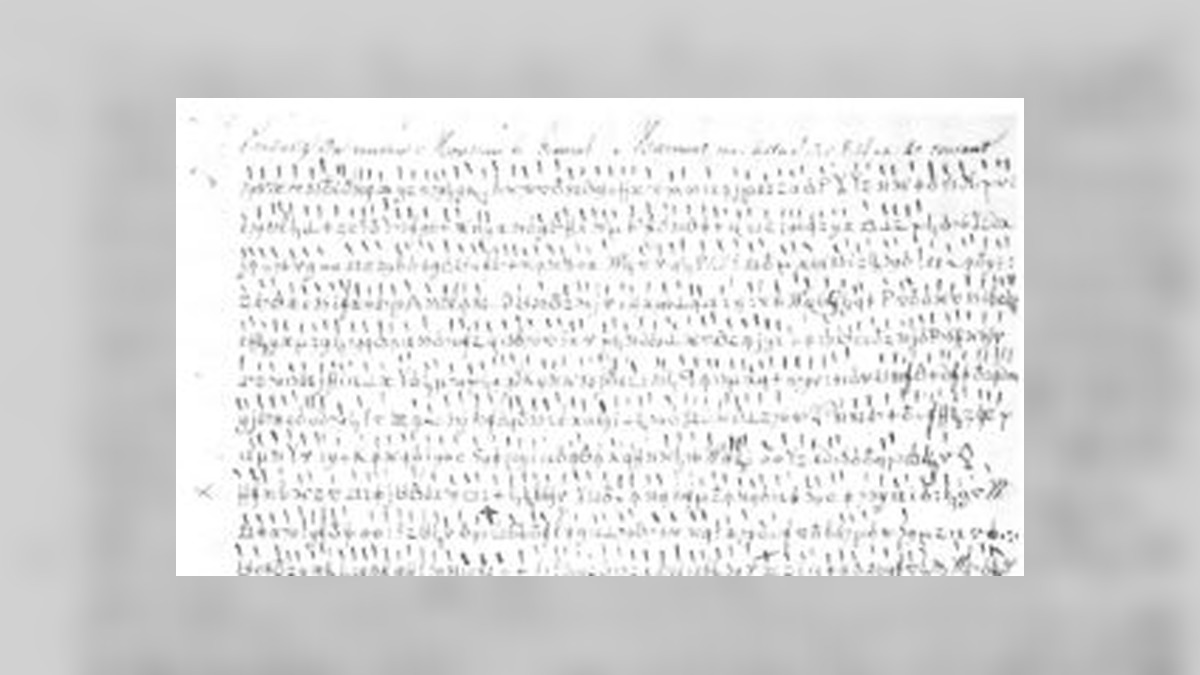
A coded letter connected to Napoleon Bonaparte has been deciphered for the first time in more than two centuries, revealing detailed military instructions that had remained inaccessible since the Napoleonic era.
The letter was sent in 1809 to French general Auguste de Marmont by Napoleon’s stepson, Eugène de Beauharnais, who was serving as Viceroy of Italy.
For generations, the document remained largely unread because its original cipher key had disappeared.
That changed when Carter Church, an engineer at cybersecurity company SentinelOne, used artificial intelligence to work through the handwritten document and reconstruct its hidden message.
Church said the process took roughly six hours and began with a single image of the letter and the goal of deciphering it.
The Letter Begins With a Familiar Message
The document contains an ordinary French sentence before suddenly switching into a complicated sequence of numbers, letters and unfamiliar symbols.
The opening line reads:
“Vous avez dû recevoir, Monsieur le Général Marmont, mes lettres des 8, 14 et 20 courant.”
In English, Napoleon’s message says that Marmont should have received the Emperor’s letters dated March 8, 14 and 20.
Everything that follows was encoded.
The remainder of the document consists of 24 lines filled with two-digit numbers, stray letters and symbols that would have been meaningless without the missing key.
Church’s work has now revealed that the seemingly indecipherable material contained Napoleon’s assessment of military movements across Europe and instructions for Marmont.
Napoleon’s Military Position Was Hidden in the Code
The decoded message provides a detailed picture of where French and allied forces were positioned as Austria moved toward war with France.
It describes Bavarian forces under the Duke of Danzig around Munich and Passau, Polish troops commanded by Prince Poniatowski along the Vistula and Saxon forces positioned near Dresden.
The message also identifies French forces around Bayreuth, Ulm, Donauwörth and Augsburg.
Napoleon’s communication further states that the army of Friuli had reached approximately 80,000 men, while additional forces were being organised elsewhere.
The overall message was intended to reassure Marmont that Austria would face pressure from multiple directions.
Marmont Was Facing an Isolated Position
The circumstances surrounding the letter help explain why Napoleon considered the communication important.
On March 16, 1809, Napoleon wrote from Paris to Eugène and instructed his stepson to communicate with Marmont.
At the time, Marmont’s troops were stationed in Dalmatia, on the eastern side of the Adriatic. With Austrian territory separating his forces from other French armies, Marmont risked becoming isolated if hostilities began.
Napoleon therefore wanted him to understand the wider military situation before receiving orders to move.
The decoded message specifically warns Marmont not to be discouraged by the limited forces immediately around him.




Napoleon’s instructions told him that Austria was being threatened from several directions and that the apparent strength of Austrian forces in particular locations did not necessarily represent the full strategic picture.
AI Had to Do More Than Simply Translate a Code
Church’s account suggests that the biggest challenge was not simply identifying the cipher.
The document itself had to be processed before the encoded message could be reconstructed.
Church said the AI system, identified by him as GPT-6 Astra, worked from a 1,202-by-1,836-pixel image.
According to his description, the system first divided the document into rows and examined the handwritten symbols. It then had to determine which of roughly 175 different hand-drawn marks represented the same character written in different ways.
Only after that transcription and cataloguing process could the cipher itself be tackled.
The resulting workflow involved image analysis, character recognition, transcription, translation and cryptanalysis.
The Cipher Was Not Considered Particularly Complex
Church has stressed that the underlying cipher was not necessarily beyond the capabilities of human cryptographers.
In his assessment, specialists could probably have broken the code if they had devoted enough time and effort to the task.
The significance of the experiment, he argued, was the ability of an AI system to combine several specialised tasks into one continuous process.
“The cipher itself isn’t difficult,” Church said, while noting that the work required to transcribe, catalogue, translate and decipher the document was much more involved.
That distinction is important because the letter had remained unread not necessarily because its encryption was exceptionally sophisticated, but because solving the entire problem required considerable specialist effort.
A Detailed Picture of the 1809 Campaign
The decoded document provides a snapshot of Europe as another major conflict was approaching.
Napoleon’s message discusses Austrian forces around places including Laybach, Klagenfurth, Villach and Salzburg. It also refers to the possibility that Austria could send troops toward Galicia to confront Russian forces.
The French Emperor suggested that Austria’s preparations indicated its campaign plans had already been disrupted before the formal outbreak of war.
He also referred to the mobilisation of militia forces, while questioning how much additional strength those troops would ultimately provide.
The communication therefore served both as an intelligence assessment and as an instruction to one of Napoleon’s commanders.
The Napoleonic Wars Were Entering Another Critical Phase
The letter dates from a period when Napoleon’s France was engaged in a prolonged struggle against European powers.
Britain had resumed war with France in 1803 after the short-lived peace established by the Treaty of Amiens. Napoleon had also assembled a large force along the French coast as he considered an invasion of Britain.
The wider Napoleonic Wars would continue for years.
Napoleon’s eventual defeat came in 1815 after he escaped exile and returned to power during the period known as the Hundred Days.
His final campaign brought French forces against a coalition led by the Duke of Wellington and Prussian commander Gebhard von Blücher.
The decisive Battle of Waterloo took place on June 18, 1815.
Napoleon’s defeat ended his final attempt to retain power, and he was subsequently exiled to the island of St Helena.
Why the Discovery Matters Beyond Napoleon
The newly decoded letter offers historians more than an intriguing glimpse into Napoleon’s military communications.
It also illustrates how modern AI tools can be applied to historical material that has resisted conventional analysis or remained neglected because of the amount of specialist work required.
Church believes this could become increasingly significant as researchers confront large collections of documents containing obscure scripts, damaged handwriting, unidentified symbols and forgotten codes.
“Every field has an unsolved backlog of niche problems that specialists don’t have the bandwidth to tackle,” he said.
His conclusion is that some of those problems may increasingly be addressed by people outside the traditional specialist communities, provided they have the curiosity and tools to investigate them.
An Old Message Gets a New Life
More than 200 years after Eugène transmitted Napoleon’s instructions to Marmont, the coded letter can finally be read as its authors intended.
What initially appeared to be a page of disconnected numbers and symbols has turned out to contain a detailed account of troop movements, assessments of Austria’s military preparations and instructions for a French commander facing the possibility of isolation.
The episode also demonstrates how the study of historical documents is changing.
For centuries, the missing cipher key left the letter effectively locked away. In 2026, a combination of image analysis, artificial intelligence and human investigation has opened it again, giving historians another direct glimpse into Napoleon’s preparations for war in 1809.

