
Scientists studying the remarkably preserved remains of a puppy that died more than 14,000 years ago have uncovered an extraordinary clue about its final meal.
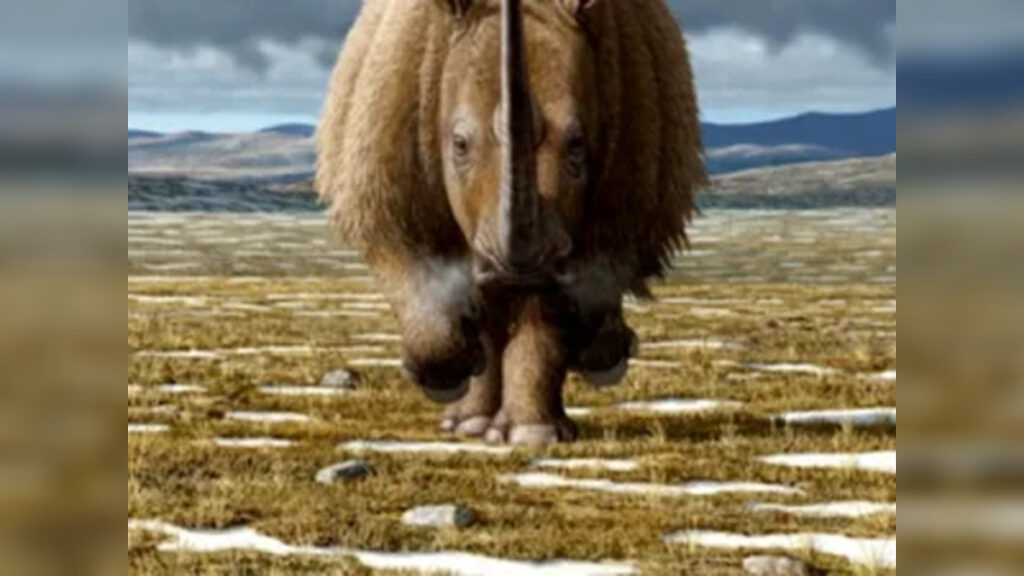
Researchers found that the young animal, recovered from the frozen Siberian permafrost, still contained a piece of tissue from an extinct woolly rhinoceros, offering a rare glimpse into life during the Ice Age.
DNA Testing Solves the Mystery of the Animal’s Last Meal
When the puppy was first examined, experts believed the preserved tissue inside its stomach may have belonged to a cave lion.
However, detailed DNA analysis carried out by researchers at Stockholm’s Natural History Museum revealed that the remains actually came from a woolly rhinoceros.
The discovery is particularly significant because the puppy, estimated to be around 14,400 years old, lived during the final period when woolly rhinos still roamed the Earth before disappearing from the fossil record.
Scientists Suspect Humans May Have Been Involved
Researchers say the piece of rhino hide showed unusually clean, straight edges that would be difficult to explain through natural tearing alone.
According to Dr. Sergey Fedorov of Russia‘s North-Eastern Federal University, the shape of the skin suggests it may have been deliberately cut by humans processing the animal.
He believes the young canine may have scavenged scraps left behind after prehistoric people butchered a woolly rhino, rather than hunting the massive animal itself.




Exceptional Preservation Offers Rare Scientific Opportunity
The puppy’s body was discovered in 2011 near the Siberian village of Tumat in the Sakha Republic, where permanently frozen ground has preserved Ice Age animals in remarkable condition.
Scientists say finding soft tissue still intact inside the digestive system of an ancient carnivore is exceptionally rare.
Professor Love Dalén of the Centre for Palaeogenetics explained that researchers matched the tissue against an extensive DNA database, producing an almost perfect genetic match with the extinct woolly rhinoceros.
He noted that discoveries of this kind are virtually unheard of because stomach contents rarely survive for thousands of years.
Second Frozen Puppy Could Provide More Answers
Researchers are now planning to examine the stomach contents of a second frozen puppy recovered from the same area.
They hope the additional specimen could reveal more about the diet, behaviour and relationship between ancient canines, humans and the Ice Age wildlife that once inhabited northern Siberia.
Mystery Still Surrounds the Puppy’s Death
Although the preserved remains have revealed what the young animal ate shortly before it died, scientists are still uncertain about what ultimately killed it.
Because the rhino tissue showed very little digestion, experts believe the puppy died soon after feeding.
Professor Dalén suggested several possible explanations.
If the animal was a wolf cub rather than an early domesticated dog, it may have discovered the carcass of a young woolly rhino.
Another possibility is that an adult rhino confronted the scavenging animal while it was feeding, leading to its death.
For now, researchers say the frozen puppy continues to provide one of the most remarkable windows yet into the final days of the Ice Age and the animals that lived alongside early humans.

