
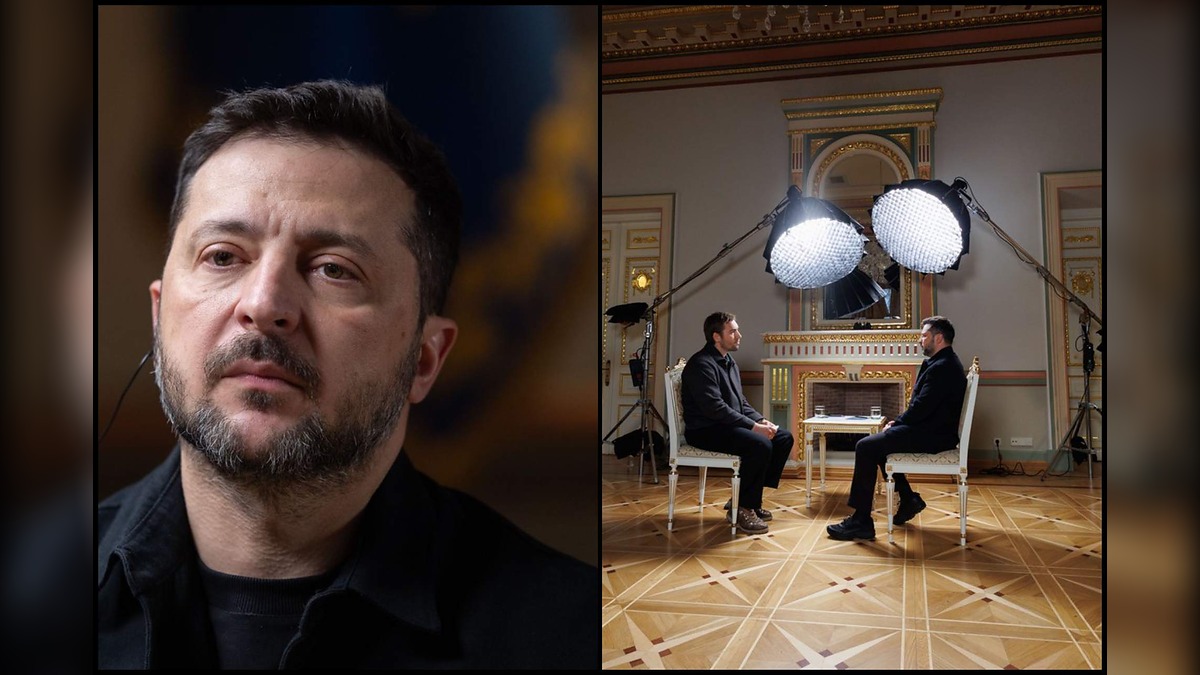
Ukrainian President Volodymyr Zelenskyy has proposed ending the active phase of Russia’s war against Ukraine through a ceasefire along the current front lines, followed by diplomatic negotiations.
In an interview with DR Nyheder, Zelenskyy said the two sides should maintain their existing positions, halt fighting and move towards discussions rather than continue military operations.
He explained that the ceasefire could initially last one month, two months, one year or even longer, depending on how negotiations progress.
According to the Ukrainian president, stopping the fighting would prevent further deaths, reduce the pace of mobilisation and allow economic activities to resume while diplomatic discussions continue.
Zelenskyy described the approach as exchanging weapons for dialogue, arguing that negotiations would provide a better path towards ending the war than continued fighting.
Ukrainian President Questions Russia’s Commitment to Peace
Zelenskyy warned that Russia could use demands for an extensive peace agreement as a way to delay an immediate ceasefire.
He said there would be numerous issues to resolve during negotiations, including the exact positions of the opposing forces, the monitoring mission’s mandate, demilitarised areas, European involvement and funding for Ukraine’s reconstruction.
However, he maintained that these questions should be addressed through the diplomatic process after the fighting has stopped.
The Ukrainian president argued that if Russian President Vladimir Putin rejects an immediate ceasefire and insists that a comprehensive agreement addressing numerous sensitive issues must first be signed, it would indicate that Moscow does not genuinely want to end the fighting.
Zelenskyy Rejects Territorial Concessions Without Clear Security Guarantees
The Ukrainian president also questioned proposals that would require Kyiv to surrender territory in exchange for security guarantees.
He described the idea of exchanging Ukrainian land for peace as an abstract proposition, pointing to what he said was a difference between Russia’s stated objectives and its military actions.
Zelenskyy recalled that Putin had previously focused his statements on Donbas but subsequently launched an operation targeting Kyiv, Ukraine’s capital.



He also challenged Russia’s justification that it was protecting Russian-speaking populations, citing the torture and deaths of civilians in Bucha and other locations.
According to Zelenskyy, these developments make it difficult for Ukraine to accept assurances that territorial concessions would guarantee lasting security.
Ukraine Questions Proposal for NATO-Like Security Arrangements
Zelenskyy disclosed that during discussions with American representatives, he was asked whether Ukraine could exchange Donbas for security guarantees.
He said he immediately sought clarification about the nature of the proposed guarantees, including whether they would involve NATO membership.
When told that the arrangement would be similar to NATO but would not involve actual membership, Zelenskyy questioned why Ukraine should accept an undefined security arrangement while being expected to provide a definite answer on Donbas.
He also recalled Ukraine’s history of giving up its nuclear weapons and subsequent difficulties with its European integration and NATO ambitions.
The president said Russia had taken Ukraine’s nuclear weapons, obstructed its European integration and prevented its NATO membership before eventually occupying Ukrainian territory.
He questioned what would happen if Ukraine accepted security guarantees outside NATO and withdrew from Donbas, arguing that Russia could simply suspend its military activities before launching another offensive in one, two or five years.
Zelenskyy said there was no basis for trusting Putin to permanently stop military operations following such territorial concessions.
Zelenskyy Warns Europe Against Reducing Support for Ukraine
The Ukrainian president further warned European countries against becoming sceptical about continued assistance to Ukraine, saying the consequences could extend beyond the country’s borders.
He argued that maintaining a strong Ukraine was important for Europe’s security, particularly because of Russia’s opposition to European rules and values.
Zelenskyy outlined two possible scenarios if European assistance to Ukraine were to disappear, describing one as dangerous and the other as very dangerous.
Under the first scenario, he said Russia could intensify its hybrid attacks across Europe, similar to activities he referenced in Moldova, Romania, Bulgaria, Germany, Finland and Denmark.
He warned that such operations could expand significantly, describing this as the less severe of the two possible outcomes.
Zelenskyy Raises Possibility of Wider Russian Expansion in Europe
In the second scenario, Zelenskyy warned that Russia could move further into Europe as part of what he described as Putin’s ambition to restore the influence of the former Soviet Union.
He said this could involve attempts to exert influence over countries that were previously part of the USSR, particularly the Baltic states and Moldova.
Zelenskyy noted that the potential threat would also involve NATO member countries, meaning that any Russian expansion into their territory could require a response from the alliance.
He warned that such a development could draw the entire European continent and the United States into a wider confrontation.
The Ukrainian president also raised concerns about maritime security, saying Russia could attempt to block the Baltic Sea in a manner similar to its blockade of the Black Sea.

