
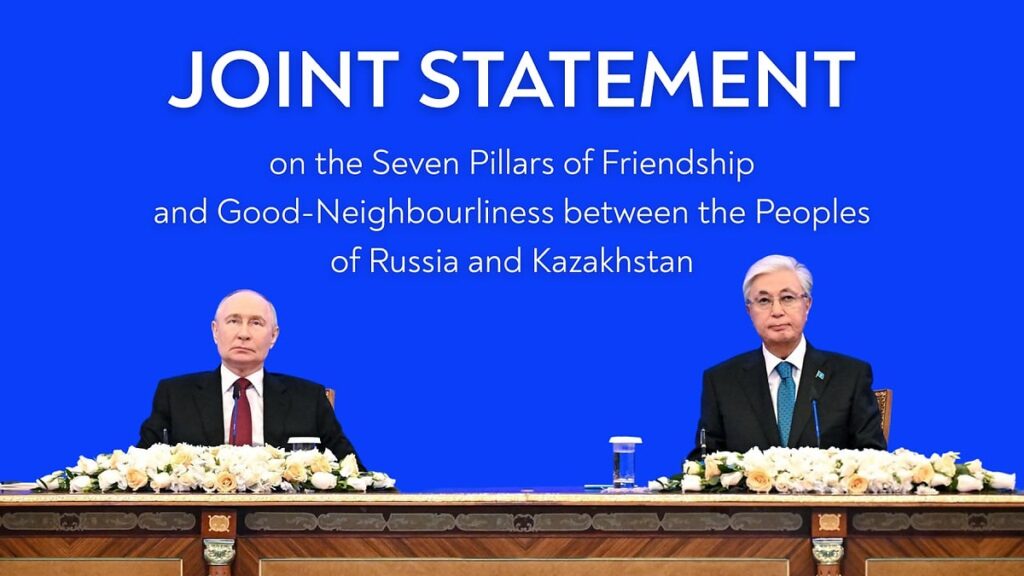
Russian President Vladimir Putin used a high-profile meeting in Astana on Wednesday to highlight what he described as the growing strategic partnership between Russia and Kazakhstan, following extensive bilateral negotiations with Kazakh President Kassym-Jomart Tokayev.
Speaking after the talks, Putin said discussions between both delegations focused on expanding cooperation across politics, trade, energy, technology, culture, and international diplomacy. He characterized the meeting as productive and reflective of what he called the “friendly and good-neighbourly” relationship shared by the two nations.
Russia and Kazakhstan Sign New Agreements Across Multiple Sectors
The talks concluded with the signing of a joint statement outlining future priorities for bilateral cooperation. Additional intergovernmental and departmental agreements were also finalized, covering sectors including healthcare, finance, education, and energy development.
According to Putin, the agreements are designed to strengthen long-term coordination between Moscow and Astana while broadening cooperation in areas considered strategically important to both economies.
Officials emphasized that the partnership is no longer limited to traditional trade, but is increasingly moving toward projects involving technology, infrastructure, and industrial development.
Trade Between Moscow and Astana Approaches Record Levels
Economic cooperation dominated much of the discussions, with Putin revealing that trade turnover between the two countries reached nearly $29 billion in 2025.
The Russian leader said both sides are now close to surpassing the $30 billion threshold, which he suggested could happen in the near future as commercial ties continue to deepen.
He also stressed that most transactions between the countries are now conducted in national currencies rather than foreign reserve currencies. According to Putin, this approach shields trade operations from external economic pressure and volatility in global financial markets.
The Kremlin further noted that trade diversification is expanding beyond raw materials into products with higher added value.
Nuclear Power Plant Project Becomes Central Energy Deal
One of the most significant outcomes of the visit involved the approval of agreements tied to the planned construction of a nuclear power plant in Kazakhstan.
Putin confirmed that Russia will support the project financially through a state-backed export credit arrangement. Once completed, the facility is expected to play a major role in Kazakhstan’s future energy supply and provide what Russian officials described as affordable and cleaner electricity for households and industries.
The announcement marks one of the largest recent infrastructure partnerships between the neighboring states.




Baikonur and Space Cooperation Remain Strategic Priorities
The leaders also highlighted ongoing collaboration in the aerospace sector through the jointly operated Baikonur Cosmodrome.
Putin pointed to the development of the Baiterek launch complex as an example of successful cooperation between the two countries. He noted that the new Soyuz-5 launch vehicle was recently launched from the site, describing it as a promising advancement for future space operations.
Russia and Kazakhstan have long maintained close cooperation in space exploration, with Baikonur remaining one of the world’s most historically significant launch facilities.
Artificial Intelligence and Digital Technology Take Center Stage
Beyond energy and trade, the discussions also focused heavily on emerging technologies and digital modernization.
Putin said Russia and Kazakhstan are expanding cooperation in artificial intelligence and other advanced technological solutions that could be integrated into economic and social sectors.
He added that high technology and innovation would feature prominently during the plenary session of the Eurasian Economic Forum, attended by leaders from member states of the Eurasian Economic Union.
Putin Praises Kazakhstan’s Support for Russian Language
During his remarks, Putin also addressed cultural and linguistic cooperation, thanking Kazakhstan’s leadership for maintaining broad use of the Russian language throughout the country.
He referenced Kazakhstan’s recently adopted constitution, which reaffirmed Russian as an official language. Putin also credited Tokayev with proposing the creation of an international organization dedicated to supporting the Russian language globally.
The issue remains politically significant as Moscow continues to emphasize cultural ties across former Soviet states.
Moscow and Astana Reaffirm Shared Foreign Policy Positions
On international affairs, Putin stated that Russia and Kazakhstan hold closely aligned positions on many global issues.
He said the two countries continue coordinating within several multilateral organizations, including the United Nations, the Commonwealth of Independent States, the Collective Security Treaty Organization, and the Shanghai Cooperation Organisation.
Putin also praised Kazakhstan’s leadership of the Eurasian Economic Union this year, saying upcoming summit decisions would focus on strengthening regional integration among member states.
The agreements announced in Astana reinforce the growing economic and geopolitical partnership between Russia and Kazakhstan at a time when regional alliances are becoming increasingly important across Eurasia.
The nuclear power plant project could significantly reshape Kazakhstan’s energy landscape while deepening its dependence on Russian technological and financial support.
Meanwhile, expanded use of national currencies in bilateral trade reflects broader efforts by Moscow and its partners to reduce reliance on Western-controlled financial systems amid continuing global economic tensions.
The emphasis on artificial intelligence, digitalization, and transport infrastructure also signals a shift toward modernizing the Eurasian partnership beyond traditional energy and commodity trade.
Attention now turns to the Eurasian Economic Union summit, where member states are expected to approve new integration measures and economic initiatives.
Observers will also closely monitor progress on the nuclear power plant financing arrangements and the implementation of recently signed bilateral agreements.
Further cooperation in space exploration, artificial intelligence, and regional trade mechanisms is expected to remain high on the agenda for both governments throughout 2026.
