
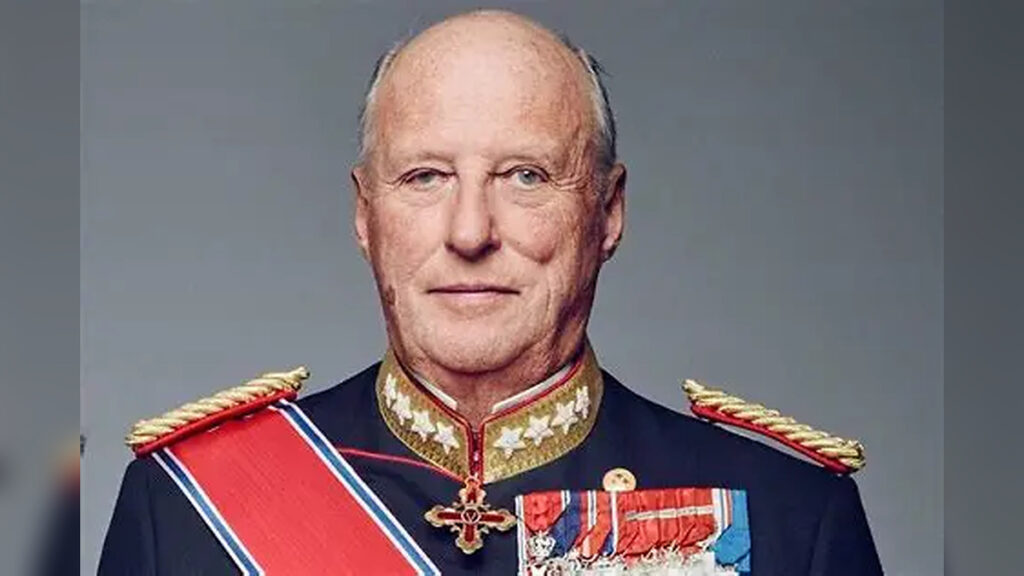
Norway is mourning the death of King Harald, who died peacefully on Friday at the age of 89 after a period of serious illness, the royal palace confirmed.
The monarch died at Oslo University Hospital at 6:35am local time on August 28, according to the palace. His death brings to an end a 35-year reign that saw him become one of Europe’s most recognisable and widely respected monarchs.
The Norwegian royal flag was lowered to half-mast at the palace in Oslo following the announcement, as members of the public gathered to pay their respects.
Crown Prince Haakon Becomes King
Harald’s death automatically places his 53-year-old son, Crown Prince Haakon, on the Norwegian throne.
Haakon had spent much of Thursday at his father’s bedside alongside his wife, Crown Princess Mette-Marit, their adult children and Queen Sonja.
Reports said the crown prince remained at the hospital overnight as his father’s condition deteriorated.
The transition marks a new chapter for Norway’s constitutional monarchy, with Haakon now expected to assume the responsibilities his father carried for more than three decades.
King’s Final Days Marked by Rapid Health Decline
Harald had been receiving treatment at Oslo University Hospital since August 17 after developing haemolytic anaemia, a condition in which red blood cells are destroyed faster than the body can replace them.
The illness had left the king experiencing serious symptoms, including fatigue and shortness of breath.
On Thursday, the palace said his condition had become “extremely serious”, prompting his immediate family to gather around him.
His death follows years of recurring health problems that increasingly limited his public duties.
Harald had previously undergone treatment that resulted in the fitting of a pacemaker and had reduced the demands of his official schedule.
Despite those difficulties, he repeatedly rejected the possibility of abdication, maintaining that his commitment to the Norwegian monarchy was a lifelong responsibility made through an oath to parliament.
Crowds Gather Outside Oslo Palace
News of the king’s death prompted an immediate public response in central Oslo, where people gathered outside the royal palace to leave flowers and mourn together.
For many Norwegians, Harald was regarded less as a distant royal figure and more as a familiar and reassuring national presence.
Kaspara Bolstad, 24, described him as a “very steady and warm king”, saying he had served as a role model who helped bring people together regardless of their views on the monarchy.
Magnus Skaugseth, 27, similarly praised Harald’s emphasis on inclusion, saying the monarch had represented values that stood against the division and polarisation affecting modern society.
The reactions reflected Harald’s unusual position in Norwegian public life: a constitutional monarch who remained broadly popular across political and social divides.
A Reign Built Around Stability and Accessibility
Harald became king in 1991 after the death of his father, King Olav V. Over the following decades, he developed a reputation for an informal and modest approach to royal duties.




His public image was closely associated with national unity rather than political intervention.
While he occupied a largely ceremonial constitutional role, his speeches and public appearances frequently focused on social cohesion and the importance of accepting differences within Norwegian society.
That approach helped strengthen his standing with the Norwegian public and contributed to the continued popularity of the monarchy.
A Difficult Year for Norway’s Royal Family
Harald’s final year was particularly challenging for the Norwegian royal household.
In February, the king was hospitalised in Tenerife after suffering from an infection and dehydration while on a private holiday with Queen Sonja.
His wife, who was also 89, was later briefly admitted to hospital in May because of heart problems.
The health concerns came as the wider royal family faced a series of controversies and personal difficulties.
Scrutiny Surrounds Crown Princess Mette-Marit
Crown Princess Mette-Marit has faced renewed scrutiny over her historical contacts with Jeffrey Epstein, the late American financier and convicted sex offender.
Documents released in the United States in January showed that she maintained correspondence with Epstein between 2011 and 2014, including communications described as sustained and at times intimate.
The contacts occurred after Epstein had already been convicted.
The revelations created additional pressure around the Norwegian royal family as it dealt with the king’s declining health.
Marius Borg Høiby Case Adds Further Pressure
Mette-Marit’s son from a previous relationship, Marius Borg Høiby, has also been at the centre of a major legal controversy.
He was sentenced in June to four years in prison after being convicted of two rapes and 32 other offences, including violence against a former partner. Høiby has appealed the judgment.
Mette-Marit herself has faced significant health challenges.
Suffering from serious lung disease, she underwent a lung transplant in July, adding another major personal strain to a royal family already confronting several crises.
Prime Minister Cancels Trip as King’s Condition Worsens
The seriousness of Harald’s condition was underlined by Prime Minister Jonas Gahr Støre’s decision to cancel a planned working trip to Germany on Thursday.
The Norwegian government closely monitored developments as the king’s health deteriorated, before the palace announced his death the following morning.
Norway Begins a New Royal Era
King Harald’s death closes one of the most consequential chapters in modern Norwegian royal history. His reign lasted more than three decades and was defined by continuity, public accessibility and an emphasis on bringing people together.
Although the royal family has endured considerable controversy and health difficulties in recent years, the monarchy remains broadly supported among Norwegians, with Harald’s personal popularity playing an important role in maintaining that support.
With Crown Prince Haakon now succeeding his father, attention will turn to how the new king carries forward Harald’s legacy while guiding the monarchy into a new generation.
What’s Next?
The immediate focus will be on the formal arrangements surrounding King Harald’s death and the constitutional transition to King Haakon.
Norway is also expected to observe a period of national mourning as the country pays tribute to a monarch who remained a central symbol of national unity throughout his long reign.
Haakon will inherit both the ceremonial responsibilities of the Norwegian crown and the expectations created by his father’s enduring popularity.
Summary
King Harald of Norway has died at 89 after his health deteriorated following hospitalisation for haemolytic anaemia.
His 53-year-old son, Crown Prince Haakon, succeeds him automatically.
The king’s death ends a 35-year reign during which he became known for his modest lifestyle, inclusive outlook and ability to unite people across political and social differences.
His passing comes during a turbulent period for the royal family, marked by serious health problems and controversies involving members of the next generation.
Nevertheless, Harald leaves behind a monarchy that remains broadly popular with the Norwegian public.

