
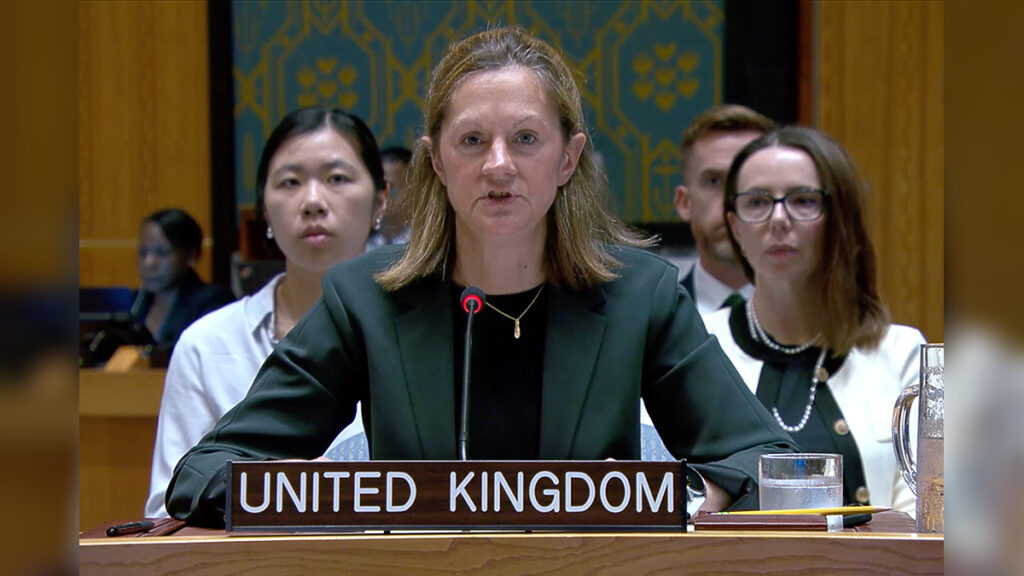
The United Kingdom has strongly condemned the Houthis over renewed fighting in Yemen and continuing attacks against Saudi Arabia, warning that the escalation could destabilize the wider Middle East and place critical international shipping routes at greater risk.
Speaking at an emergency meeting of the United Nations Security Council on September 10, UK Deputy Permanent Representative to the UN Ambassador Kate Foster called for an immediate halt to Houthi attacks and urged the group to return to the political process aimed at ending Yemen’s prolonged conflict.
Britain and Bahrain requested the urgent Security Council meeting following the latest escalation.
London Accuses Houthis of Targeting Saudi Infrastructure
Foster accused the Houthis of conducting what Britain described as reckless attacks against Saudi Arabia, including strikes targeting civilian and energy infrastructure.
She said London stood alongside Saudi Arabia and Yemen’s internationally recognized government and offered condolences to those killed, injured or otherwise affected by the latest violence.
Britain also reaffirmed what it described as the right of Saudi Arabia and Yemen to protect their security and sovereignty in accordance with international law.
The UK placed responsibility for the latest crisis squarely on the Houthis, arguing that their renewed military operations had reversed efforts to reduce tensions.
Bab al-Mandeb Advance Raises International Alarm
Particular concern was expressed about Houthi military movements toward the Bab al-Mandeb, one of the world’s most strategically important maritime passages.
The narrow waterway connects the Red Sea with the Gulf of Aden and serves as a major route for international shipping between Europe and Asia.
Britain warned that further Houthi advances in the area could increase risks to commercial vessels, maritime security and global supply chains.
According to Foster, continued attacks threaten freedom of navigation and transit passage as well as trade through both the Red Sea and Bab al-Mandeb.
Developing Economies Could Face Greater Trade Disruption
The consequences of instability around the shipping corridor could extend far beyond Yemen and Saudi Arabia, the UK warned.
Disruption to commercial shipping can increase transportation and insurance costs and create delays for goods moving through international markets.
Foster argued that developing countries are likely to experience the consequences first and most severely because of their greater vulnerability to rising food, fuel and transportation costs.




The warning comes as the security of Middle Eastern maritime routes remains a significant concern for governments and international businesses.
More Than 22 Million Yemenis Need Humanitarian Assistance
Britain also warned that renewed hostilities could deepen Yemen’s already severe humanitarian emergency.
According to figures cited in the UK statement, more than 22 million Yemenis currently require humanitarian assistance, while over 18 million people are experiencing acute food insecurity.
London said restarting major hostilities would expose already vulnerable communities to additional displacement, shortages and disruption to essential assistance.
The humanitarian situation has therefore become a central part of Britain’s argument for an immediate return to de-escalation.
UK Demands Release of 73 Detained UN Workers
Foster also criticized the Houthis over the continued detention of personnel associated with the United Nations and non-governmental organizations.
Britain said the detentions were obstructing humanitarian operations precisely when millions of Yemenis require outside assistance.
The UK demanded the immediate and unconditional release of personnel from NGOs, civil society organizations and diplomatic missions, along with 73 UN staff members it said remained detained.
London argued that preventing humanitarian workers from operating freely further increases the suffering of civilians caught in the conflict.
Britain Blames Iranian Support for Fuelling Instability
The UK also turned its attention to Iran, accusing Tehran of providing long-standing support to the Houthis that continues to contribute to instability in Yemen.
Foster called for full enforcement of UN Security Council resolutions 2140 and 2216, including restrictions designed to prevent transfers of weapons and military assistance to the group.
Britain said the restrictions should also cover dual-use components that could contribute to Houthi military capabilities.
London called on all UN member states to comply with their obligations and prevent transfers that could facilitate attacks against civilians, neighboring countries and international shipping.
London Reaffirms Support for UN-Led Peace Process
Despite the renewed fighting, Britain said a negotiated settlement remains the preferred route toward ending Yemen’s conflict.
Foster reaffirmed UK support for the work of the UN Special Envoy and efforts to secure a lasting political settlement.
She called on the Houthis to prioritize the needs of Yemen’s population, immediately stop their attacks and re-engage with the peace process.
Britain said it would continue working with international partners to support diplomatic efforts.
UK Calls for Unified Security Council Response
London concluded its intervention by urging the Security Council to deliver a clear and unified message demanding de-escalation.
Britain wants the Houthis to halt attacks, reduce military tensions and return to negotiations aimed at securing a durable peace.
The latest escalation has raised the stakes beyond Yemen itself, with attacks on Saudi Arabia, instability around the Bab al-Mandeb and threats to Red Sea shipping transforming renewed fighting into a broader international security and economic concern.
For Britain, the immediate priority is preventing further military escalation while preserving a route back to UN-led negotiations.
