
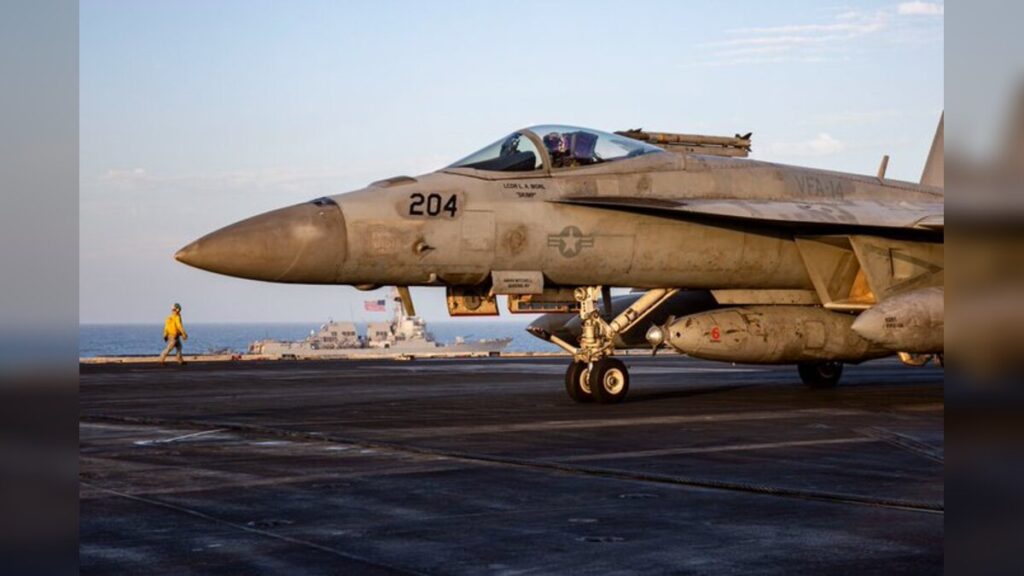
U.S. Central Command has released a new snapshot from the military’s blockade operation around Iran, sharing an image of an F/A-18E Super Hornet moving across the flight deck of the USS Abraham Lincoln while the destroyer USS Delbert D. Black sailed nearby.
The post was presented as another public sign of the scale and readiness of American forces involved in the mission.
Fighter Jet and Warship Image Underscores Military Presence
The image showed the Super Hornet taxiing on the deck of the Nimitz-class aircraft carrier as operations continued at sea.
CENTCOM paired the visual with a message stressing that the United States currently has a large number of service members deployed in support of the blockade effort.
The scene was designed to reinforce the message that U.S. naval and air assets remain active and prepared as the mission continues.
More Than 10,000 U.S. Personnel Said to Be Enforcing the Blockade
According to CENTCOM, more than 10,000 American Sailors, Marines, and Airmen are taking part in enforcing the blockade. The military said the operation is focused on ships attempting to enter or leave Iranian ports and coastal areas.
That description suggests the U.S. is maintaining a large, coordinated force posture involving both sea and air power as part of its pressure campaign.
Operation Framed as Maritime Control and Deterrence
By spotlighting carrier-based aircraft and escorting warships, CENTCOM appears to be emphasizing both capability and deterrence.



The combination of naval and aviation assets points to a mission built not only around surveillance and interception, but also around showing overwhelming force in a strategically sensitive region.
The post fits into a wider pattern of military messaging aimed at signaling that the blockade is active, organized, and backed by significant resources.
Pressure Campaign Continues Around Iranian Coastal Access
The wording of the update makes clear that the operation is centered on controlling maritime movement connected to Iranian ports and coastal zones.
Rather than focusing only on one vessel or one interception, the message presents the blockade as a sustained campaign involving constant monitoring and enforcement.
That ongoing presence is meant to show that the blockade is not symbolic, but an active effort being carried out by a large deployed force.
Impact and Consequences
If CENTCOM’s description reflects the full scale of the deployment, the blockade represents a major military commitment with significant regional implications.
A force of this size increases pressure on maritime traffic linked to Iran and raises the stakes for any ship attempting to challenge U.S. instructions.
The continued presence of carrier aircraft and warships could also heighten tensions in surrounding waters, especially if the operation leads to more direct confrontations or attempted breaches.
What’s next?
The next major question is whether CENTCOM follows this update with more details about interceptions, ship movements, or expanded enforcement actions.
Attention will also remain on how long the U.S. maintains such a large deployment and whether any vessels attempt to test the blockade in the coming days.
Further military imagery and operational updates are likely to be used to show that the mission remains active and fully supported.
Summary
CENTCOM has spotlighted the USS Abraham Lincoln and USS Delbert D. Black as part of its latest blockade update, saying more than 10,000 U.S. Sailors, Marines, and Airmen are enforcing restrictions on ships entering or leaving Iranian ports and coastal areas.
The post highlights the scale of the American military presence and the continuing role of naval and air power in the blockade operation.
Bulleted Takeaways:
- CENTCOM shared an image of an F/A-18E Super Hornet on the USS Abraham Lincoln.
- The USS Delbert D. Black was also shown operating alongside the carrier.
- The military said the image was taken on April 16.
- CENTCOM says more than 10,000 U.S. Sailors, Marines, and Airmen are involved in the blockade mission.
- The operation is aimed at ships trying to enter or depart Iranian ports and coastal areas.
- The update highlights both naval and air assets involved in the enforcement effort.
- The post presents the blockade as an ongoing and large-scale military operation.
