
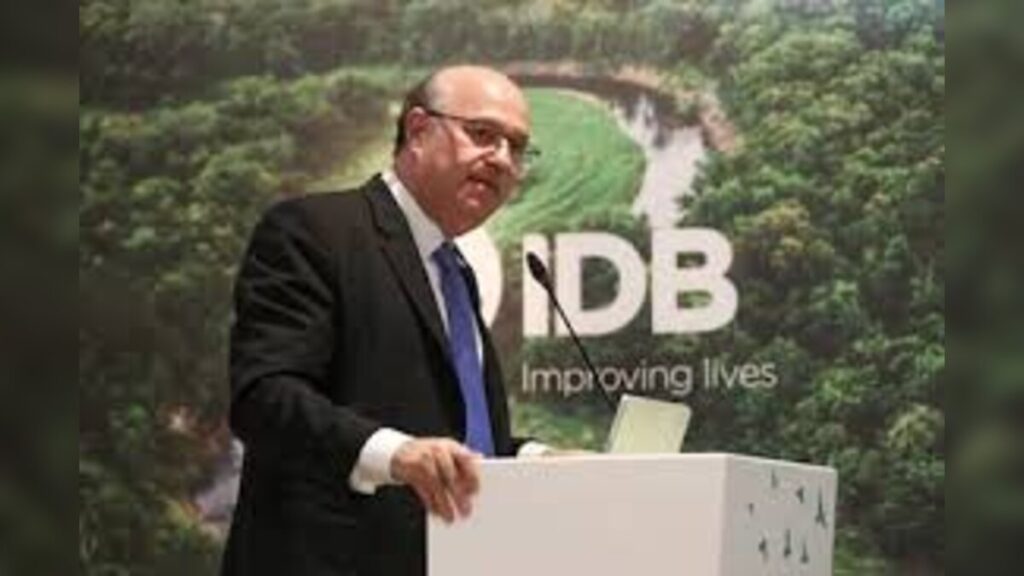
Few careers in global finance move across as many arenas as that of Ilan Goldfajn.
From academia to central banking, from private-sector economics to international development, his path has been less of a straight line and more of a long, deliberate migration across systems of influence.
Today, as president of the Inter-American Development Bank, a role he took in December 2022, Goldfajn talks less about titles and more about scale.
For him, scale means impact across 660 million people in Latin America and the Caribbean.
A life shaped by movement between countries and institutions
Goldfajn’s background is unusually international.
Born in Israel and raised in Brazil, he later built a career that constantly crossed boundaries—geographic, institutional, and intellectual.
He worked as an academic economist, later became chief economist at a major Brazilian bank, and then stepped into public service as president of the Central Bank of Brazil.
Each role exposed him to a different angle of economic reality: theory, markets, and national policy.
That constant rotation wasn’t accidental. It reflected a long-running search for where influence actually turns into improvement in people’s lives.
From central banking to a mission of broader impact
After years in both public and private finance, Goldfajn eventually joined the International Monetary Fund before being nominated by Brazil to lead the IDB.
That appointment shifted his focus entirely toward development economics at continental scale.
At the IDB, he now oversees not only sovereign lending but also private-sector operations through IDB Invest and innovation programs through IDB Lab.
The institution’s reach spans infrastructure, climate resilience, education, and social development projects across Latin America and the Caribbean.
Unlike commercial banks, the IDB is not driven by profit.
Its mandate is explicit: development first, returns second.
The philosophy behind “doing good at scale”
Goldfajn often returns to a simple idea—purpose.
In his view, careers in economics eventually converge on one question: where can your work matter most?
For him, the answer became development banking.
“You want to affect well-being,” he has said, framing his current role less as a job and more as a responsibility to millions of people rather than markets alone.
That mindset shapes how the IDB evaluates projects.




Infrastructure, social programs, and climate investments are measured not just in financial return but in long-term human outcomes.
Lessons from Israel, Brazil, and early experiences
One of the more personal influences on Goldfajn’s worldview comes from a teenage year spent on a kibbutz in Israel.
There, he saw early examples of agricultural innovation in water-scarce environments.
That experience stayed with him. It reinforced a belief that scarcity often drives innovation, and that technology developed in one region can transform another facing similar constraints.
He often points to parallels between Israel and Latin America—especially in agriculture, water management, and technology-driven development.
Building bridges across politics, finance, and technology
The IDB today operates as more than a lender.
It functions as a connector between governments, investors, and industries across multiple continents.
Its membership includes countries from the Americas, Europe, Asia, and the Middle East.
Goldfajn describes the institution as a “bridge”—linking capital, ideas, and policy across regions that don’t always naturally interact.
That role has become increasingly important as countries in Latin America deepen ties with partners like Israel in areas such as irrigation technology, cybersecurity, energy systems, and infrastructure financing.
Concrete development work on the ground
Behind the high-level diplomacy, the IDB’s work is intensely practical.
In recent years, it has financed tens of billions of dollars in projects across the region, supporting everything from hurricane recovery in the Caribbean to school feeding programs in Haiti.
Goldfajn has personally highlighted visits to schools and hospitals where IDB-backed projects directly affect daily life.
These moments, he suggests, are what give meaning to otherwise abstract financial figures.
The institution also invests in technical assistance and research, helping governments design policies and build institutional capacity—not just fund projects.
Impact and Consequences
The IDB’s expanded role under Goldfajn reflects a broader shift in global development finance.
Institutions are no longer just lenders; they are expected to be problem-solvers, knowledge producers, and diplomatic intermediaries.
For Latin America and the Caribbean, this means greater access to capital and technology, but also deeper exposure to global economic shifts.
Partnerships with countries like Israel bring innovation, but also require careful coordination across political and regulatory systems.
At the same time, the emphasis on measurable social impact raises expectations.
Governments and citizens increasingly expect visible improvements in infrastructure, education, and resilience—not just funding announcements.
What’s next for Goldfajn and the IDB?
Looking ahead, the focus appears to be on scaling investment while strengthening partnerships across regions.
Climate resilience, digital infrastructure, and food security are likely to remain central priorities.
The IDB is also expected to deepen its role as a platform connecting private investors with public development needs.
That includes expanding collaboration with technology-driven economies and emerging markets.
For Goldfajn personally, the mission remains consistent: expand impact without losing sight of the people behind the numbers.
Summary
Ilan Goldfajn’s leadership of the Inter-American Development Bank reflects a career built on movement between sectors and a consistent search for meaningful economic impact.
From central banking to global development, his focus has shifted from national systems to regional transformation across Latin America and the Caribbean.
The IDB under his leadership continues to blend finance, policy, and innovation in an effort to improve lives at scale.
Bulleted Takeaways
- Ilan Goldfajn leads the Inter-American Development Bank, focusing on development across Latin America and the Caribbean
- His career spans academia, private banking, central banking, and international finance
- The IDB finances infrastructure, education, climate resilience, and social development projects
- The institution operates on a non-profit mandate focused on social impact, not financial return
- Goldfajn emphasizes “scale” as improving outcomes for hundreds of millions of people
- Early experiences in Israel influenced his thinking on technology and resource management
- The IDB acts as a bridge between governments, investors, and global regions
- Partnerships with countries like Israel support innovation in water, energy, and cybersecurity
- Future priorities include climate resilience, digital infrastructure, and expanded global cooperation

