
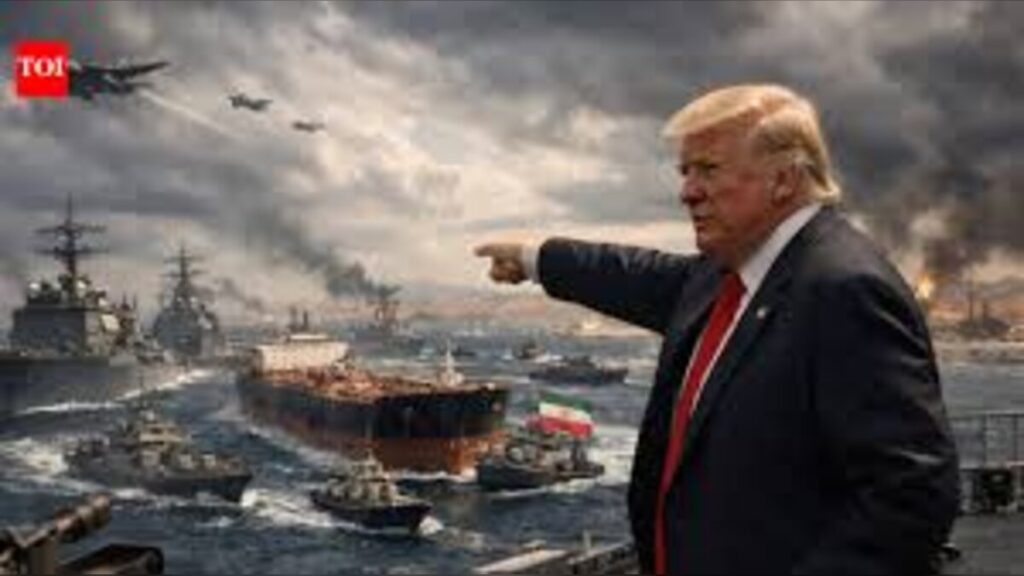
Donald Trump has stirred fresh global debate after suggesting that the ongoing Middle East conflict could be nearing its conclusion, even as military pressure intensifies around one of the world’s most sensitive waterways—the Strait of Hormuz.
Speaking publicly, Trump described the situation in unusually confident terms, saying he believes the war is “close to over,” despite the lack of any confirmed breakthrough in peace negotiations.
His comments arrive at a moment when tensions remain high, and diplomatic efforts are still struggling to produce a lasting agreement.
Washington Pushes Harder While Diplomacy Tries to Catch Up
Behind the scenes, the United States appears to be tightening its strategic pressure.
According to military officials, a blockade on Iranian maritime access has now been fully enforced, effectively restricting sea-based trade routes in and out of Iran.
A senior commander from United States Central Command stated that operations around the Strait of Hormuz have significantly disrupted shipping activity, marking one of the most aggressive enforcement actions in the region in recent months.
The Strait itself is a critical global energy corridor, meaning any disruption there sends immediate shockwaves through international oil markets and shipping costs.
Talks, Setbacks, and the Push for a “Grand Bargain”
While military pressure escalates, political negotiations are still ongoing—but uneven.
US officials, including Vice President JD Vance, have hinted at a broader diplomatic strategy aimed at securing what he called a “grand bargain” with Iran.
Rather than isolated agreements, the administration appears to be pursuing a sweeping deal covering security, nuclear concerns, and regional influence.
Vance claimed recent discussions made “significant progress,” though he acknowledged that earlier talks in Pakistan over the weekend failed to deliver concrete results.
Still, the messaging from Washington suggests patience is running thin, with a preference for a large-scale agreement rather than incremental compromises.
Mixed Signals From Allies and International Responses
Reactions from global actors remain divided and cautious.
The United Nations has stopped short of confirming progress, with Secretary-General António Guterres suggesting that renewed talks remain “highly likely,” but not guaranteed.




Meanwhile, regional players like Lebanon and Israel have described indirect discussions as “productive,” though both sides remain careful not to signal too much optimism.
Israel has indicated that recent diplomatic engagement suggests alignment among key stakeholders, while broader geopolitical trust remains fragile.
Trump Links War Timeline to Royal Visit and US-UK Relations
Adding a diplomatic twist, Trump also suggested the conflict could end before King Charles’ scheduled visit to the United States later this month.
The British monarch is expected to arrive on April 27 for a short state visit, and Trump described the timing as potentially significant if the situation stabilizes beforehand.
He also made pointed remarks about US-UK relations, criticising Prime Minister Sir Keir Starmer while claiming the alliance has “been better” in previous periods.
These comments highlight ongoing political tension layered on top of the already volatile international situation.
Economic Pressure at the Center of Strategy
A major factor shaping the current escalation is economic disruption.
The Strait of Hormuz is one of the busiest maritime chokepoints in the world, responsible for a large share of global oil transport.
By restricting access, the US is effectively applying pressure not just militarily, but economically—targeting Iran’s ability to conduct trade and maintain revenue flow through maritime routes.
Experts note that such blockades historically carry high risks, including potential retaliation, global price spikes, and unintended regional escalation.
Impact and Consequences
The current developments could reshape both regional stability and global markets.
If the blockade continues, energy prices may remain volatile, especially in countries heavily dependent on oil imports.
Diplomatically, Trump’s comments introduce uncertainty—especially since they suggest optimism while on-the-ground conditions remain tense.
This disconnect between political messaging and military reality can complicate negotiations further.
For Iran, restricted maritime access could significantly strain economic activity, potentially increasing internal pressure for a diplomatic resolution—or alternatively hardening its position.
What’s Next?
The coming weeks are expected to be critical.
If negotiations advance, the focus may shift toward a broader multi-issue agreement rather than isolated ceasefire terms.
At the same time, the US is likely to maintain or adjust its maritime restrictions depending on diplomatic progress.
Attention will also turn to upcoming international visits and meetings, which could serve as informal pressure points for accelerating talks.
Summary
Donald Trump has suggested the Middle East conflict may be nearing its end, even as the United States intensifies maritime pressure on Iran through a blockade of the Strait of Hormuz.
Diplomatic efforts continue behind the scenes, with calls for a broad “grand bargain,” but outcomes remain uncertain. The situation sits at a crossroads between escalation and potential resolution.
Bulleted Takeaways
- Trump says the Middle East war is “close to over” despite ongoing tensions
- US Central Command confirms full enforcement of blockade near Strait of Hormuz
- Maritime trade into and out of Iran has been heavily disrupted
- JD Vance pushes idea of a “grand bargain” with Iran in negotiations
- Earlier peace talks in Pakistan failed to produce a final agreement
- UN says renewed diplomatic talks are “highly likely” but not confirmed
- Regional discussions involving Israel and Lebanon described as “productive”
- Trump links potential war timeline to King Charles’ upcoming US visit
- Strait of Hormuz remains a critical global oil and shipping route
- Outcome remains uncertain as diplomacy and military pressure run in parallel

