
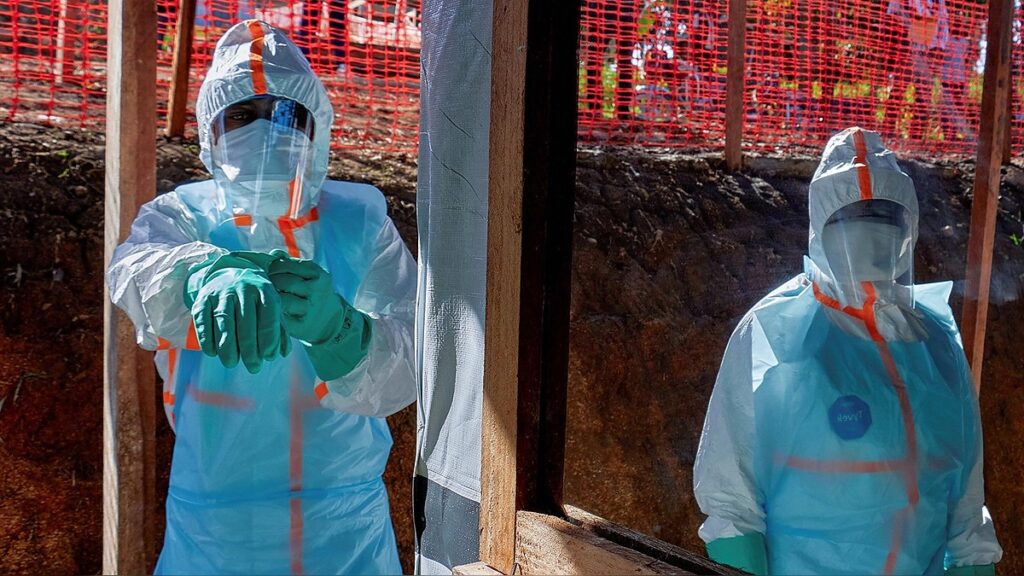
A race to contain a fast-moving Ebola outbreak in Central Africa has triggered urgent global scientific activity, with three separate vaccine candidates now under rapid development as health authorities warn the situation could escalate further.
The outbreak, driven by the Bundibugyo strain, has already resulted in more than 1,000 suspected cases and over 250 deaths, primarily across the Democratic Republic of the Congo and parts of Uganda.
Experts caution that the true scale may be significantly higher.
Health officials working with the World Health Organization have warned that the situation remains highly fluid, with international surveillance widened after isolated suspected cases were flagged in countries including Brazil, Italy and Austria—though all have tested negative so far.
Fears Grow as Bundibugyo Strain Shows High Fatality Potential
Unlike more commonly studied Ebola variants, the current outbreak involves the Bundibugyo strain, which is known to have a fatality rate of up to 50% and currently has no licensed vaccine.
This has raised alarm among epidemiologists who fear the outbreak could exceed the devastating 2014–2016 West Africa epidemic, which caused more than 11,000 deaths.
Humanitarian experts from Doctors Without Borders have described the situation as “deeply alarming,” warning that case numbers are rising faster than response systems can fully track.
Field reports from eastern Democratic Republic of the Congo show overwhelmed hospitals, strained burial teams, and increasing community resistance in some areas, complicating containment efforts.
Three Vaccine Programs Enter High-Speed Development
In response to the escalating crisis, three major vaccine initiatives are now underway, led by a combination of academic institutions, biotech firms, and global health partnerships.
Researchers at the University of Oxford are working on a candidate vaccine expected to enter human testing within two to three months, though widespread availability is not expected in the immediate future.
Meanwhile, the biotech company Moderna is applying its mRNA platform—previously used during the COVID-19 pandemic—to rapidly design a targeted Ebola vaccine.




A third approach is being developed by the International AIDS Vaccine Initiative, which is adapting an existing Ebola vaccine technology to address the Bundibugyo strain.
Dr Mark Feinberg of IAVI warned that the outbreak could become one of the most severe ever recorded, stressing that vaccine development is now a top global priority.
Scientific Race Against Time as Trials Remain Months Away
Despite rapid progress, researchers caution that all three vaccine candidates remain in early stages.
IAVI’s modified vaccine approach has shown promising results in animal studies, reportedly offering near-complete protection in primates, but experts estimate it could still take up to nine months before clinical trials are fully underway.
Oxford scientists similarly acknowledge that while development is accelerating, logistical and safety testing requirements will delay deployment in affected regions.
Dr Richard Hatchett of the Coalition for Epidemic Preparedness Innovations emphasized that every day is critical, noting that the absence of an approved vaccine makes rapid containment far more difficult.
WHO Warns True Scale May Be Larger Than Reported
Officials at the World Health Organization have raised concerns that current case counts may underestimate the real extent of transmission due to limited testing capacity and delayed reporting in remote regions.
WHO Director-General Dr Tedros Adhanom Ghebreyesus said early vaccine development could transform outbreak control efforts but warned that immediate containment measures remain essential.
He also urged countries to reconsider travel restrictions affecting Ebola-hit regions, arguing that such measures may discourage reporting and cooperation with health teams.
Ground Conditions in Congo Remain Volatile and Unpredictable
In the hardest-hit areas of the Democratic Republic of the Congo, medical teams report ongoing challenges including community resistance, attacks on health facilities, and disruptions to safe burial procedures.
Red Cross and emergency responders continue to carry out decontamination and recovery operations under protective protocols, as Ebola remains highly infectious even after death.
Authorities have imposed flight restrictions in and out of key outbreak zones, while neighbouring countries remain on alert for possible cross-border transmission.
Global Preparedness Under Scrutiny as Outbreak Spreads
Public health analysts warn that the outbreak is testing global readiness for highly lethal infectious diseases, especially in regions with limited healthcare infrastructure.
Some experts argue that international systems remain underfunded and reactive rather than proactive, increasing the risk of wider spread before vaccines become available.
At the same time, health authorities continue to emphasize that Ebola is only contagious once symptoms appear, with a 21-day incubation period providing a critical window for contact tracing and isolation.
Outlook: Containment Possible, but Urgency Intensifies
While officials in the Democratic Republic of the Congo estimate that containment could be achieved within four to six months under optimal conditions, scientists caution that such projections depend heavily on rapid vaccine deployment, community cooperation, and sustained international support.
For now, the global health community remains in a high-stakes race: slow enough progress in vaccine development could allow the outbreak to expand further, while accelerated success could mark a turning point in preventing one of the most serious Ebola crises in recent years.
