
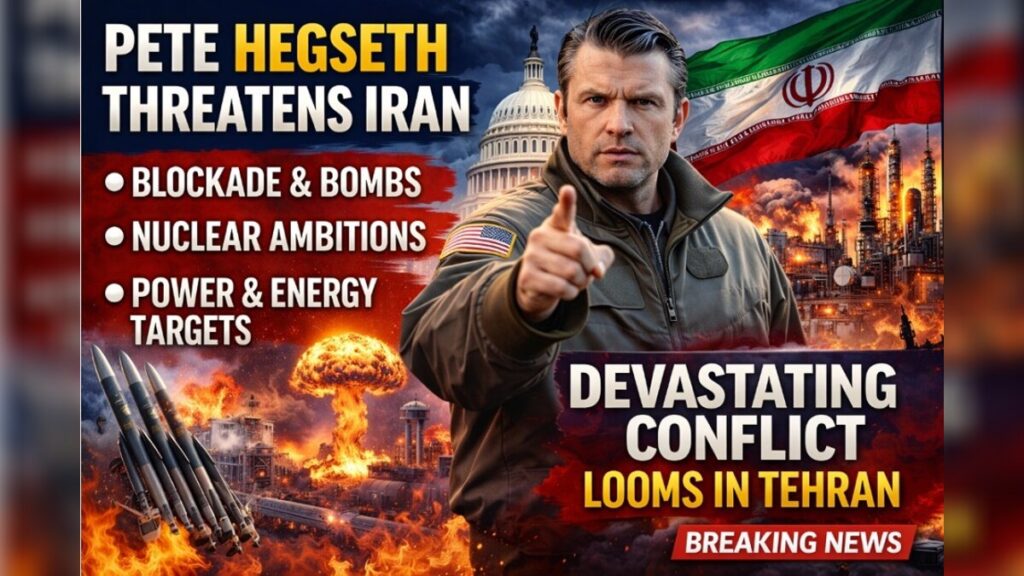
The United States is using the current pause in combat with Iran to send a hard-edged message: use the ceasefire to reach a deal, or face more military and economic pressure.
During a Pentagon briefing, Secretary of War Pete Hegseth said Washington wants the new Iranian leadership to negotiate in good faith, but also made clear that the U.S. is prepared to keep tightening pressure if Tehran refuses.
Hegseth Tells Iran to Choose Between a Deal and More Force
Hegseth said Iran now faces a clear choice. On one side, he described the possibility of a diplomatic agreement that could open what President Donald Trump has called a “golden age” for the Middle East.
On the other, he warned that refusing to cooperate would bring continued blockade pressure and the prospect of additional military action. He repeated the administration’s position that Iran will not be allowed to obtain a nuclear weapon under any circumstances.
U.S. Says It Is Closely Tracking Iran’s Military Movements
In some of the sharpest remarks of the briefing, Hegseth said the U.S. is watching Iran’s military leadership closely and knows what assets are being moved and where they are going.
He argued that Iran’s forces are in a weakened state and no longer have the means to rebuild quickly, saying U.S. operations had already destroyed the country’s military industrial base.
According to his account, Iran may still be shifting launchers and missiles around, but it no longer has the capacity to meaningfully reconstitute its offensive or defensive strength.
Washington Says the Blockade Is Working
A major focus of the briefing was the U.S. naval blockade now being enforced against shipping linked to Iranian ports.
The administration said the blockade applies to ships entering or leaving Iranian ports, regardless of nationality, but stressed that it is not a blockade of the Strait of Hormuz itself.
Instead, enforcement is aimed at Iran’s coastline and port access, including operations in Iranian territorial seas and in international waters.
U.S. Military Expands Focus to “Dark Fleet” Shipping
Air Force Gen. Dan Caine, chairman of the Joint Chiefs of Staff, said the U.S. is also tracking so-called “dark fleet” vessels, including ships that left Iran before the blockade began but are still believed to be supporting Tehran through oil transport or other material assistance.
He described those vessels as ships using illicit methods to avoid international rules, sanctions, or insurance obligations.



The broader message was that the U.S. blockade extends beyond visible shipping lanes and includes vessels attempting to operate in the shadows.
More Than 10,000 U.S. Personnel Involved in Mission
Caine said the blockade operation is being carried out by a large force that includes more than 10,000 sailors, Marines and airmen, backed by over a dozen ships and dozens of aircraft.
He said the mission has so far succeeded without requiring aggressive escalation, with ships choosing to turn away rather than challenge U.S. forces directly.
That, he said, has allowed the blockade to be enforced without having to board vessels up to this point.
U.S. Says 13 Ships Have Already Turned Around
According to Caine, 13 ships have already reversed course rather than continue toward Iranian ports under blockade conditions.
He said that if a vessel refuses U.S. instructions in the future, American forces are prepared to use preplanned tactics that could escalate from warnings to boarding and seizure.
As of the morning of the briefing, however, he said CENTCOM had not yet needed to board any ship.
Troops Use Ceasefire to Rearm and Adjust Tactics
CENTCOM commander Adm. Bradley Cooper, who recently returned from two separate trips to the Middle East, said U.S. forces are using the ceasefire period to strengthen readiness.
He said troops are rearming, refining tactics and adjusting procedures while maintaining a high level of motivation and vigilance.
Cooper said he visited personnel across 70 locations, including air crews, drone teams, cyber and Space Force specialists, missile defenders and logistics units, and came away convinced that U.S. forces remain fully prepared for whatever comes next.
Impact and Consequences
The combined military and diplomatic message raises the stakes for Iran during the ceasefire. Washington is trying to use the pause not just to avoid immediate conflict, but to force a strategic decision from Tehran under pressure.
The blockade is now central to that pressure campaign, and if it continues to disrupt shipping without major resistance, the U.S. may view it as an increasingly effective leverage tool.
At the same time, the threats of renewed bombing and ship seizures show how quickly the situation could escalate if negotiations fail.
What’s next?
The next phase will depend largely on whether Iran moves toward a negotiated agreement or resists the terms being pushed by Washington.
In the meantime, the blockade is expected to remain in place, and U.S. forces appear set to continue enforcing it while using the ceasefire to rebuild stocks and sharpen operational plans.
If any vessel attempts to defy the blockade, that could become the first real test of how far the U.S. is willing to go in enforcing its warnings.
Summary
The U.S. says the two-week ceasefire with Iran is a chance for diplomacy, but officials are pairing that message with unmistakable military pressure.
Secretary Pete Hegseth warned that Iran must choose between a deal and harsher consequences, while Gen. Dan Caine said the blockade of Iranian ports is working and has already turned back 13 ships.
With thousands of U.S. personnel involved and troops using the pause to rearm and adapt, Washington is signaling that the ceasefire is not a retreat, but a moment to tighten leverage.
Bulleted Takeaways:
- The U.S. says the ceasefire with Iran should be used to pursue a deal.
- Pete Hegseth warned Tehran that rejecting diplomacy could lead to more bombs and a continued blockade.
- He also said Iran will never be allowed to obtain a nuclear weapon.
- U.S. officials say the naval blockade applies to ships entering or leaving Iranian ports.
- Gen. Dan Caine said the U.S. is also tracking “dark fleet” vessels tied to Iran.
- More than 10,000 U.S. personnel, over a dozen ships and dozens of aircraft are involved in the mission.
- The Pentagon says 13 ships have already turned around rather than test the blockade.
- U.S. troops are using the ceasefire period to rearm, adjust tactics and prepare for further developments.
