
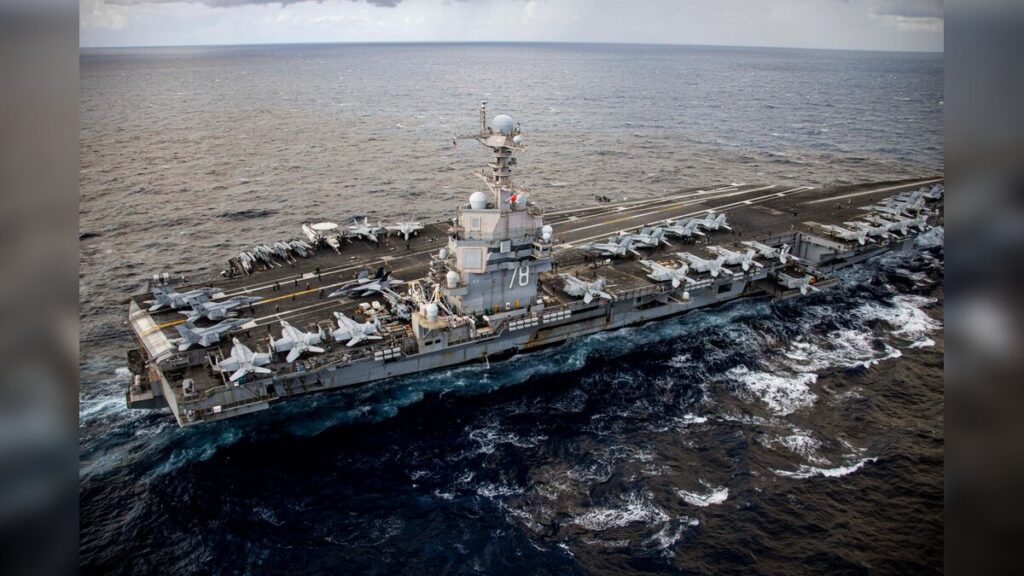
The U.S. Navy’s newest and most advanced aircraft carrier, USS Gerald R. Ford (CVN-78), has officially moved into the Red Sea, marking a significant repositioning of American naval power in the region.
Two U.S. defense officials confirmed the development, noting that the carrier recently exited the Eastern Mediterranean and entered a new phase of its deployment under U.S. Central Command.
Transit Through Strategic Waters
The carrier’s journey into the Red Sea followed a passage through the Suez Canal, one of the world’s most critical maritime chokepoints.
Accompanying the Ford were two guided-missile destroyers: USS Mahan (DDG-72) and USS Winston S. Churchill (DDG-81).
This coordinated movement highlights a broader naval operation, with multiple vessels shifting into position to reinforce U.S. presence in the Middle East.
Recent Repairs and Return to Deployment
Before heading south, the Ford had made a stop in Split, Croatia, earlier in April. The visit came after the ship experienced a fire in a laundry area in March while already deployed.
Following repairs, the carrier resumed operations and has now rejoined active duty at sea, continuing what has become a historically long deployment.
Record-Breaking Deployment Duration
The Ford has now surpassed post-Cold War deployment records, remaining at sea for 297 days as of mid-April.
Navy officials have indicated the deployment could stretch to nearly 11 months, underscoring the sustained demand for U.S. naval presence in key global regions.




Growing U.S. Naval Presence in the Region
The Ford is not operating alone. It joins the USS Abraham Lincoln (CVN-72) Carrier Strike Group, which has been active in the Middle East since January.
Also deployed is the USS Tripoli (LHA-7) Amphibious Ready Group, alongside USS New Orleans (LPD-18) and USS Rushmore (LSD-47).
These vessels are currently operating in the Arabian Sea with Marines embarked, forming a powerful expeditionary force.
Another Carrier Group on the Way
Adding to the buildup, a third carrier strike group led by USS George H. W. Bush (CVN-77) is en route to the region.
The carrier is currently sailing around the southern tip of Africa and is expected to join U.S. Central Command operations soon.
This will bring an unusually high concentration of U.S. naval assets into the Middle East, reflecting heightened strategic priorities.
Impact and Consequences
The arrival of the Ford in the Red Sea significantly strengthens U.S. military presence in a region already marked by geopolitical tension and critical shipping routes.
With multiple carrier groups and amphibious forces now either deployed or en route, the U.S. is signaling its readiness to respond to potential threats, safeguard maritime trade, and support regional stability.
However, such a buildup may also raise tensions, as increased military activity often draws attention from rival powers and regional actors.
What’s Next?
As the Ford continues operations under U.S. Central Command, attention will turn to how long the carrier remains deployed and what specific missions it undertakes.
The anticipated arrival of the USS George H. W. Bush strike group could further reshape the naval balance in the region, potentially leading to coordinated multi-carrier operations.
Military analysts will also be watching for any changes in posture, exercises, or responses tied to evolving developments in the Middle East.
Summary
The USS Gerald R. Ford has entered the Red Sea after transiting from the Mediterranean, joining a growing concentration of U.S. naval forces in the Middle East.
With additional carrier groups already deployed and another on the way, the move underscores a major show of force and long-term strategic commitment by the United States.
Bulleted Takeaways
- USS Gerald R. Ford has moved from the Mediterranean into the Red Sea
- The carrier transited the Suez Canal alongside two U.S. destroyers
- It recently resumed operations after repairs in Croatia following a fire
- The deployment has reached a record 297 days and could extend to 11 months
- It joins USS Abraham Lincoln and USS Tripoli-led forces already in the region
- USS George H. W. Bush carrier group is also heading toward the Middle East
- The buildup reflects increased U.S. military focus on regional security and stability
