
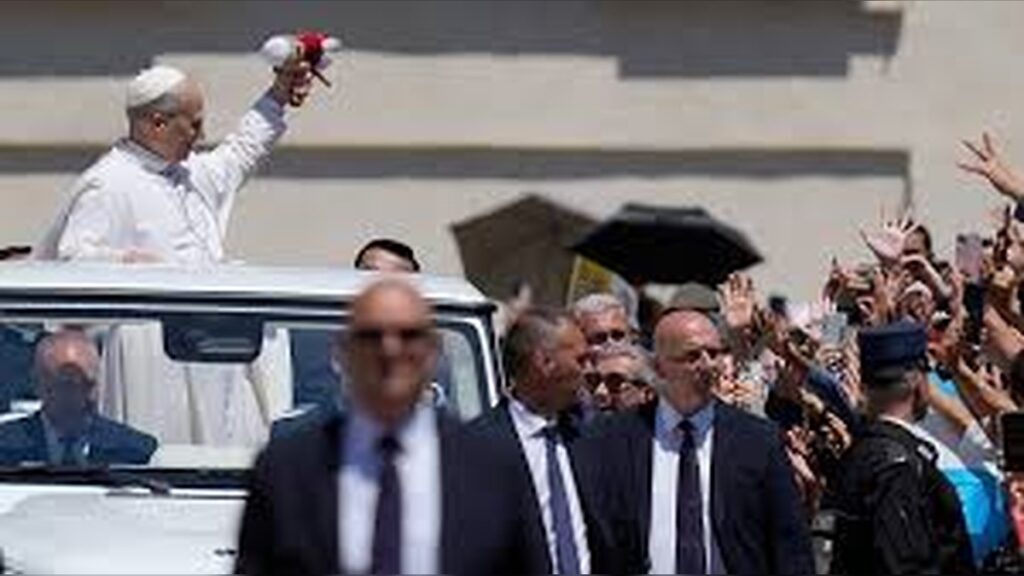
Pope Leo XIV is set to begin a major seven-day visit to Spain on Saturday, with his itinerary centering on immigration, social justice, and reconciliation at a time of heightened political tension under Prime Minister Pedro Sánchez.
The trip comes as Spain faces deep divisions over migration policy, corruption scandals in government circles, and growing pressure from opposition forces challenging the current administration’s direction.
Royal Welcome Opens the Visit in Madrid
The Pope’s arrival will be marked by an official reception at the Royal Palace in Madrid, hosted by King Felipe VI and Queen Letizia of Spain.
The ceremony is expected to set a formal tone for the visit, underscoring the Vatican’s continued diplomatic engagement with Spain, one of Europe’s historically Catholic nations.
Massive Gatherings Planned at Bernabéu and City Centre
Later on Saturday, a large prayer vigil is scheduled near the Santiago Bernabéu Stadium, where organizers anticipate up to 400,000 attendees.
On Sunday, the scale is expected to increase significantly, with authorities preparing for around one million people to gather in Madrid’s city centre for a public Mass.
The events are among the largest public religious gatherings Spain has seen in recent years, reflecting both the Pope’s global influence and continued interest in Catholic traditions despite declining church attendance in the country.
Parliament Address and Landmark Blessing in Barcelona
During the visit, Pope Leo XIV will also address Spain’s parliament, a politically sensitive engagement expected to touch on social inequality, migration, and national unity.
In Barcelona, he will bless the newly completed tower of the Sagrada Familia Basilica, which now holds the distinction of being the tallest church structure in the world.
The symbolic act links the Pope’s visit to one of Spain’s most iconic architectural and religious landmarks.



Meeting Victims of Clergy Sexual Abuse
The Vatican confirmed that the Pope will meet victims of sexual abuse committed by Catholic clergy during his time in Spain.
According to a 2023 report by Spain’s national ombudsman, an estimated 200,000 minors may have suffered abuse since 1940.
In March, the Spanish government under Sánchez and the Catholic Church reached an agreement to establish compensation mechanisms for survivors, following years of criticism over institutional silence and delays.
Canary Islands: Migration and Memorials at Europe’s Edge
Before arriving on the mainland, the Pope will travel to the Canary Islands on Thursday and Friday, where he is expected to meet migrants and organizations supporting them.
He will also join Prime Minister Sánchez in honoring thousands of people who have died attempting the dangerous sea crossing from Africa to Europe.
The Canary Islands have become the primary entry point for irregular migration into Spain, often involving perilous journeys across the Atlantic.
The International Organization for Migration estimates that 1,172 migrants died or went missing on the route in 2025, only slightly below the 1,215 recorded the previous year.
Political Pressure and a Divided Spain
Spain’s relatively open migration stance under Sánchez contrasts with hardline opposition from the conservative Popular Party and the far-right Vox movement, which campaigns under the slogan of defending “Spain, the family and life.”
At the same time, Sánchez is facing mounting domestic pressure due to corruption allegations involving figures close to him, including relatives and former senior officials.
The cases have added political strain despite his repeated refusal to resign.
He continues to insist that his minority coalition will complete its mandate through the next scheduled elections in 2027.
Security, Media Attention, and a Highly Charged Visit
Officials describe Spain as a “polarised country” during the Pope’s visit, with concerns that different political actors may attempt to shape or exploit the narrative surrounding the trip.
Around 15,000 members of Spain’s National Police and Guardia Civil are being deployed, alongside local forces, to secure events across multiple cities.
More than 4,000 journalists from 80 countries have also been accredited, highlighting the global attention focused on the visit.
First EU Trip Outside Italy and a Symbolic Moment for the Papacy
This marks Pope Leo XIV’s first visit to a European Union country outside Italy and the first papal state visit to Spain since Pope Benedict XVI’s trip in 2010.
His predecessor, Pope Francis, largely bypassed many of Europe’s traditional Catholic strongholds, including Spain, where religious participation has continued to decline sharply in recent decades.

