
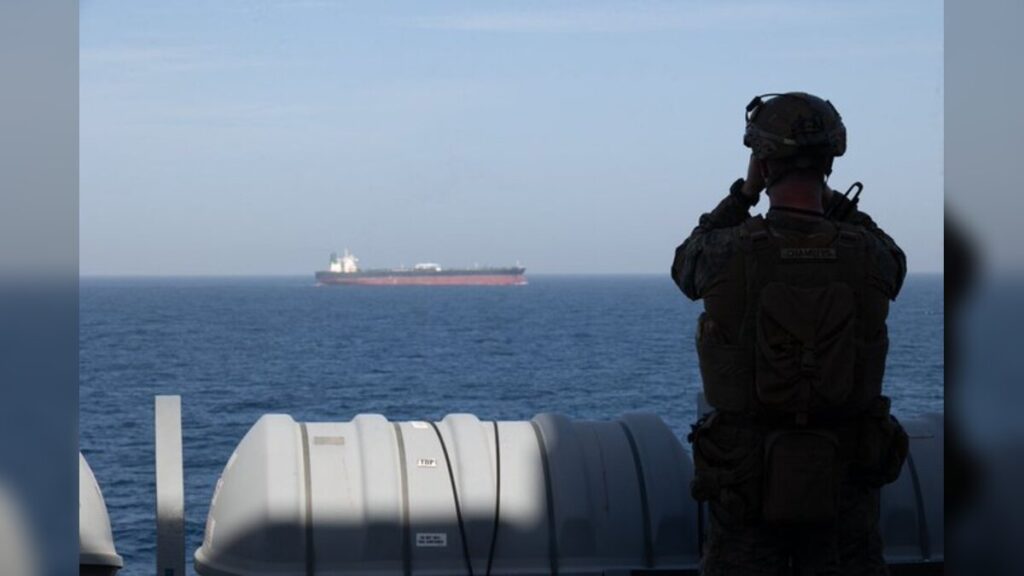
Tensions in the Gulf escalated sharply again after Iran moved to shut the Strait of Hormuz once more and warned vessels not to approach the waterway while the U.S. blockade of Iranian ports remains in force.
The renewed closure was followed by reports of gunfire involving merchant ships, raising fears of a deeper energy shock and another dangerous turn in the widening regional confrontation.
Tehran Says Passage Will Stay Restricted Until U.S. Blockade Ends
Iran’s Revolutionary Guard navy said the strategic waterway would remain closed until Washington lifts its blockade.
The warning went even further, saying vessels should not leave anchorage in the Persian Gulf or the Sea of Oman and that any attempt to move toward the strait could be treated as cooperation with the enemy.
Iranian state media later confirmed that traffic through the strait was again under strict military control and that any passage now requires Tehran’s approval.
Gunfire Reported as Ships Tried to Cross
The latest flare-up was accompanied by reports of direct attacks on vessels.
The British military’s United Kingdom Maritime Trade Operations center said a tanker was approached by two Revolutionary Guard gunboats around 20 nautical miles northeast of Oman and came under fire.
A separate report said an unknown projectile struck a container ship, damaging some containers. Maritime sources also suggested that at least two ships were targeted after trying to cross the strait following Iran’s renewed closure order.
India Reacts After Its Ships Are Drawn Into Incident
India’s foreign ministry summoned Iran’s ambassador after two India-flagged merchant ships were caught up in the incident.
New Delhi described the matter as serious and deeply concerning, especially since Iran had earlier allowed some India-bound vessels to pass safely. India urged Tehran to quickly resume the process of facilitating ships heading toward Indian destinations through the strait.
Temporary Ceasefire Hangs Over a Region Still on Edge
The escalation comes with a fragile ceasefire still in place but only temporarily.
The truce is due to expire by Wednesday, adding fresh uncertainty to an already unstable moment. Iran has said it received new proposals from the United States, while Pakistani mediators are reportedly trying to arrange another round of direct negotiations.
Even so, events in the strait suggest the military confrontation remains very much alive despite diplomatic contacts continuing in the background.
Strait Remains a Global Pressure Point
The waterway is one of the world’s most important shipping lanes, with roughly one-fifth of global oil and gas normally passing through it.




Any serious disruption there immediately raises the risk of higher energy prices, shipping delays and broader global economic fallout.
The latest exchange has therefore alarmed not just the countries involved directly, but governments and markets far beyond the region.
U.S. and Iran Continue Trading Warnings
President Donald Trump accused Iran of trying to blackmail Washington through the fate of the strait and said Tehran would not be allowed to do so.
At the same time, Iran’s top national security body said it was reviewing new American proposals but insisted its negotiators would not compromise under pressure.
The result is a familiar pattern: public threats, military pressure and diplomacy all unfolding at once.
U.S. Blockade Enforcement Appears to Be Expanding
The pressure campaign from Washington also appears to be growing.
According to the report, more than 10,000 U.S. personnel are involved in enforcing the blockade of Iranian ports, and preparations are underway for possible boarding operations against Iran-linked commercial vessels in international waters.
U.S. Central Command is said to have reported that 23 ships have already turned back after leaving Iranian ports.
Lebanon Front Adds to the Wider Regional Instability
The Gulf crisis is unfolding alongside continued tension on the Lebanon front.
The same report says a French peacekeeper was killed and others wounded in southern Lebanon, while accusations and denials continue over who was responsible.
Israel also said it had established a “Yellow Line” in southern Lebanon and claimed to have struck what it described as a militant cell near its troops.
These parallel developments show that the Hormuz crisis is not isolated, but part of a wider and increasingly unstable regional picture.
Impact and Consequences
The reclosure of the Strait of Hormuz and reported attacks on merchant ships could have immediate consequences for global shipping, oil markets and diplomatic stability.
Any prolonged disruption risks driving up energy costs and increasing insurance and security pressure on commercial traffic.
It also pushes the U.S. and Iran closer to direct confrontation at a moment when a ceasefire is already fragile and regional battle lines remain active elsewhere.
What’s next?
The next major question is whether the ceasefire survives long enough for negotiations to resume in a meaningful way.
Attention will also be on whether Iran continues firing on ships that try to pass, whether Washington escalates blockade enforcement through boardings or seizures, and whether outside powers such as India and Pakistan can help prevent the maritime crisis from spiraling into a broader conflict.
Summary
The Strait of Hormuz crisis has worsened after Iran reimposed its closure of the key waterway and ships attempting to pass reportedly came under fire.
Tehran says the strait will remain under strict military control until the U.S. ends its blockade of Iranian ports, while Washington continues to press ahead with enforcement.
With India protesting after its vessels were targeted and a ceasefire deadline approaching, the standoff is now threatening both regional stability and the global energy supply.
Bulleted Takeaways:
- Iran has reclosed the Strait of Hormuz and warned ships not to approach it.
- Tehran says the waterway will remain restricted until the U.S. lifts its blockade of Iranian ports.
- British maritime authorities reported gunfire involving a tanker and damage to a container vessel.
- India summoned Iran’s ambassador after two India-flagged ships were involved in the incident.
- Roughly one-fifth of global oil and gas normally passes through the strait.
- A fragile ceasefire is due to expire by Wednesday.
- Iran says it is reviewing new U.S. proposals while Pakistani mediators seek fresh talks.
- The U.S. is reportedly preparing to board Iran-linked vessels as blockade enforcement intensifies.
