
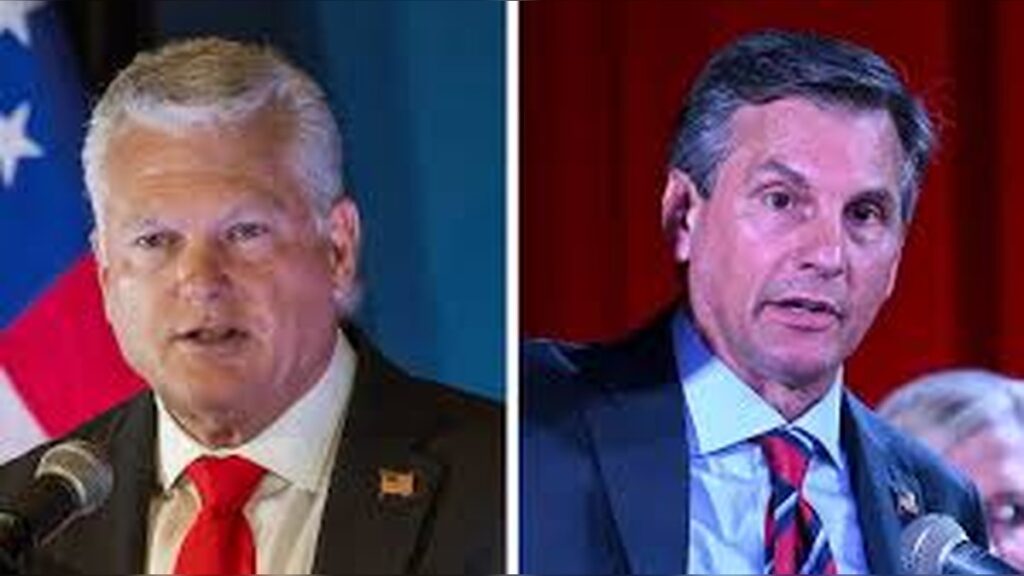
U.S. President Donald Trump has formally endorsed Representative Mike Collins in Georgia’s closely watched Republican Senate runoff, injecting fresh momentum into a race that will help decide the party’s nominee for the 2026 U.S. Senate election.
The endorsement was made public on Saturday evening through Trump’s Truth Social platform, where he described Collins as a long-time political ally and a strong supporter of his agenda.
The move arrives just days before voters in the state decide between Collins and his rival in a contest that has drawn national attention.
Runoff Set After Competitive Primary in Georgia
The Republican field initially featured multiple contenders in the May 19 primary in the state of Georgia, where no candidate cleared the majority threshold required to win outright.
Collins led the pack with roughly 40.5% of the vote, followed by former University of Tennessee head football coach Derek Dooley at about 30.2%. U.S. Representative Buddy Carter trailed with approximately 25.1%, ultimately forcing a runoff between Collins and Dooley.
The winner of the runoff will go on to challenge Democratic Senator Jon Ossoff in the November general election.
Trump’s Endorsement and Political Messaging
Trump’s endorsement message emphasized Collins’ loyalty and political alignment with his broader movement, portraying him as a “fighter” and “warrior” who has consistently supported his policy agenda.
He also contrasted Collins with Dooley, questioning the former coach’s political background and familiarity with the state, while highlighting Collins’ established presence in Congress and alignment with Republican priorities.




The endorsement is widely viewed as a significant boost for Collins, particularly given Trump’s continued influence over Republican primary voters.
Candidates Compete for Late Momentum Ahead of Voting
Collins, a former trucking executive and two-term congressman first elected in 2022, has built his campaign around strong alignment with Trump-era policies, especially on immigration and border security.
His campaign has also incorporated advisers with experience in Trump-aligned political operations.
Dooley, by contrast, has positioned himself as a political outsider, emphasizing a fresh approach to governance.
He has received backing from Georgia Governor Brian Kemp, adding establishment Republican support to his candidacy despite his lack of prior elected office experience.
Early voting has already taken place in parts of the state, and recent polling has shown Collins with an advantage, ranging from narrow leads to double-digit margins depending on the survey.
Senate Control in the Broader National Spotlight
The Georgia Senate race is expected to be one of the most closely watched contests heading into the 2026 general election, with control of the U.S. Senate potentially hanging in the balance.
Analysts currently classify the matchup between the eventual Republican nominee and Ossoff as highly competitive, with forecasts ranging from toss-up to slight Democratic lean.
The runoff outcome will determine whether Republicans can unify behind a single candidate early enough to mount a strong challenge in November, or whether the race remains tightly contested through the general election cycle.
Parallel Political Battle in Georgia’s Gubernatorial Race
Alongside the Senate contest, Trump has also weighed in on Georgia’s gubernatorial primary dynamics, endorsing Lieutenant Governor Burt Jones.
Jones has advanced to a Republican runoff against businessman Rick Jackson, adding another layer of intra-party competition in a state that remains a key political battleground heading into the 2026 election cycle.

