
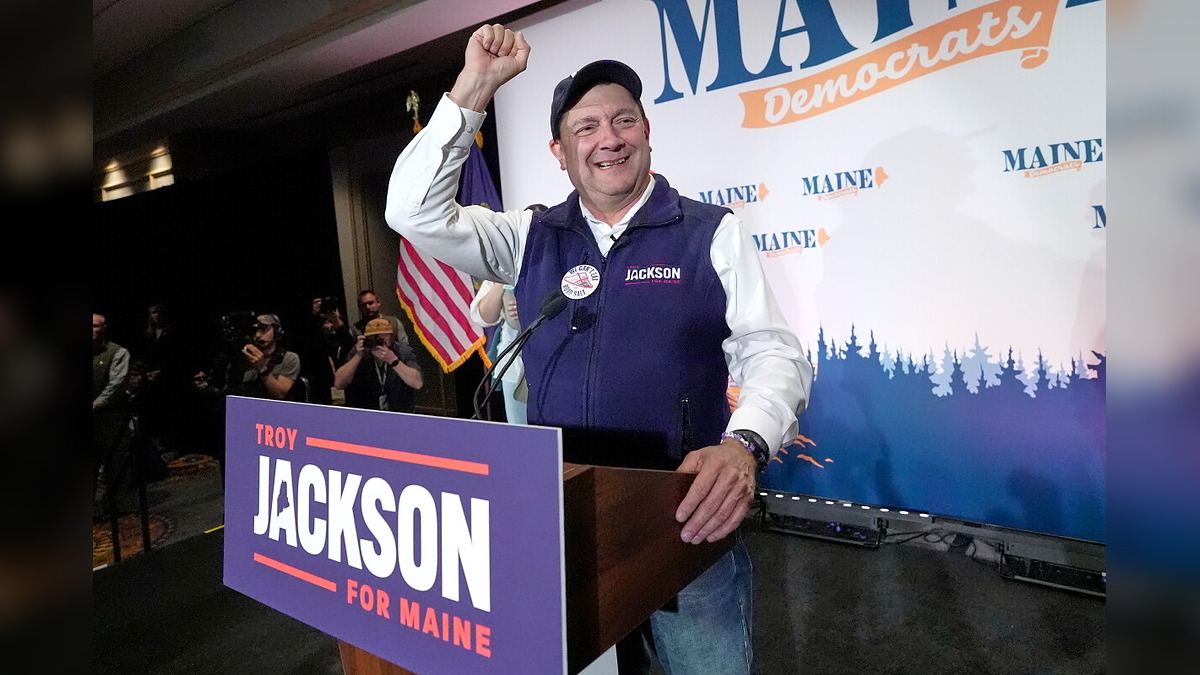
Democrat Troy Jackson has defeated Republican Senator Susan Collins in Maine, bringing an end to her nearly 30-year career in the US Senate and ending her position as the longest-serving active Republican woman in the chamber.
CNN and NBC projected Jackson as the winner shortly before midnight. According to Associated Press figures, he held 52 per cent of the vote against Collins’s 47 per cent, with 67 per cent of ballots counted.
Collins, who has represented Maine since 1997, conceded the contest shortly after the race was called, speaking directly with Jackson.
In a statement, she described serving Maine in the Senate as the greatest honour of her life, adding that she was proud of her achievements for the state and the country over the past 30 years.
Democrats Secure Another Republican-Held Senate Seat
Jackson’s victory handed Democrats another seat previously held by Republicans, strengthening their position in the Senate amid a series of election defeats for the GOP.
Democrats entered election night needing a net gain of four seats to take control of the chamber.
Republicans had previously held a 53–47 majority, with Vice President JD Vance responsible for breaking any 50–50 tie.
The Democratic victories included North Carolina, South Carolina, Maine, Kansas, Iowa and Texas, giving the party at least 53 Senate seats.
The results represent another major setback for Republicans in an election widely viewed as a referendum on President Donald Trump and his administration.
Collins Was Maine’s Only Republican Senator Facing Voters
Collins was the only Republican senator seeking re-election in 2026 in Maine, a state carried by former Vice President Kamala Harris in the 2024 presidential election.
Her defeat ended a political career spanning almost three decades and denied her the opportunity to become the longest-serving senator in Maine’s history.
She had previously won every Democratic challenge since 1996 and entered the latest contest with a considerable advantage in name recognition and experience.
Jackson Entered the Race After Platner’s Withdrawal
Jackson’s campaign took an unexpected direction after Graham Platner, who won 72 per cent of the vote in the June Democratic primary, withdrew in July following sexual assault allegations that he denied.
Democratic delegates selected Jackson at a party convention in Bangor on July 25 to replace Platner, leaving him with just 101 days to challenge Collins.
Jackson, a logger and local lawmaker from northern Maine, had himself recently lost the Democratic primary for governor to Hannah Pingree before being chosen as the party’s Senate candidate.
During the campaign, he criticised Collins over her relationship with Trump, portraying her as an enabler of the Republican president.




Jackson’s Family Relationship Became Campaign Controversy
The Democratic candidate also faced scrutiny over his relationship with his longtime partner, Lana Pelletier, who is the mother of his two children.
Reports revealed that the couple are second cousins by blood and share the same great-grandparents.
Both Jackson and Pelletier come from rural communities in northern Maine, where residents of sparsely populated towns often share family names.
The revelation became a subject of controversy during the campaign and featured in political attacks against Jackson.
Republican Groups Spent Millions Defending Collins
Republican-aligned political organisations invested heavily in Collins’s re-election campaign, with a network of super PACs and nonprofit groups booking approximately $126 million in advertising.
Despite the spending, Collins was unable to retain her seat.
Jackson raised $26.9 million in just under three months, while Collins collected $22.5 million across the full election cycle, according to federal campaign finance filings covering contributions through October 14.
The final days of the contest also featured attacks from Republican groups.
One super PAC aired a radio advertisement featuring a jingle that described Jackson as a ‘freak’ and a ‘creep’. Collins publicly said the advertisement should be withdrawn.
Trump Had Previously Criticised Collins
Collins had repeatedly disagreed with Trump on major decisions during his second term in office.
She opposed the confirmation of Pete Hegseth as defence secretary and voted against the final passage of Trump’s One Big Beautiful Bill.
In January, Trump publicly criticised the senator, writing that she ‘should never be elected to office again’ after she supported a measure to rein in his military powers following the US operation in Venezuela.
Her disagreements with the president became another issue surrounding her re-election campaign.
Voters Were Divided Ahead of Election Day
In the week before the election, several Maine voters told the Daily Mail they intended to support Collins, citing their limited familiarity with Jackson.
Collins also highlighted her position as chair of the Senate Appropriations Committee, arguing that her influence in Washington helped secure federal funding for Maine.
A Washington Post-Schar School poll found that voters gave her a 24-point advantage over Jackson on the question of bringing federal money into the state.
However, final polling suggested the contest was closely contested.
Marist placed Jackson ahead by 49 per cent to 47 per cent among likely voters, while CNN’s polling showed him leading 49 per cent to 45 per cent.
Trafalgar gave Collins a narrow advantage of 47 per cent to 46.5 per cent.
The figures indicated a competitive race, with both candidates within or close to the polls’ margins of error.
Trump’s Approval Ratings Featured in Maine Election
Collins had previously overcome unfavourable polling during her 2020 re-election campaign, when she trailed for much of the race before defeating her opponent by more than eight percentage points.
However, polling during the 2026 campaign showed considerable dissatisfaction with Trump’s performance in Maine.
A Marist survey found that 58 per cent of likely voters disapproved of the president’s job performance, compared with 41 per cent who approved.
The same survey found that 41 per cent of likely voters said their decision at the ballot box was a vote against Trump.
