
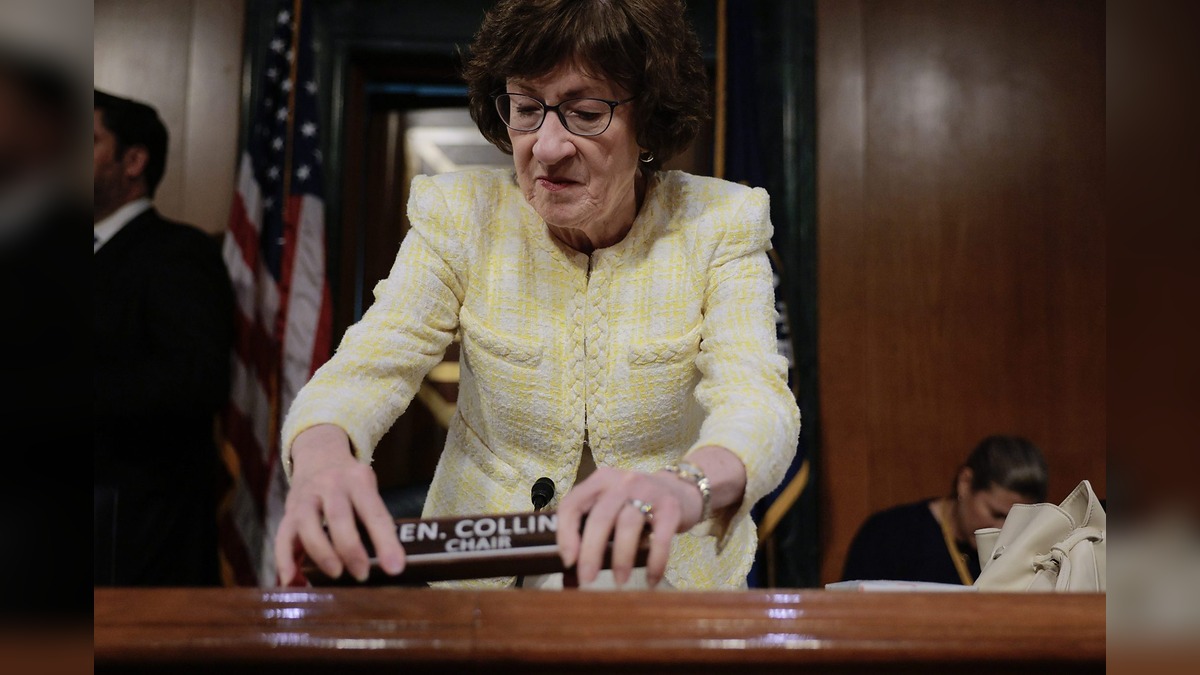
Republican Senator Susan Collins has conceded defeat to Democrat Troy Jackson in Maine’s Senate election, bringing her 30-year career in the upper chamber to an end and potentially leaving New England without a Republican representative in Congress for the first time since the Republican Party was established.
Collins contacted Jackson shortly after midnight on Wednesday to congratulate him on his victory.
In a statement issued from Bangor, she described her time representing Maine in the Senate as the greatest honour of her life and confirmed that she had offered to work with her staff to ensure a smooth transition.
NBC News projected Jackson as the winner, although the Associated Press had not officially called the race as of 1 a.m. Eastern Time.
Addressing supporters in Portland, Jackson acknowledged Collins’ years of public service, saying he had thanked her and wished her and her family well.
His victory also makes him the first Democrat to win a Senate election in Maine since 1988.
Maine Congressional Race Could Determine Historic Republican Shutout
Despite Collins’ defeat, the possibility of New England losing all Republican representation in Congress depends on the outcome of another closely contested Maine election.
In the state’s 2nd Congressional District, former Republican Governor Paul LePage is competing against Democrat Matt Dunlap for the seat being vacated by retiring Representative Jared Golden.
The Associated Press had not declared a winner in that contest either.
A Dunlap victory would mean New England could enter the next Congress without a single Republican in either the House or Senate.
The development would mark a major change from the Republican Party’s early presence in the region.
Following its establishment in 1854, Republicans controlled 38 of New England’s 41 congressional seats.
Their representation subsequently declined over the decades.
New Hampshire also maintained a Republican presence in its congressional delegation for 81 consecutive Congresses before that streak ended in 2017.
The party’s decline across New England has been particularly evident in recent years.
By 2018, Republicans had lost their remaining House seats in the region after Jared Golden defeated the last Republican representative.
Collins subsequently became the only Republican from New England serving in either chamber of Congress.
Although she will remain in office until January, the region could lose its final Republican congressional representative when the new Congress begins its term.




Collins Was Republicans’ Main Hope in Maine
Republican leaders had previously identified Collins as the party’s strongest prospect for winning statewide elections in Maine.
Senate Majority Leader John Thune said last year that Collins represented the only viable route to electing a Republican in the state.
With Collins expected to leave electoral politics at 73, Republicans could face difficulties mounting a competitive campaign for the Senate seat in the foreseeable future.
Throughout her political career, Collins maintained a reputation for performing better electorally than other Republican candidates.
In the 2020 election, she secured a result in Maine that exceeded President Donald Trump’s performance in the state by 18 percentage points.
During this year’s campaign, she highlighted her seniority and record of securing federal investment for Maine.
At a debate, Collins said she had obtained $1.5 billion for 672 projects across the state over five years.
Preliminary voter polling also indicated that approximately six in 10 Maine Senate voters believed Collins would be more effective than Jackson at securing federal funding.
Voters Questioned Collins’ Support for Trump
Despite her efforts to highlight her record, Collins faced criticism over her relationship with Trump.
Preliminary polling showed that approximately six in 10 voters believed she was too supportive of the president.
That figure represented an increase from 2020, when half of voters expressed the same concern.
Collins attempted to distinguish her political positions from Trump’s during the campaign, telling voters at a debate that she was not particularly favoured by the president.
However, Trump publicly expressed support for her re-election in an August interview, saying he hoped she would win.
Her association with the administration also became an issue as Trump’s trade policies affected businesses and industries across Maine.
Canada Tariffs Became a Campaign Issue
Collins publicly opposed tariffs imposed on Canada and secured exemptions from some of the measures.
However, Jackson argued that her efforts had not gone far enough to protect Maine’s economy.
The tariffs affected industries including forestry, seafood and tourism, with voters questioning the consequences of the trade dispute for businesses and communities in the state.
Approximately two weeks before election day, Collins announced that the administration would release 315,000 barrels of heating oil from the Northeast reserve.
The announcement came as she continued campaigning in a closely contested race against Jackson.
Pro-Collins Campaign Group Makes Advertising Error
Collins also faced an embarrassing setback involving a political action committee supporting her re-election campaign.
In October, Defending Main Street disclosed that its advertising vendor had mistakenly spent approximately $25,000 on advertisements attacking Jackson in Portland, Oregon, rather than Portland, Maine.
The error involved campaign advertising intended for voters in the Maine city but placed in the wrong state.
Collins’ Centrist Political Approach Ends in Defeat
Collins built her Senate career around a reputation for political moderation, bipartisan negotiations and dealmaking, regularly positioning herself as an independent voice within the Republican Party.
However, her defeat marked the end of a political career that had spanned three decades.
The Bangor Daily News reported that national political divisions had played a central role in her downfall, as the senator’s established centrist approach failed to overcome the political pressures surrounding the election.
Her concession to Jackson leaves Maine with a Democratic senator-elect and places New England on the verge of entering a new congressional session without any Republican representation for the first time since the party’s founding.
