
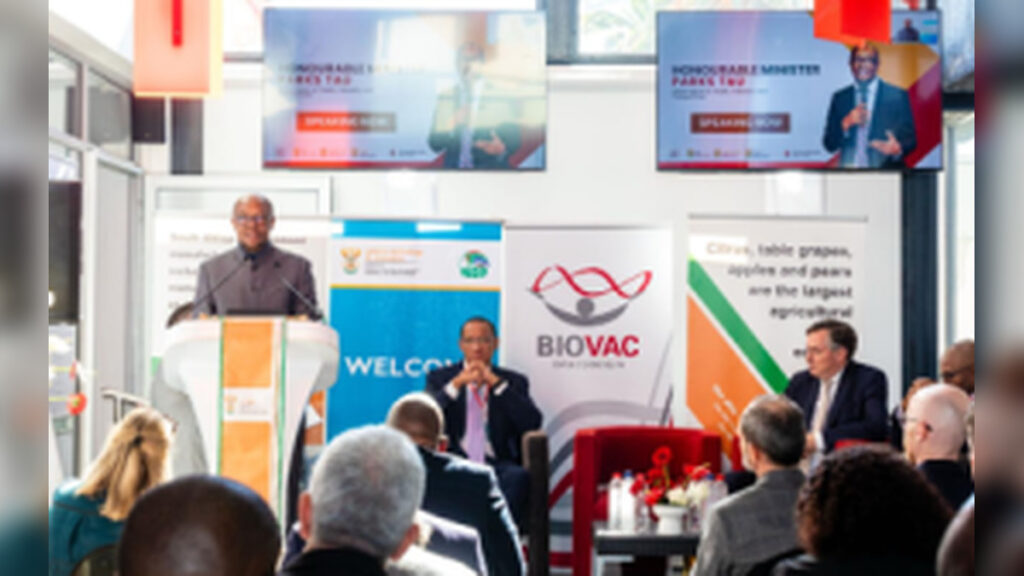
South Africa is making a bold move to strengthen Africa’s healthcare independence, and the latest expansion project at Biovac’s pharmaceutical facility in Cape Town is being viewed as a major step in that direction.
Government officials, international investors, and healthcare leaders gathered this week for a ceremonial soil-turning event that signals the start of a much larger vision for vaccine production on the continent.
Trade, Industry and Competition Minister Parks Tau said the expansion proves that Africa is no longer only a consumer of medical products but is gradually becoming a serious manufacturing and innovation hub for global healthcare.
The project centers on Biovac, a South African biopharmaceutical company established in 2003 through a partnership with government to develop local vaccine production capabilities.
The expanded facility is expected to manufacture vaccines for diseases such as cholera, polio, pneumonia, and meningitis.
Why the Expansion Matters Beyond South Africa
The COVID-19 pandemic exposed how dependent many African countries were on imported vaccines and medical supplies.
Delays in access during the height of the pandemic sparked renewed conversations about health sovereignty across the continent.
That experience appears to be driving the urgency behind projects like Biovac’s expansion.
Tau explained that Africa must develop stronger pharmaceutical and vaccine manufacturing systems to reduce dependence on foreign supply chains and improve long-term health security.
The Cape Town facility is expected to produce between 30 and 40 million vaccine doses annually once completed in 2028.
Officials believe this will help Africa respond faster during future health emergencies while also lowering costs tied to imports.
International Partners Backing the Project
The project is attracting significant international support, particularly from European institutions and development finance organizations.
Financial backing is coming from the European Investment Bank, the International Finance Corporation, Proparco, the Industrial Development Corporation, and the European Commission.
David McAllister, Chairperson of the European Parliament’s Foreign Affairs Committee, described the €95 million package supporting Biovac as the biggest financing deal in the company’s history.
He noted that the investment is not only about vaccines but also about creating skilled jobs, building industrial value chains, and strengthening cooperation between Africa and Europe.
The project also aligns with the African Union’s broader goal of producing 60% of the continent’s vaccines locally by 2040.
Job Creation and Economic Benefits
Beyond healthcare, the project is expected to bring major economic gains.




Government officials estimate the expansion will create more than 340 highly skilled direct jobs and around 7,000 indirect employment opportunities.
Those positions are expected to span manufacturing, logistics, biotechnology, research, engineering, and supply chain management.
For South Africa, this kind of investment supports a broader industrialization strategy focused on advanced manufacturing and localization.
Authorities believe building stronger domestic industries can help stabilize the economy while attracting future foreign investment.
Biovac Says Local Support Is Critical
Biovac CEO Morena Makhoana emphasized that while international partnerships are valuable, local support from the South African government remains essential.
According to Makhoana, the project demonstrates that South Africa is serious about becoming a globally competitive vaccine producer rather than simply participating at the margins of the pharmaceutical industry.
His remarks reflected a growing sentiment among African business leaders that the continent should move from being largely import-dependent to becoming a creator of high-value medical technologies.
Africa’s Healthcare Manufacturing Ambitions Are Growing
The Biovac project is part of a larger shift taking place across Africa.
Several countries have recently announced plans to build pharmaceutical plants, vaccine research centers, and biotechnology hubs.
Nations such as Rwanda, Senegal, Egypt, and South Africa have all accelerated efforts to attract pharmaceutical investment since the pandemic.
International organizations including GAVI and the African Vaccine Manufacturing Accelerator have also increased support for local production initiatives.
Experts say this trend could reshape healthcare access in Africa over the next decade if governments maintain consistent investment and regulatory support.
Impact and Consequences
The expansion of vaccine manufacturing in Africa could significantly reduce the continent’s dependence on imported medicines and emergency vaccine donations during future outbreaks.
It may also improve regional health security by allowing faster production and distribution during crises.
Economically, the project could strengthen South Africa’s pharmaceutical sector while helping develop specialized skills in biotechnology and medical manufacturing.
However, the initiative will also face challenges.
Vaccine manufacturing requires strict quality controls, long-term funding, advanced scientific expertise, and stable regulatory systems.
Competition from large international pharmaceutical firms could also place pressure on African producers.
Still, if successful, the project could become a model for future industrial healthcare investments across Africa.
What’s Next?
Construction of the expanded Biovac facility is expected to continue over the next few years, with completion targeted for 2028.
Once operational, the plant will focus on producing vaccines for key diseases affecting millions across Africa and other developing regions.
Government officials are also expected to continue promoting partnerships aimed at boosting local pharmaceutical production.
Industry observers will be watching closely to see whether South Africa can successfully scale production while maintaining international quality standards and competitive pricing.
Summary
South Africa’s expansion of the Biovac vaccine manufacturing facility marks a major moment in Africa’s healthcare and industrial ambitions.
The project represents more than just a pharmaceutical investment — it reflects a broader push toward self-reliance, health security, and economic development across the continent.
With international financing, government backing, and growing demand for regional vaccine production, the Cape Town facility could become one of Africa’s most important healthcare manufacturing centers in the coming years.
Bulleted Takeaways
- South Africa is expanding Biovac’s vaccine manufacturing facility in Cape Town.
- The project aims to strengthen Africa’s healthcare independence.
- The facility will produce vaccines for cholera, polio, pneumonia, and meningitis.
- Production capacity is expected to reach 30–40 million doses annually.
- Completion is targeted for 2028.
- More than 340 direct skilled jobs and 7,000 indirect jobs are expected.
- The expansion aligns with the African Union’s goal of producing 60% of vaccines locally by 2040.
- International investors and European institutions are heavily backing the project.
- The initiative reflects Africa’s growing ambitions in pharmaceutical manufacturing and biotechnology..

