
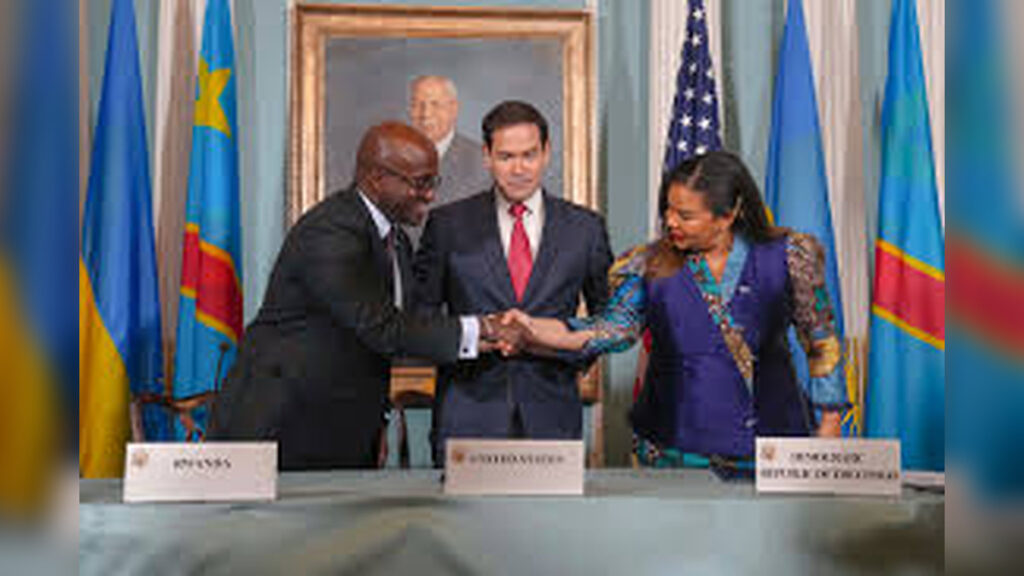
Diplomatic pressure on the crisis in eastern Democratic Republic of the Congo has intensified after a major international meeting in Stockholm brought together the International Contact Group for the Great Lakes region.
The group, known as the International Contact Group for the Great Lakes, includes Belgium, Denmark, the European Union, France, Germany, the Netherlands, Sweden, Switzerland, the United Kingdom, and the United States.
Their latest statement reflects growing concern that the conflict continues to block stability, development, and humanitarian progress across the region.
Officials stressed that while diplomatic talks are advancing, the situation on the ground remains fragile and unpredictable, with civilians still bearing the heaviest burden.
Peace Efforts Gain Momentum but Ground Reality Remains Fragile
Meeting in Stockholm on 20–21 May 2026, the group reviewed ongoing mediation efforts involving multiple international actors, including Qatar, the African Union mediation framework, and US-backed diplomatic channels.
The statement highlighted progress made under the Washington Accords between the Democratic Republic of the Congo and Rwanda, alongside the Doha Framework Agreement involving Congolese authorities and the AFC/M23 rebel alliance.
Despite these developments, the group warned that agreements alone are not enough unless fully implemented.
Previous peace deals in the region have often struggled at the enforcement stage, leading to cycles of renewed violence.
Ceasefire Promises and Prisoner Releases Mark Partial Progress
One of the key points welcomed by the group was the April talks in Montreux, Switzerland, where the Congolese government and AFC/M23 representatives agreed on humanitarian coordination measures.
These included commitments to prisoner releases and steps toward activating a ceasefire monitoring mechanism supported by regional and international partners, including MONUSCO, the United Nations peacekeeping mission in the country.
Another diplomatic milestone was recorded in Washington, where a joint oversight committee involving the DRC and Rwanda reaffirmed commitment to existing agreements.
The group also referenced UN Security Council Resolution 2773 as a key legal framework guiding peace enforcement efforts.
Civilians Caught in the Middle of Expanding Conflict Risks
Despite diplomatic progress, the statement raised alarm over worsening civilian protection issues.
The use of drones in the conflict—by both state and non-state actors—has reportedly increased civilian casualties.


The group emphasized that all parties are legally bound under international humanitarian law to protect civilians, warning that violations must stop immediately.
Humanitarian access remains a major concern. Aid delivery is still constrained in several areas, including North and South Kivu, where insecurity and administrative restrictions continue to slow relief efforts.
Officials also stressed the importance of reopening key transport routes such as Goma and Kavumu airports to allow faster humanitarian response.
Health Crisis Adds Pressure to an Already Volatile Region
The situation has been further complicated by a recent Ebola outbreak, which was declared a Public Health Emergency of International Concern by the World Health Organization on 17 May and recognized as a continental emergency by Africa CDC the following day.
This dual crisis—conflict and disease—has placed enormous strain on healthcare systems already weakened by years of instability.
Experts warn that without safe access for medical and humanitarian teams, outbreaks like Ebola could spread more rapidly, creating risks beyond the region.
Long Road Ahead for Stability in the Great Lakes Region
The International Contact Group for the Great Lakes reaffirmed its commitment to supporting long-term peace efforts under the broader Peace, Security and Cooperation Framework for the region.
Officials stressed that military solutions alone cannot resolve the crisis, echoing a long-standing international consensus that political dialogue is essential.
The group also highlighted the need for inclusive governance in the Democratic Republic of the Congo, arguing that unresolved political grievances continue to fuel cycles of violence.
Impact and Consequences
If current diplomatic momentum continues, there is potential for gradual stabilization in eastern DRC, especially if ceasefire mechanisms are fully enforced and humanitarian corridors are opened.
However, failure to implement agreements could deepen mistrust between parties and prolong armed conflict, particularly in North and South Kivu regions where fighting has historically been intense.
Humanitarian consequences remain severe.
Restricted aid access combined with disease outbreaks like Ebola could escalate into a wider regional crisis if not urgently addressed.
Politically, the role of external mediators—including African Union-linked diplomacy and Western governments—will likely grow stronger, but also face scrutiny if tangible improvements do not follow.
What’s Next?
The next phase depends heavily on whether all parties honor commitments made in Washington, Doha, and Montreux meetings.
Observers will be watching for concrete actions such as ceasefire compliance, prisoner exchanges, and improved humanitarian access on the ground.
Further international meetings are expected, and pressure may increase for enforcement mechanisms if violations continue.
There is also growing expectation that regional actors will push for a more inclusive Congolese political dialogue involving all major stakeholders.
Summary
The International Contact Group for the Great Lakes has reaffirmed concern over the ongoing conflict in eastern Democratic Republic of the Congo while acknowledging progress in recent peace talks.
Although diplomatic frameworks in Washington, Doha, and Montreux show movement toward resolution, violence, humanitarian restrictions, and health emergencies continue to threaten stability.
The group insists that only sustained political engagement—not military action—can bring lasting peace.
Bulleted Takeaways
- The International Contact Group for the Great Lakes met in Stockholm to assess the DRC conflict.
- Progress was noted under Washington Accords and Doha Framework agreements.
- Ceasefire monitoring, prisoner releases, and humanitarian coordination were discussed in recent talks.
- Civilian protection concerns are rising due to drone use and ongoing fighting.
- Humanitarian access remains limited in parts of North and South Kivu.
- Ebola outbreak has worsened an already fragile humanitarian situation.
- The group insists there is no military solution and calls for sustained negotiations.
- Future stability depends on implementation of existing peace commitments.

