
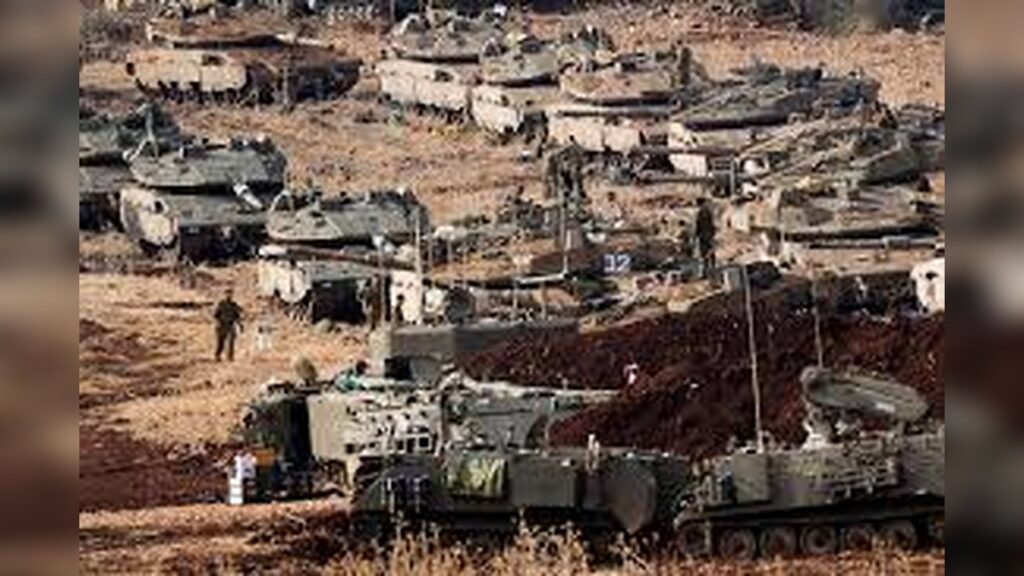
The situation along the northern frontier of Israel has remained tense for years, largely shaped by the presence and activities of Hezbollah in southern Lebanon.
According to security assessments referenced in Israeli military materials, Hezbollah has developed a long-term presence near the border, which Israeli officials describe as a sustained security threat.
The group has repeatedly been accused of embedding military infrastructure in civilian-populated areas, a claim that has been a central point of dispute in regional security debates.
These tensions have periodically flared into cross-border exchanges, especially in periods of wider regional instability.
Military Build-Up and Long-Standing Accusations
Israeli defense sources have long argued that Hezbollah maintains an extensive arsenal, including rockets and other long-range weapons capable of reaching deep into Israeli territory.
Over the years, concerns have also been raised about underground infrastructure and fortified positions close to the border.
These allegations form part of Israel’s broader security narrative, which views Hezbollah as one of the most significant military threats on its northern front.
At the same time, Hezbollah presents itself as a resistance movement against Israeli military presence and influence in the region, a framing that continues to divide international opinion.
Civilian Areas Caught in a Security Standoff
One of the most controversial aspects of the Israel–Hezbollah dynamic is the reported proximity of military assets to civilian areas in southern Lebanon.
Israeli officials argue that this creates heightened risks for civilians during any potential escalation, while Hezbollah and its supporters accuse Israel of using similar arguments to justify military operations in Lebanon.
This cycle of accusation and counter-accusation has contributed to long-running mistrust and repeated flare-ups along the border region.




Regional Context and Past Escalations
The Israel–Hezbollah conflict has a long history, including the 2006 war, which caused significant destruction in both southern Lebanon and northern Israel.
More recently, border tensions have intensified in the context of wider regional conflict dynamics, including spillover effects from unrest in Gaza and broader Middle East instability.
The United Nations peacekeeping force in Lebanon (UNIFIL) continues to operate in the area, but its ability to prevent escalation is often limited by the complexity of the security environment.
IDF Perspective on Hezbollah’s Threat
Israeli defense messaging consistently emphasizes Hezbollah’s military capabilities and its positioning near the border as a key national security concern.
For a detailed breakdown of the group’s alleged infrastructure and threat assessments, readers are directed to official Israeli military materials:
Hezbollah threat breakdown by IDF
These materials outline concerns ranging from weapons storage in populated areas to potential attack scenarios targeting Israeli communities near the border.
Impact and Consequences
The continued presence of armed tensions along the Israel–Lebanon border increases the risk of sudden escalation, even from isolated incidents.
Any miscalculation could quickly expand into a broader confrontation involving both state and non-state actors.
For civilians on both sides, the uncertainty contributes to displacement risks, economic disruption, and long-term insecurity in border communities.
Regionally, sustained friction between Hezbollah and Israel also complicates diplomatic efforts aimed at stabilizing the wider Middle East.
Global actors closely monitor the situation because escalation could draw in additional regional powers and disrupt already fragile security balances.
What’s Next?
The immediate future depends heavily on whether border tensions remain contained or escalate into broader military exchanges.
Diplomatic efforts, including international mediation and UN monitoring, are expected to continue, but their effectiveness remains limited without political breakthroughs.
Military preparedness on both sides is likely to remain high, with periodic incidents continuing to test the fragile status quo.
The broader trajectory will depend on whether regional conflicts elsewhere intensify or whether diplomatic channels manage to reduce pressure along the northern border.
Summary
Hezbollah’s presence along the Israel–Lebanon border remains a major security concern for Israel, with Israeli assessments highlighting alleged weapons buildup and infrastructure close to civilian areas.
While the situation has not escalated into full-scale war in recent years, persistent tensions and periodic clashes continue to raise the risk of wider conflict in the region.
Bulleted Takeaways
- Hezbollah is accused by Israel of maintaining military infrastructure near the border.
- Israeli officials say the group possesses significant rocket and missile capabilities.
- Civilian areas in southern Lebanon are often cited as part of the security concern debate.
- The Israel–Hezbollah conflict has a long history, including the 2006 war.
- UNIFIL operates in the region but has limited ability to fully prevent escalation.
- Tensions increase the risk of sudden cross-border conflict between Israel and Hezbollah.
- The IDF provides assessments of Hezbollah’s threat network and capabilities.
- Regional instability continues to influence the likelihood of future escalation.

