
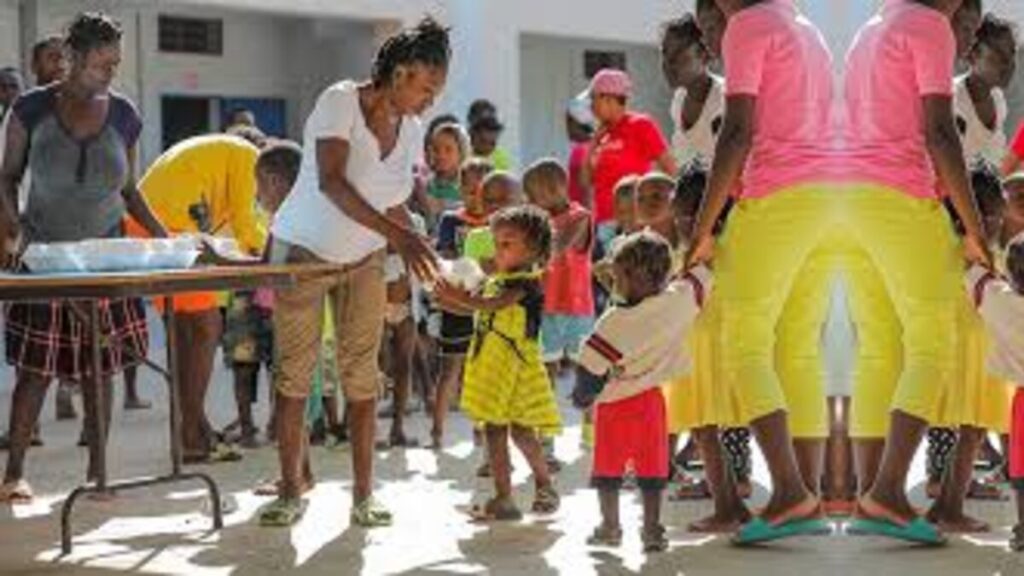
In the heart of Haiti’s most feared neighbourhood, Cité Soleil, something unusual is happening: children are going to school, eating meals, and learning faith in a place many would describe as beyond hope.
At the centre of it all is a French religious sister, born Claire Joelle Phillipe in Lorraine, who now goes by Sister Paesie.
Raised in a Catholic home, she felt drawn early to religious life and later joined the Missionaries of Charity, inspired by Mother Teresa and her work with the poorest communities.
Her path eventually led her to Haiti in 1999, where she encountered a reality that would change the direction of her entire ministry.
From Mother Teresa’s Vision to Haiti’s Streets
Sister Paesie often traces her calling back to a spiritual reflection attributed to Mother Teresa: a vision of children living in darkness, disconnected from love and faith, needing guidance and protection.
That image stayed with her.
When she arrived in Haiti, she saw children roaming the streets of Cité Soleil with no protection, education, or stability.
That experience became the foundation of her life’s mission: to create safe spaces where children could learn, eat, and simply be children again.
In 2017, after decades of missionary work, she founded a new religious community under the approval of the archbishop of Port-au-Prince called the Kizito Family, named after St. Kizito, a young Ugandan martyr remembered for protecting children.
Building Schools in the Middle of Chaos
What began as a small initiative has grown into a major humanitarian network inside one of the most unstable parts of the Caribbean.
Today, the Kizito Family runs multiple schools, homes, and catechism centres across Cité Soleil.
Thousands of children pass through its classrooms, many of whom would otherwise be on the streets or worse.
The organisation now supports orphaned and abandoned children, runs education programmes, and provides daily meals—often the only reliable food some children receive.
Local staff, many of them from the same neighbourhood, keep the system running even when violence flares nearby.
Life Under Constant Threat in Cité Soleil
The environment surrounding the mission is anything but stable.
Haiti remains the poorest country in the Latin American and Caribbean region, with widespread hunger, limited access to clean water, and recurring outbreaks of disease.
Nearly 1.4 million people have been displaced due to violence and instability.
In Cité Soleil, gangs control large sections of territory.
Violence has escalated sharply in recent years, with reports of kidnappings, attacks on homes, and mass displacement.
There have even been horrific incidents, including church attacks where entire communities have been killed.




For organisations like the Kizito Family, safety is never guaranteed.
During one recent wave of violence, staff had to evacuate children overnight after armed groups moved into the area.
Schools That Are More Than Just Classrooms
Despite the danger, education continues.
Around 3,000 children are connected to Kizito Family programmes, with more than half attending daily.
Others come for weekend catechism and faith formation.
But these schools are not just about learning maths or reading.
For many children, they are survival spaces—places where they can eat, rest, and feel protected for a few hours a day.
The organisation also provides religious education, preparing children for sacraments and offering structure in a community where instability is the norm.
Faith, Identity, and Cultural Tension
Religion plays a complicated role in Haiti. The country has deep Catholic roots, but also strong traditions of evangelical Christianity and Vodou practices.
Sister Paesie emphasises that part of the mission is helping children develop a stable spiritual foundation, especially in a context where multiple belief systems overlap in daily life.
For her, faith is not just doctrine—it is a stabilising force in an environment shaped by fear and uncertainty.
A Home for the Most Vulnerable Children
Beyond schools, the Kizito Family operates homes for children who have no one left to care for them.
Some are orphans. Others have been separated from families due to violence or extreme poverty.
A growing number are very young children whose parents were killed or died due to hardship and lack of medical care.
Adoption, once a possible pathway, has largely stalled due to insecurity and corruption concerns in the country.
Still, these children are given shelter, education, and emotional care in a structured environment designed to replace the chaos they came from.
Impact and Consequences
The impact of the Kizito Family’s work is visible in thousands of children who now have access to education, food, and emotional stability in one of the world’s most dangerous urban areas.
However, the consequences of operating in such an unstable region are serious.
Staff and children regularly face sudden evacuations, disrupted schooling, and psychological stress due to ongoing violence.
There is also a wider societal impact: these programmes reduce the number of children exposed to gang recruitment, trafficking, and street violence, even if only within limited zones.
At the same time, the scale of need far exceeds available resources, meaning many children remain outside the system entirely.
What’s Next?
The future of the Kizito Family depends heavily on Haiti’s security situation.
If violence continues to escalate, maintaining schools and homes could become increasingly difficult.
Expansion may slow, and resources could become strained.
However, Sister Paesie and her team continue to seek support, partnerships, and international attention to sustain their work.
Long-term survival will likely depend on both improved national stability and sustained global humanitarian backing.
Summary
In the midst of severe violence and poverty in Cité Soleil, Sister Paesie and the Kizito Family are providing education, shelter, and faith-based support to thousands of vulnerable children.
Despite constant threats from gang violence and national instability, the organisation continues to operate schools and homes that offer safety in an otherwise chaotic environment.
Their work highlights both the fragility of life in Haiti and the resilience of those committed to protecting its youngest citizens.
Bulleted Takeaways
- Sister Paesie, born Claire Joelle Phillipe, founded a mission in Haiti inspired by Mother Teresa.
- The Kizito Family operates in Cité Soleil, one of Haiti’s most dangerous slums.
- The organisation runs schools, homes, and catechism centres for thousands of children.
- Haiti faces extreme poverty, hunger, displacement, and escalating gang violence.
- Many children in the programme are orphans or victims of family loss due to violence or hardship.
- Schools function as both education centres and safe havens for food and protection.
- Adoption processes in Haiti are largely stalled due to insecurity and corruption.
- Despite challenges, the mission continues to expand support for vulnerable children.

