
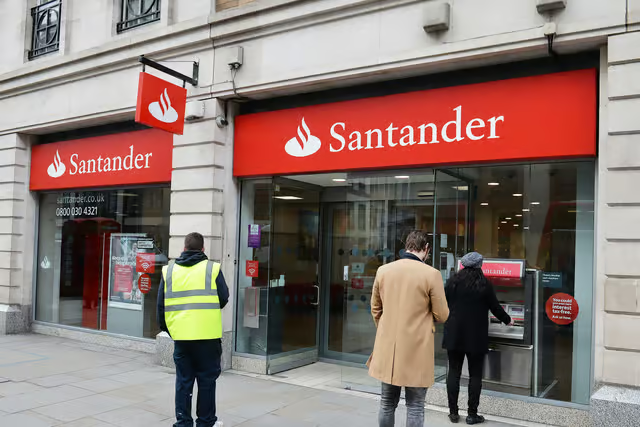
There’s something almost symbolic about another round of bank branch closures hitting the UK.
This time, it’s Santander confirming that 26 more of its locations will shut their doors for good in May.
It’s not a sudden move, though—it’s part of a broader plan already in motion, with dozens of branches marked for closure as banking habits continue to evolve.
Walk down many high streets today and you’ll notice the change: fewer queues inside banks, more “To Let” signs outside former branches.
It’s a reflection of how people now handle their money—less face-to-face, more screen-to-screen.
Why Santander Is Pulling the Plug on Branches
The core reason behind these closures is simple: customers are going digital.
According to Santander, a staggering 96% of all transactions are now completed online, either through mobile apps or internet banking.
This trend isn’t unique to Santander.
Other major players like Lloyds Banking Group, Barclays, and NatWest Group have all been trimming their physical presence as foot traffic drops.
Research from Which? paints an even bigger picture: over 6,000 bank and building society branches disappeared between 2015 and 2024.
That’s not a trend—it’s a transformation.
The Full List of Santander Branches Closing in May
Here’s where the impact will be felt most directly.
These communities will see their local Santander branch shut down on the following dates:




- Andover, Hampshire – May 12
- Banbridge, County Down – May 19
- Bridgend, Mid Glamorgan – May 12
- Cwmbran, Gwent – May 13
- Enniskillen, County Fermanagh – May 12
- Glengormley, County Antrim – May 6
- Golders Green, London – May 13
- Gosport, Hampshire – May 5
- Haverfordwest, Pembrokeshire – May 5
- Heswall, Merseyside – May 13
- Huntingdon, Cambridgeshire – May 5
- Leyland, Lancashire – May 6
- Liskeard, Cornwall – May 20
- Macclesfield, Cheshire – May 12
- Mansfield, Nottinghamshire – May 6
- Merthyr Tydfil, Mid Glamorgan – May 6
- Newton Abbot, Devon – May 19
- Northallerton, North Yorkshire – May 6
- Pontefract, West Yorkshire – May 5
- Redditch, Worcestershire – May 13
- Ringwood, Hampshire – May 6
- Shirley, West Midlands – May 20
- Stafford, Staffordshire – May 19
- Stranraer, Wigtownshire – May 13
- Stratford-upon-Avon, Warwickshire – May 12
- Welwyn Garden City, Hertfordshire – May 5
For many residents—especially older customers or small business owners—these closures may feel less like modernization and more like a loss of essential services.
A Bigger Deal Looming: Santander’s Move on TSB
Adding another layer to the story is Santander’s planned takeover of TSB Bank.
The deal, initially pegged at £2.65 billion, could climb to around £2.9 billion once finalized.
TSB isn’t a small player either. As the UK’s 11th largest mortgage lender, it operates roughly 175 branches and employs over 5,000 people.
That scale raises a pressing question: what happens when both networks overlap?
So far, Santander hasn’t confirmed whether the TSB brand will survive the acquisition.
That uncertainty alone is enough to keep employees and customers on edge.
Impact and Consequences
The closures ripple far beyond banking halls. Local economies often rely on physical branches to drive foot traffic to nearby shops and services.
When a bank leaves, it can quietly drain activity from an entire area.
There’s also a human cost. Job losses remain a real concern, particularly with the TSB acquisition in play.
While banks typically offer redeployment options, not every role survives consolidation.
And then there’s financial inclusion. Not everyone is comfortable—or even able—to bank online.
Rural communities, elderly customers, and those without reliable internet access risk being left behind in this digital-first shift.
What’s Next?
All eyes are now on two key developments: regulatory approval of the TSB deal and Santander’s long-term strategy for its combined network.
If the acquisition goes through, further branch closures could follow as the bank looks to eliminate duplication and cut costs.
At the same time, we may see increased investment in digital tools, AI-driven customer service, and fewer—but more “flagship”—physical locations.
The bigger question is whether banks will find a balance between efficiency and accessibility—or continue leaning heavily toward digital at the expense of in-person service.
Summary
Santander’s decision to close 26 UK branches in May is part of a broader industry shift toward online banking.
While the move reflects changing customer behavior, it also raises concerns about job security, community impact, and access to financial services—especially with a major acquisition on the horizon.
Bulleted Takeaways
- Santander will shut 26 UK branches in May as part of a wider closure plan
- 96% of its transactions now happen online, driving the shift away from physical branches
- Over 6,000 UK bank branches have closed between 2015 and 2024
- Other major banks like Lloyds, Barclays, and NatWest are following the same path
- Santander is in the process of acquiring TSB in a deal worth up to £2.9 billion
- Job losses and further closures are feared once the merger is complete
- Communities and vulnerable customers may struggle with reduced access to in-person banking services

