
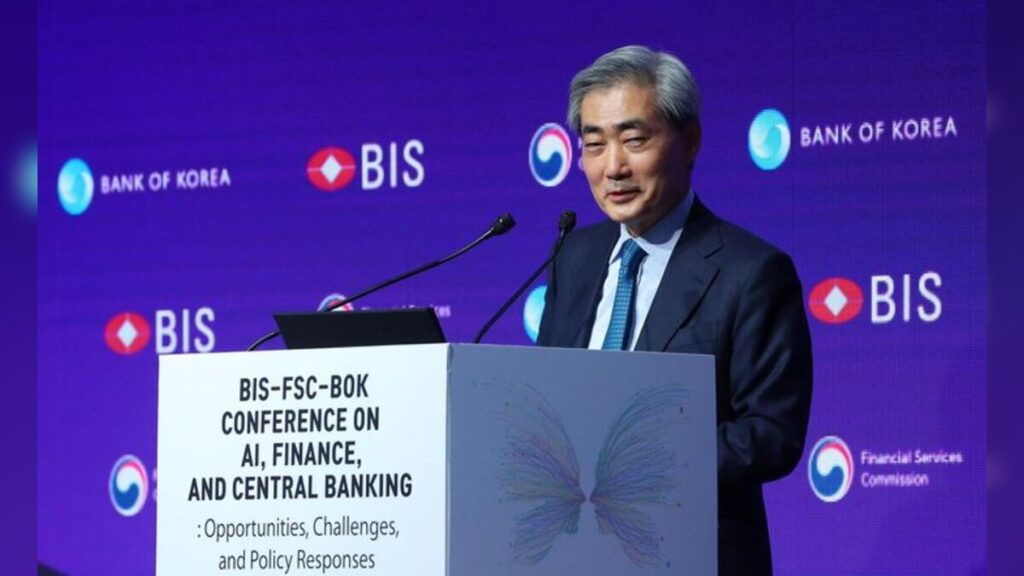
When Shin Hyun-song stepped into his new role as governor of the Bank of Korea, he didn’t waste time setting the tone.
Speaking in Seoul during his inaugural address, Shin made it clear that digital finance will sit at the heart of the institution’s future strategy.
Rather than easing into the position, he leaned straight into one of the most debated topics in global finance: central bank digital currencies (CBDCs) and tokenized deposits.
His message was simple—Korea intends to stay competitive in an increasingly digital monetary world.
Doubling Down on Project Hangang
A key highlight of Shin’s remarks was the continuation of “Project Hangang,” the central bank’s ongoing experiment with blockchain-powered finance.
Now entering its second phase, the initiative focuses on building and testing a wholesale CBDC system designed for financial institutions rather than everyday consumers.
The goal isn’t just innovation for its own sake.
Shin framed the project as a strategic move to strengthen the Korean won’s relevance in digital payments, especially as global financial systems evolve rapidly.
Looking Beyond Borders with Global Collaboration
Shin also pointed to the importance of international cooperation.
He referenced the “Agora Project,” a joint effort launched in 2024 by the Bank for International Settlements alongside several central banks.
This initiative explores how tokenization could reshape cross-border payments—an area long plagued by delays, high costs, and inefficiencies.
For Korea, participation signals ambition: not just to keep up, but to help shape the rules of the next financial era.
The Missing Piece: Stablecoins
Interestingly, Shin avoided mentioning stablecoins altogether—despite earlier speculation that he might support won-based versions.
That silence stands out, especially as lawmakers in South Korea remain divided on how to regulate them.
At the heart of the debate is a simple but consequential question: should only banks issue stablecoins, or should fintech and tech companies be allowed in? For now, the proposed legislation remains stuck, reflecting broader uncertainty about how far to open the financial system.
A Reality Check: Geopolitics and Inflation
Beyond digital currencies, Shin struck a more cautious note.




He pointed to rising tensions in the Middle East and their ripple effects—especially on oil prices—as a reminder that old-school economic risks haven’t disappeared.
According to him, the Bank of Korea must balance innovation with stability.
That means staying flexible in monetary policy while keeping inflation and financial risks in check.
It’s a delicate act, especially in a world where shocks can come from both technology and geopolitics.
From Global Advisor to National Leader
Before taking on this role, Shin built a strong international reputation.
He served as an economic adviser at the BIS for over a decade and later led its Monetary and Economic Department.
He’s also been vocal in academic circles.
In a recent paper, he questioned whether stablecoins truly function as “money,” arguing they fall short due to fragmentation across blockchain networks.
Different fees, security levels, and structures, he noted, weaken their consistency—a core feature of traditional money.
Government Experiments with Tokenized Spending
Meanwhile, Korea’s broader public sector is also stepping into the digital arena.
The Ministry of Economy and Finance is preparing a pilot program to test blockchain-based payments for government spending.
This experiment will begin in Sejong City, using tokenized deposits to handle selected expenses under controlled conditions.
If successful, the system could expand nationwide, with a full rollout targeted by late 2026.
Impact and Consequences
Shin’s early signals suggest a more assertive digital strategy for Korea’s financial system.
If CBDCs and tokenized deposits gain traction, they could reshape everything from interbank settlements to government payments.
At the same time, the cautious stance on stablecoins may slow private-sector innovation—or at least keep it tightly regulated.
Globally, Korea’s moves could influence how other mid-sized economies approach digital currency adoption, especially those balancing innovation with financial stability.
What’s Next?
All eyes will be on the next phase of Project Hangang and the government’s spending pilot.
These initiatives will serve as real-world tests of whether blockchain-based systems can deliver on their promises.
On the policy side, the unresolved stablecoin debate is likely to resurface, especially as other countries move ahead with their own frameworks.
Shin’s future speeches may offer clearer guidance on where he stands.
Summary
Shin Hyun-song’s first address as central bank governor sets a clear direction: embrace digital finance, but proceed carefully.
With CBDC development accelerating and government pilots underway, South Korea is positioning itself as a serious player in the future of money—while still keeping one foot firmly planted in traditional economic discipline.
Bulleted Takeaways
- Shin Hyun-song has signaled strong support for CBDCs and tokenized deposits
- The Bank of Korea is advancing “Project Hangang” into its next phase
- International collaboration, especially through the BIS-led Agora Project, is a priority
- Stablecoins remain a contentious and unresolved issue in South Korea
- Geopolitical risks and inflation are still major concerns for policymakers
- Korea is preparing real-world blockchain trials for government spending
- The country is balancing innovation with financial stability as it enters the digital finance era

