
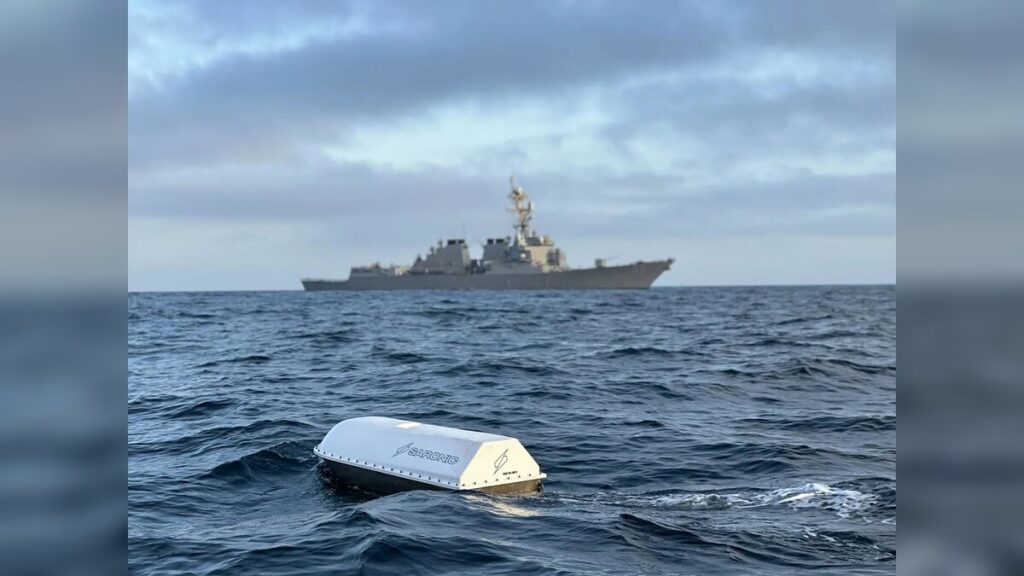
The U.S. Navy is preparing a dramatic expansion of unmanned naval capabilities, with plans to deploy thousands of autonomous surface vessels across the Indo-Pacific region by 2030.
According to senior officials involved in the program, the initiative represents one of the most ambitious shifts in modern naval warfare, moving away from traditional manned-only operations toward a hybrid fleet of crewed and uncrewed systems.
Thousands of Drone Vessels Expected by 2030
Speaking at a defense symposium, Capt. Garrett Miller outlined projected force levels that include more than 30 medium unmanned surface vessels operating in the Indo-Pacific, along with thousands of smaller autonomous surface units.
He also indicated that unmanned aerial systems could operate in large numbers from both traditional warships and future unmanned platforms, forming a layered network of surveillance and strike capability across the region.
The projections are based on long-term planning tied to anticipated operational needs extending into the mid-2040s.
Indo-Pacific Strategy Focuses on Deterrence Through Autonomy
The expansion is closely tied to strategic concerns about rising maritime competition in the Indo-Pacific, particularly in relation to People’s Liberation Army Navy.
U.S. defense planners have increasingly explored the idea of distributed, autonomous “drone swarms” designed to enhance deterrence and complicate potential adversary operations in contested waters, including scenarios involving Taiwan.
The concept has been described by military planners as a way to create overwhelming maritime presence without relying solely on large crewed fleets.
Lessons From Ukraine and Middle East Conflicts
Recent conflicts have influenced the Navy’s thinking. Drone boat operations in the Black Sea during the Russia-Ukraine war and unmanned systems used in the Red Sea and Persian Gulf have provided real-world testing grounds for maritime autonomy.
However, U.S. officials acknowledge that those environments differ significantly from the vast distances of the Pacific Ocean, where operational challenges are far more complex.




Challenges of Operating Across Vast Ocean Distances
Rear Adm. Douglas Sasse noted that while unmanned systems have shown success in smaller, enclosed waters, the Indo-Pacific presents a fundamentally different challenge.
He explained that unlike confined seas, the Pacific offers no natural cover and requires long-range endurance, advanced coordination, and greater logistical support for unmanned platforms operating far from shore.
This means future drone operations will likely require more advanced autonomy and support systems than those currently used in regional conflicts.
Testing and Early Deployment Already Underway
The Navy has already begun testing key capabilities. A recent demonstration involved an unmanned surface vessel conducting astern refueling operations with a logistics tanker off the California coast, marking a milestone in sustaining autonomous ships at sea.
Officials described the test as a critical step toward integrating unmanned vessels into carrier strike group operations.
Integration With Carrier Strike Groups
According to Navy planners, unmanned vessels are expected to operate alongside traditional carrier groups, including the Theodore Roosevelt Carrier Strike Group.
Their roles may include surveillance, maritime domain awareness, and intelligence gathering, effectively acting as extended sensor networks for larger fleet operations.
Impact and Consequences
The planned expansion represents a major transformation in naval warfare strategy, potentially reshaping how maritime dominance is maintained in the Indo-Pacific.
If successful, thousands of autonomous systems could significantly increase surveillance coverage and operational reach, while reducing risk to human personnel.
However, the shift also raises concerns about escalation dynamics, command-and-control complexity, and the potential for autonomous systems to operate in contested environments without immediate human oversight.
What’s next?
The Navy is expected to continue testing unmanned systems in real-world fleet exercises, including integration with carrier strike groups over the coming year.
Further procurement decisions will determine how quickly thousands of systems can be built, deployed, and sustained across the Indo-Pacific.
Defense planners will also continue refining doctrine for how autonomous systems interact with traditional naval forces in high-threat environments.
Summary
The U.S. Navy is planning a large-scale deployment of unmanned surface vessels across the Indo-Pacific by 2030, aiming to field thousands of autonomous systems alongside traditional warships.
The strategy is driven by growing regional competition and lessons from recent conflicts, though officials acknowledge significant operational challenges due to the vast distances of the Pacific.
Bulleted Takeaways
- U.S. Navy plans thousands of unmanned surface vessels by 2030
- More than 30 medium unmanned vessels expected in Indo-Pacific
- Thousands of smaller autonomous surface systems also planned
- Strategy linked to deterrence against People’s Liberation Army Navy
- Influenced by drone warfare in Ukraine and Middle East conflicts
- Officials warn Pacific operations are far more complex than confined seas
- Refueling and integration tests already underway off California
- Unmanned systems expected to support Theodore Roosevelt Carrier Strike Group
- Program aims to reshape future naval warfare and fleet structure
