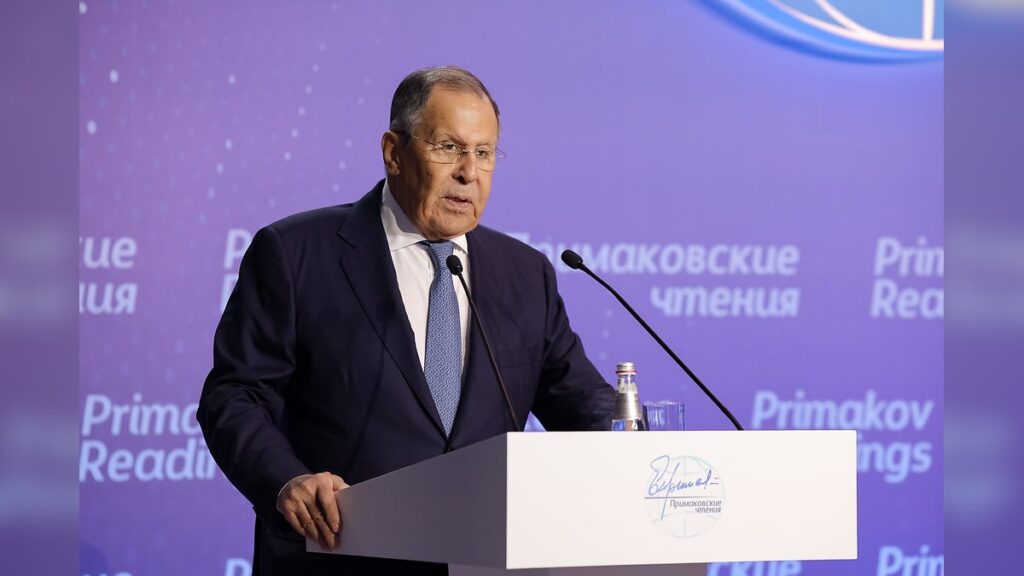
Russian Foreign Minister Sergey Lavrov used his appearance at the 12th International Scientific and Expert Forum Primakov Readings in Moscow to outline Moscow’s views on global affairs, international security, and the future of the world order.
Speaking before diplomats, academics, and policy experts, Lavrov paid tribute to former Russian statesman Yevgeny Primakov, describing his ideas and diplomatic legacy as highly relevant to Russia’s current foreign policy approach.
He said the forum serves as an opportunity to honor Primakov’s contributions while discussing major international challenges facing the world today.
Lavrov Criticizes Western Approach to International Relations
A significant portion of Lavrov’s remarks focused on criticism of Western countries and their role in shaping global politics.
According to the Russian foreign minister, Western governments have increasingly moved away from internationally recognized legal principles established under the United Nations Charter.
He argued that nations that formally committed themselves to those principles should apply them consistently rather than selectively.
Lavrov also accused Western powers of altering international norms when doing so serves their political and economic interests.
Russia Accuses West of Undermining Global Economic Principles
The foreign minister claimed that Western countries had abandoned many of the economic principles they previously championed, including free trade, fair competition, and the protection of private property.
Lavrov argued that the emergence of new economic powers across Asia, Africa, and Latin America prompted Western governments to resort to sanctions, tariffs, and financial restrictions in an effort to preserve their influence.
He specifically pointed to the use of sanctions and restrictions on financial assets as examples of what he described as the politicization of global economic tools.



Security Concerns Remain Central to Moscow’s Position
Lavrov also addressed Russia’s long-standing objections to NATO’s expansion and broader Western influence near Russian borders.
He argued that decades of eastward expansion by what he referred to as the “Atlantic community” have weakened the international security architecture and contributed to rising tensions across Europe.
According to Lavrov, Russia views these developments as a direct challenge to its national security interests and believes they have played a significant role in shaping current geopolitical conflicts.
Moscow Welcomes US-Iran Diplomatic Progress
Turning to developments in the Middle East, Lavrov welcomed the recent agreement between the United States and Iran to halt hostilities and continue diplomatic engagement.
He said Russia supports ongoing negotiations and remains willing to assist efforts aimed at reaching a broader and more durable agreement between the two countries and regional stakeholders.
The foreign minister indicated that Moscow would be prepared to contribute diplomatically if its involvement were requested by the parties involved.
Ukraine Conflict Remains a Key Focus
Lavrov reiterated Russia’s position on the war in Ukraine, arguing that the roots of the conflict must be addressed to achieve a lasting settlement.
He maintained that a political and diplomatic resolution remains possible and referenced previous statements by President Vladimir Putin supporting negotiations under specific conditions.
According to Lavrov, any future agreement would need to include legally binding security guarantees and reflect what Russia describes as the principle of indivisible security, particularly concerning Russia’s western borders.
Call for Recognition of Russian Security Interests
The Russian foreign minister argued that Western governments must reconsider policies that Moscow views as military, political, and ideological expansion into areas it considers strategically important.
He suggested that reducing tensions would require a greater willingness to acknowledge Russia’s security concerns and establish a framework based on mutual guarantees rather than confrontation.
Multipolar World Order Highlighted as Alternative
Lavrov concluded by promoting the concept of a multipolar international system, which he described as an alternative to what Russia sees as Western dominance in global affairs.
He argued that a balance of interests among sovereign states can be achieved through adherence to international law and mutual respect.
The minister pointed to cooperation between Russia and China, as well as the growing roles of organizations such as BRICS and the Shanghai Cooperation Organisation, as examples of how countries can work together while maintaining independent foreign policies.
According to Lavrov, these groupings demonstrate that international cooperation can be built around sovereign equality and shared interests rather than geopolitical rivalry, a model he believes will play an increasingly important role in shaping the future global order.
