
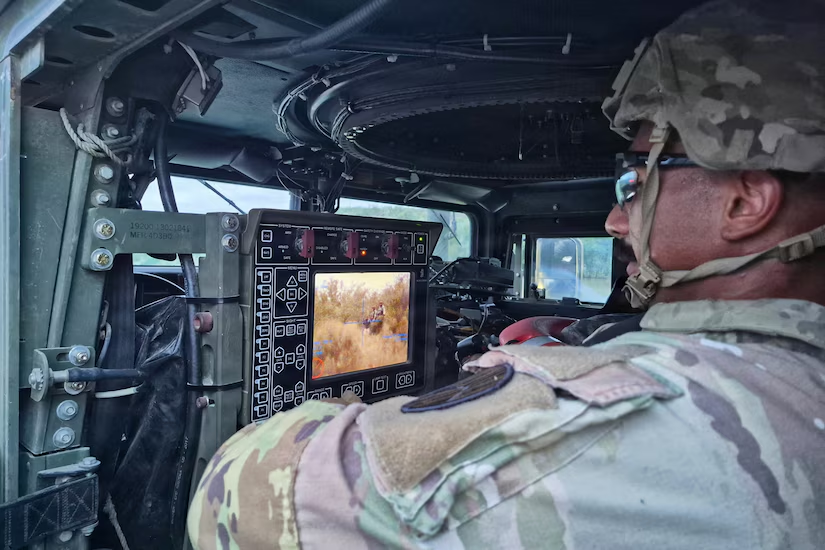
The U.S. Department of War has announced a major new effort focused on bringing advanced quantum sensing technologies into military operations, marking what officials describe as a significant step toward the next generation of battlefield intelligence.
The initiative, launched through the Defense Innovation Unit (DIU), follows President Donald Trump’s recent executive order aimed at accelerating American leadership in quantum technology.
Officials say as much as $200 million could be invested over the next year to help transition promising quantum systems from research laboratories into operational military use.
Quantum Technology Moves From Theory to Defense Applications
Military leaders believe quantum sensing could dramatically improve the way armed forces gather intelligence and monitor threats in complex environments.
Unlike conventional sensors, which often face trade-offs between sensitivity, performance, and physical size, quantum-based systems are designed to overcome many of those limitations.
By taking advantage of the unique properties of quantum physics, officials hope to create compact devices capable of detecting signals and environmental changes that traditional equipment may struggle to identify.
The technology is expected to support intelligence, surveillance, and reconnaissance missions across air, land, sea, and underwater domains.
Focus on Precision Detection and Timing
A central goal of the program is the development of highly advanced sensors capable of detecting electric, magnetic, and gravitational fields with unprecedented accuracy.
The Defense Innovation Unit plans to support work on quantum electric field sensors, magnetometers, gravimeters, and tactical timing systems.
Officials say these technologies could provide military personnel with improved awareness of battlefield conditions while enabling the detection of weak signals over long distances.
In addition to sensing capabilities, the initiative seeks to deliver highly stable tactical clocks that can provide precise timing for military operations in environments where traditional navigation and communication systems may be disrupted.



Four Key Areas Drive Development Strategy
The project has been organized around four primary areas of focus.
These include quantum electric field sensors and magnetometers, gravity gradiometers, tactical clocks, and technologies that can be integrated into future military systems.
Defense officials say concentrating on these areas will accelerate the development of practical tools that can be deployed in real-world operational environments rather than remaining confined to research settings.
Commercial Industry Expected to Play Major Role
The Department is also looking beyond traditional defense contractors by encouraging participation from companies already developing quantum technologies for commercial applications.
Officials believe innovations from industries such as mineral exploration, energy surveying, and advanced medical imaging could help speed military adoption while reducing development costs.
By leveraging existing commercial breakthroughs, the Pentagon hopes to shorten the timeline between technological discovery and field deployment.
Government Seeks to Accelerate Quantum Manufacturing
Beyond military applications, the initiative is intended to stimulate broader investment in the emerging quantum technology sector.
Officials say the program sends a strong signal to private industry that there is growing demand for quantum sensing solutions.
They hope that increased government involvement will encourage manufacturers and suppliers to expand production capabilities and strengthen domestic and allied technology supply chains.
The long-term objective is to move quantum sensing from specialized laboratories into widespread military and commercial use.
Companies Invited to Submit Proposals
The Defense Innovation Unit is now seeking proposals from organizations capable of delivering innovative and rugged solutions suitable for military environments.
Participants have been invited to submit solution briefs outlining technologies that can meet the program’s performance requirements while demonstrating practical deployment potential.
Officials say the effort represents an important step toward ensuring the United States remains competitive in a future where quantum sensing could become a defining element of both national security and commercial technological leadership.
Military Leaders View Quantum Sensing as Strategic Priority
Program leaders argue that maintaining an advantage in modern warfare increasingly depends on superior awareness, faster decision-making, and access to better information.
As nations around the world invest heavily in quantum research, U.S. defense officials believe accelerating the deployment of quantum sensing technologies will be essential for preserving military effectiveness and technological leadership in the years ahead.
The new initiative signals that quantum systems are moving beyond experimental research and closer to becoming a practical tool on tomorrow’s battlefield.

