
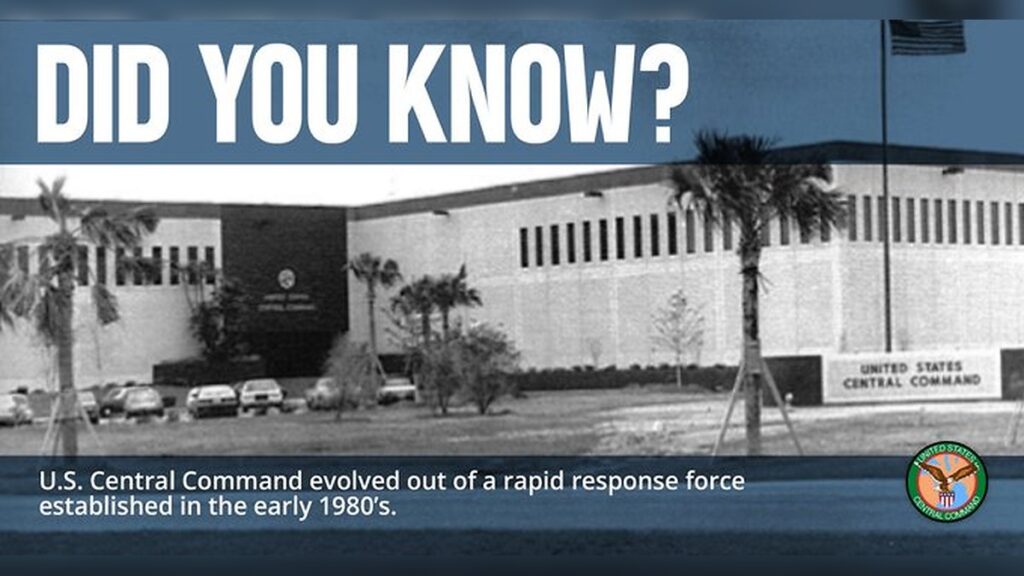
U.S. Central Command, commonly known as CENTCOM, was established in response to a changing strategic environment in the Middle East and surrounding regions, with its origins tracing back to events that reshaped U.S. military planning in the early 1980s.
The command recently highlighted its history, noting that the Iranian Revolution and the Soviet invasion of Afghanistan were key developments behind the creation of a new American rapid-response capability.
Carter Establishes Rapid Deployment Force
The roots of CENTCOM date to March 1980, when President Jimmy Carter established the Rapid Deployment Joint Task Force (RDJTF).
The initiative was designed to give the United States a flexible military force capable of responding quickly to threats affecting American interests in the Middle East. The move followed growing concerns about regional instability and the strategic importance of the Persian Gulf.
Iranian Revolution Changed U.S. Strategy
The Iranian Revolution of 1979 significantly altered the regional security landscape and challenged long-standing American assumptions about its position in the Middle East.
Washington increasingly recognized the need for a military structure capable of responding rapidly to crises in a region considered strategically vital because of its geopolitical position and energy resources.




Soviet Invasion Added to Regional Concerns
The Soviet Union’s invasion of Afghanistan in December 1979 further intensified American concerns about the security environment surrounding the Middle East.
The combination of the Iranian Revolution and the Soviet military intervention encouraged Washington to develop a more flexible force capable of operating rapidly across a broad geographic area.
Reagan Converts Task Force Into CENTCOM
The RDJTF initially served as the mechanism for addressing these concerns, but U.S. officials eventually determined that a permanent command structure was needed.
On January 1, 1983, President Ronald Reagan transformed the Rapid Deployment Joint Task Force into United States Central Command.
The move established CENTCOM as a permanent combatant command responsible for U.S. military operations and strategic planning across its designated area of responsibility.
A Command Shaped by Decades of Conflict
Since its creation, CENTCOM has played a major role in U.S. military operations and security policy across the Middle East and surrounding areas.
Its history has included periods of major conflict, counterterrorism operations, regional crises and efforts to maintain partnerships with countries throughout its area of responsibility.
CENTCOM Remains Central to U.S. Regional Strategy
More than four decades after its establishment, CENTCOM continues to serve as a major component of the U.S. military’s global command structure.
The command’s origins demonstrate how major geopolitical developments can reshape military organization, with the crises surrounding Iran and Afghanistan in the late 1970s and early 1980s ultimately contributing to the creation of one of the United States’ most important regional combatant commands.
